Blood Moon Total Eclipse Visible Across Bay Area March 3
Bay Area viewers can watch the total lunar eclipse — the “blood moon” — with the naked eye; totality is expected for roughly 3–4 a.m., with Chabot hosting a 1–5 a.m. watch party in Oakland.

1. Quick overview and immediate stakes
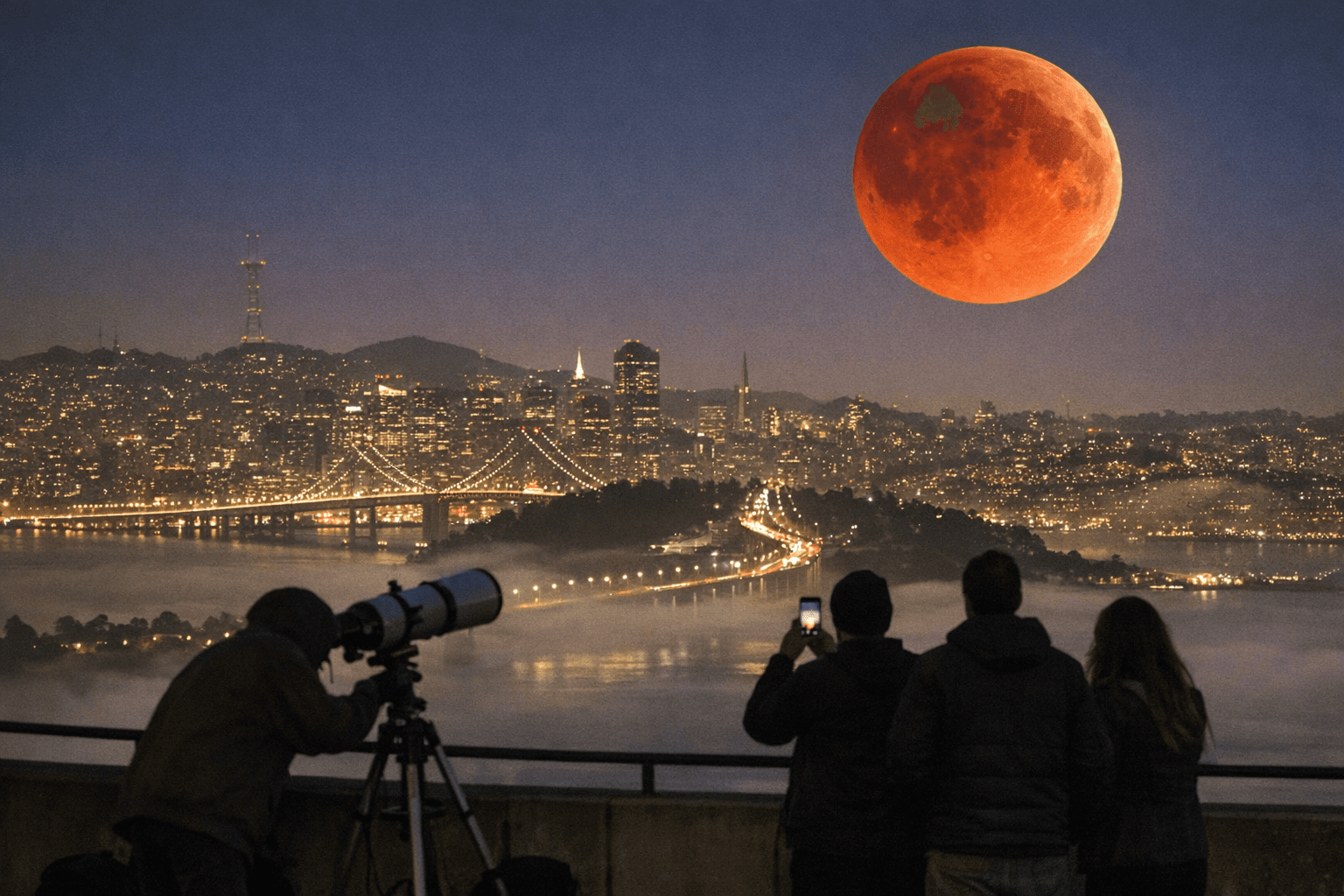
The Bay Area will see a total lunar eclipse — commonly called a “blood moon” because the moon can take on a reddish hue during totality — visible from anywhere in the region with a clear view of the sky. The stakes are simple and local: city lights won’t stop the show, but low cloud decks could; Chabot Space and Science Center in Oakland has a ticketed watch party and a cloud contingency to stream the event into its planetarium.
2. Exact Bay Area timing you should set your alarm for
For local viewers, most sources reconcile around a totality window between about 3 a.m. and 4 a.m.; ABC7 provides the most precise timeline, reporting the partial eclipse begins at 1:50 a.m. with totality from 3:04 a.m. to 4:03 a.m. KTVU summarizes that “the event’s period of totality — the best time for viewing for the Bay Area — will occur between 3 a.m. and 4 a.m.” Use the ABC7 times as your on-the-ground schedule but check final authoritative updates before you leave.
3. Phases of the eclipse explained
The eclipse unfolds in three standard phases: a penumbral eclipse as the Moon crosses Earth’s penumbra, a partial eclipse as it begins to enter Earth’s umbra, and totality when the Moon is fully inside the umbra and can take on reddish tones. Sources note that totality for this event runs roughly an hour in the Bay Area, though some summaries elsewhere use broader phrasing about typical phase durations; for practical viewing, plan for the partial start at 1:50 a.m. and totality about 3:04–4:03 a.m.
4. Why the Moon turns red during totality
The red or saffron tint appears because sunlight is refracted through Earth’s atmosphere: blue wavelengths scatter away while longer red and orange wavelengths curve into Earth’s shadow and illuminate the Moon. KQED and Chabot explain this is the same atmospheric filtering that makes sunrises and sunsets red — during totality, “sunlight slips around the edges of Earth's atmosphere and shines onto the moon's face,” producing the blood‑red effect.
5. Who can see the eclipse — hemisphere and Bay Area specifics
A lunar eclipse is visible to anyone on the night side of Earth with clear skies; Outsideonline stresses that the March total lunar eclipse will be visible across the U.S., “that includes stargazers in all 50 states.” Locally, KQED and Chabot emphasize: “As long as you can see the moon, you'll see the eclipse,” a reminder that even in light‑polluted neighborhoods the event will be apparent if cloud cover is absent.
6. Weather caveats and where to go if clouds threaten visibility
The National Weather Service warned that cloud cover early Tuesday could block views across much of the Bay Area, and forecasts can change quickly; for statewide viewers, NWS and ABC7 recommend higher elevations such as the Sierra Nevada where you may rise above the cloud deck. If clouds obliterate local views, Chabot will implement its contingency: “If clouds obliterate views, Chabot will move its planned viewing event inside and the eclipse will be streamed from a clear skies location in the facility's planetarium,” per Chabot Marketing Manager Sarah Nelson Goswick.
7. Chabot Space and Science Center: watch party and logistics
Chabot is staging a Total Lunar Eclipse Watch Party from 1 a.m. to 5 a.m. at 10000 Skyline Boulevard in Oakland; ABC7 notes tickets and event information are available through Chabot’s event listing. Chabot astronomer Ben Burress frames the moment as communal and reflective: “It's t's a time where you can reflect on the connections between the Earth and the moon and the sun... It's almost like reaching out and touching our neighbor in space — the moon,” he said. “Earth's shadow is reaching out and touching it, and we get to witness that. It creates a moment of connection, a much deeper experience than the typical full moon.”
8. Media and streaming options if you can’t get outside
If you cannot reach a high‑elevation vantage or if clouds dominate, Chabot’s plan to stream a clear‑sky feed into its planetarium offers an indoor alternative for ticket holders; ABC7 and KQED have signaled they will provide local coverage and context. KQED’s local programming roster — including on‑air hosts and KQED Live — will supply analysis and framing around the eclipse, useful if you’re watching from home or joining Chabot’s interior stream.
9. Safety rules and basic equipment guidance
Total lunar eclipses are safe to watch with the naked eye — no protective eclipse glasses are required — and USF Fromm Institute astronomer Andrew Fraknoi reminds the public that “Total eclipses of the moon are very democratic ... easy to spot, perfectly safe to look at, and not requiring any special equipment to see.” Binoculars or a small telescope can enhance crater and surface detail; light pollution reduces contrast but does not prevent seeing the eclipse itself.
10. Specific gear recommendations and what to expect with optics
Binoculars like the Nikon Monarch M7 8×42 (mentioned by an Outsideonline author) give a closer, crater‑level look without complex setup; telescopes are optional but can reveal more lunar texture. Outsideonline notes that you do not need pristine dark‑sky sites to witness dramatic coloring — the author has seen a blood moon from a light‑polluted backyard — but the farther you are from bright city lighting, the more vivid the color shift will appear.
11. Smartphone photography: concrete tips to get better moon images
Smartphone cameras default to wide angles that make the Moon look tiny; Outsideonline recommends using the phone’s zoom dial rather than pinch zoom for better retained quality and pairing zoom with stabilization. On an iPhone, “do this via the dial at the bottom of your camera instead of pinching and zooming; the former retains more quality.” Use a tripod when possible; “here’s a hack if you don’t have one: make a stabilizer by propping your phone in the back of your shoe.” Combined, zoom plus steady support produces far better moon photos than default wide shots.
12. Regional travel tips and notable vantage examples
If local weather looks unfavorable, consider a plan B at higher elevations or a longer drive: ABC7 and NWS point to the Sierra Nevada as a statewide best bet above the cloud deck. Outsideonline’s travel roundup includes Buffalo Waterfront as an example of dramatic west‑facing water views — noting Buffalo will enjoy “45 minutes of totality before the moon sets at 6:50 A.M.” — illustrating how shoreline and elevation choices alter the duration and framing of the spectacle.
13. How this eclipse fits the broader calendar and what’s next
NASA notes the planet sees between four and seven eclipses of various kinds each year; however, full total lunar eclipses are less frequent in any single region. KTVU reports that the next total lunar eclipse is not expected until late 2028, making this March 3 totality the next major total‑lunar opportunity for Bay Area observers for several years.
14. Reconciling conflicting or imprecise reporting
Some sources phrase typical phase lengths in ways that can confuse readers — for example, Insidehalton’s line that “typically, all three phases of a total lunar eclipse will last between 30 and 60 minutes” contrasts with ABC7, KTVU and others that give totality itself at roughly an hour. For Bay Area practical planning, rely on ABC7’s detailed schedule (partial begins 1:50 a.m.; totality 3:04–4:03 a.m.) and KTVU’s 3–4 a.m. totality summary, while noting phrasing differences elsewhere likely reflect shorthand or variations in terminology.
- Check the current National Weather Service forecast for cloud cover and choose a location with an unobstructed view of the southern/eastern sky.
- If you plan to attend Chabot’s watch party, confirm ticket availability and the venue’s streaming contingency plan.
- Prepare optics if you want them: binoculars (e.g., 8×42) or a small telescope, and a tripod or stabilizer for phone photos.
- Set alarms for the partial start at 1:50 a.m. and totality beginning about 3:04 a.m.; expect peak viewing roughly 3–4 a.m. local time.
15. Practical checklist for Bay Area viewers
16. Closing observation and what to expect in the moment
This is a quiet, communal moment for Bay Area skywatchers: you’ll be able to see an entire celestial hemisphere witness a single shadowed event, and Chabot and local media will provide shared viewing options if clouds interfere. As Ben Burress puts it succinctly: “As long as you can see the moon, you'll see the eclipse.” Witness the color shift, take a steady photo if you can, and plan to savor the hour when Earth literally reaches out and touches its lunar neighbor.
Know something we missed? Have a correction or additional information?
Submit a Tip