Bosnia and Herzegovina balances EU hopes, NATO ties, and security risks
Bosnia and Herzegovina’s World Cup surge spotlights a state still shaped by Dayton, EU accession talks, NATO ties and persistent security risks.
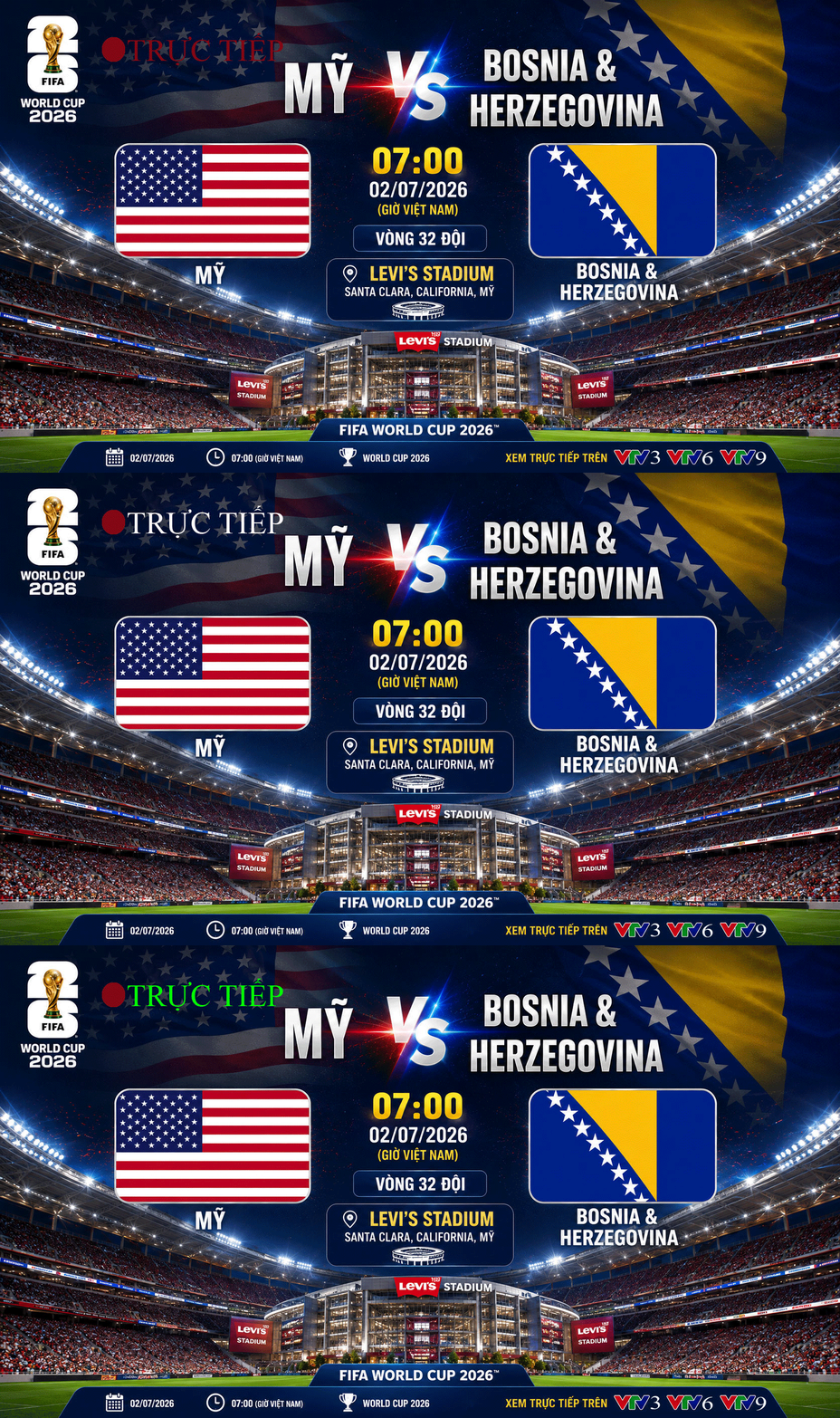
Bosnia and Herzegovina’s World Cup run is a sports story with a political map behind it. The team advanced to the 2026 knockout round after drawing Canada and beating Qatar, then met the United States in Santa Clara, California, on July 1. For many fans, the name on the jersey points to a country whose identity is still organized by peace accords, power-sharing and unresolved pressure from inside and outside its borders.
What the full name means
Bosnia and Herzegovina is a parliamentary republic split into two main entities, the Federation of Bosnia and Herzegovina and Republika Srpska, plus the Brčko District with special status. The full legal name reflects that layered structure: one state, but not one centralized political system. Bosnia and Herzegovina combines two historical regions and a postwar constitutional design that still governs how power is shared.
That arrangement matters because the country is not simply “Bosnia” in the political sense. The full name signals a compromise built into the state itself, where geography, ethnicity and postwar governance all remain visible in the structure of government. For readers trying to place the country quickly, that is the first fact to remember: Bosnia and Herzegovina is a single sovereign state with a divided internal architecture.
Dayton built the modern state
The country’s present constitutional order came out of the 1995 Dayton Peace Accords, signed after the 1992-1995 war. The peace agreement was brokered with crucial U.S. involvement, and the United States established diplomatic relations with Bosnia and Herzegovina in 1992. That history still shapes Washington’s posture, and the State Department says Bosnia and Herzegovina remains a focus of bilateral engagement, including a recent meeting involving Deputy Secretary Landau and Bosnia and Herzegovina Chairman of the Presidency Denis Bećirović.
The Dayton framework ended the war, but it also froze a political settlement that continues to define public life. Bosnia and Herzegovina’s institutions were designed to stop the fighting, not to erase the deep divisions that produced it. Three decades later, the country is still living inside the architecture of that peace.
A security picture that still carries war’s shadow
The war ended years ago, but the risks did not disappear. The U.S. Embassy in Sarajevo tells Americans to exercise increased caution because of terrorism, crime and land mines. The land mine warning is especially telling, because it links present-day travel advice to the physical remnants of a conflict that ended in the 1990s and never fully left the landscape.
That warning also captures the country’s broader public health and safety burden. Land mines remain a direct threat to movement, development and everyday security in some areas, while crime and terrorism concerns shape how visitors and residents assess risk. In a country still balancing postwar recovery with normal civic life, safety is not abstract policy language. It is part of the terrain.
EU membership is a live, conditional path
Bosnia and Herzegovina won EU candidate status in December 2022, then moved a step closer when the European Council decided in March 2024 to open accession negotiations. That did not make membership automatic. Progress still depends on meeting EU criteria and long-standing reform priorities, which means the country’s European future remains tied to political compromise, institutional functioning and rule-of-law changes at home.
The significance of that path is practical as well as symbolic. EU accession talks create pressure for reforms in governance, the justice system and administrative capacity, all of which affect daily life. For a country with a modest economy and a complex state structure, the accession track is one of the main external incentives pushing toward stability.
NATO keeps a parallel track open
Bosnia and Herzegovina is also inside NATO’s Membership Action Plan, the alliance’s framework for preparing partners for possible membership. In October 2025, NATO and Bosnia and Herzegovina agreed the country’s first Individually Tailored Partnership Programme, and NATO reaffirmed in May 2026 that it supports Bosnia and Herzegovina’s territorial integrity and Euro-Atlantic path. NATO’s cooperation with the country is structured through the Bosnia and Herzegovina Reform Programme, a reminder that security alignment is proceeding alongside, not instead of, domestic reform.
That NATO track matters because it gives Bosnia and Herzegovina another strategic anchor at a time when regional politics remain unsettled. The alliance’s stated backing for territorial integrity is not ceremonial language in this context. It is a direct answer to the country’s internal fragility and to the wider question of where Bosnia and Herzegovina sits between Europe’s institutions and the security anxieties of the western Balkans.
Politics remain fragile at home
The country’s internal balance has been tested by renewed tensions tied to Bosnian Serb leader Milorad Dodik and secessionist pressure in Republika Srpska. That friction matters because Bosnia and Herzegovina’s state design depends on keeping different centers of power inside a single constitutional frame. When that frame is strained, questions about sovereignty, governance and outside guarantees move back to the center of public life.
This is where the postwar settlement and today’s diplomacy meet. EU accession, NATO cooperation and domestic politics are not separate stories. They are different responses to the same unresolved problem: how to keep one state functioning across identities and institutions that still pull in different directions.
The economy explains part of the pressure
The World Bank put Bosnia and Herzegovina’s population at 3,164,253 in 2024, with GDP of about $29.6 billion and GDP per capita of $9,358.8. Unemployment stood at 11.0% in 2025, while remittances accounted for 10.6% of GDP in 2024. Those figures describe an economy that is relatively small, job creation remains weak, and families rely heavily on money sent home from abroad.
That dependence on remittances says as much about the country’s social fabric as any growth chart does. Large numbers of Bosnians live and work outside the country, and the money they send back helps sustain households and consumption at home. In a place where economic mobility is limited and political uncertainty is persistent, that outside income has become part of the social safety net.
Why the team matters beyond sport
That is part of why the national team’s tournament run has landed so strongly. Bosnia and Herzegovina reached the 2026 World Cup knockout stage after results against Canada and Qatar, then faced the United States in Santa Clara on July 1, a stage that put the country’s full name in front of a wider audience. Roger Bennett said Bosnia’s players often speak about the sacrifices and suffering of their nation, and that sense of endurance helps explain why the team resonates so deeply with fans.
The football moment works as civic literacy because it points back to the country itself. Bosnia and Herzegovina is a state built through war, held together by Dayton, pulled by the EU and NATO, and still living with the consequences of its own divided design. The match is memorable, but the country behind it is what makes the story endure.
This article was produced by Prism’s automated news system from verified source data, official records, and press releases, then run through automated quality and moderation checks before publishing. The system is built and supervised by the people who set the standards it runs under. Read our full AI policy.
Did this article answer your question?