Brawley earthquake swarm slows after more than 350 quakes, strongest 4.7
Brawley’s quake swarm eased after 350-plus tremors and a magnitude 4.7, but the fault zone’s history keeps officials and residents on alert.

The shaking near Brawley began to taper off after a burst of more than 350 earthquakes, capped by a magnitude 4.7, but the sequence left a familiar question hanging over Imperial County: whether a swarm is ending, or only pausing.
The epicenter sat near Brawley, between the Salton Sea and the U.S.-Mexico border, where foreshocks started around 3 a.m. Saturday. By Sunday evening, the swarm had produced more than 350 minor quakes. Early in the sequence, the first U.S. Geological Survey-recorded event was a magnitude 3.5 about two miles west-southwest of Brawley at 4:14 p.m. Saturday, followed by quakes of magnitude 4.4 at 8:03 p.m., 4.0 at 8:13 p.m. and 4.5 at 8:39 p.m. The California Governor’s Office of Emergency Services said it was monitoring the situation, while the City of Brawley said public works, fire, building and utilities crews handled minor water leaks and utility concerns. Officials reported no major infrastructure damage, no gas leaks and no immediate threat to public safety.
A swarm like this signals an active fault system, but it does not by itself say whether larger shaking is coming. In the Brawley Seismic Zone, where many smaller faults intersect, clusters of earthquakes are part of the geologic pattern scientists watch closely. The zone has a long record of swarm activity, including a 2012 episode that brought quakes of magnitude 5.5, 5.3, 4.9 and 4.2 without reported injuries. Past Salton Sea-region swarms have stayed active for as long as 20 days, with an average duration of about a week, a reminder that even as the pace slows, the ground can keep moving.
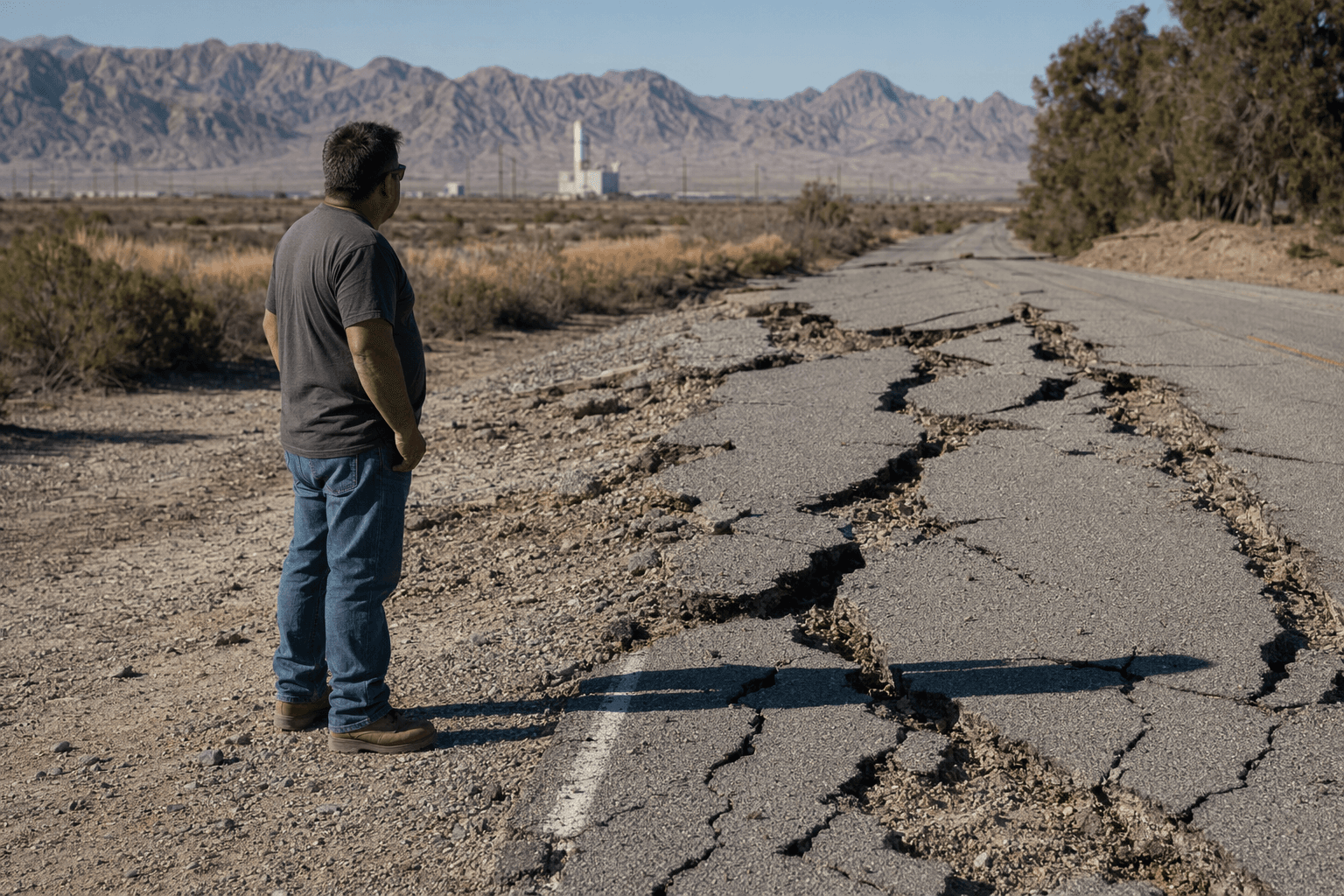
The scientific backdrop makes Brawley a place where small shocks carry outsized attention. The North Brawley Geothermal Field sits inside the Brawley Seismic Zone, and U.S. Geological Survey research found that a 2012 swarm there included two earthquakes larger than magnitude 5. A 2022 analysis concluded there was 80% more pre-swarm aseismic slip than previously recognized from 2009 to 2012, evidence that the fault system can deform quietly before it breaks. That complexity helps explain why scientists treat Brawley as a living laboratory, not a place where one swarm neatly predicts the next.
For residents, the practical lesson is narrower than the fear can feel. Aftershocks may continue, utilities can be stressed, and minor damage can surface after the strongest jolts. California’s “Don’t Get Caught Off Guard” campaign and the Great California ShakeOut keep the basic response front and center: drop, cover, hold on. In a region that has seen repeated swarms, readiness is the part people can control even when the ground will not stay still.
This article was produced by Prism’s automated news system from verified source data, official records, and press releases, then run through automated quality and moderation checks before publishing. The system is built and supervised by the people who set the standards it runs under. Read our full AI policy.
Did this article answer your question?