Brit Awards 2026: Heavy Gold Chains and Pear-Cut Diamond Showstoppers
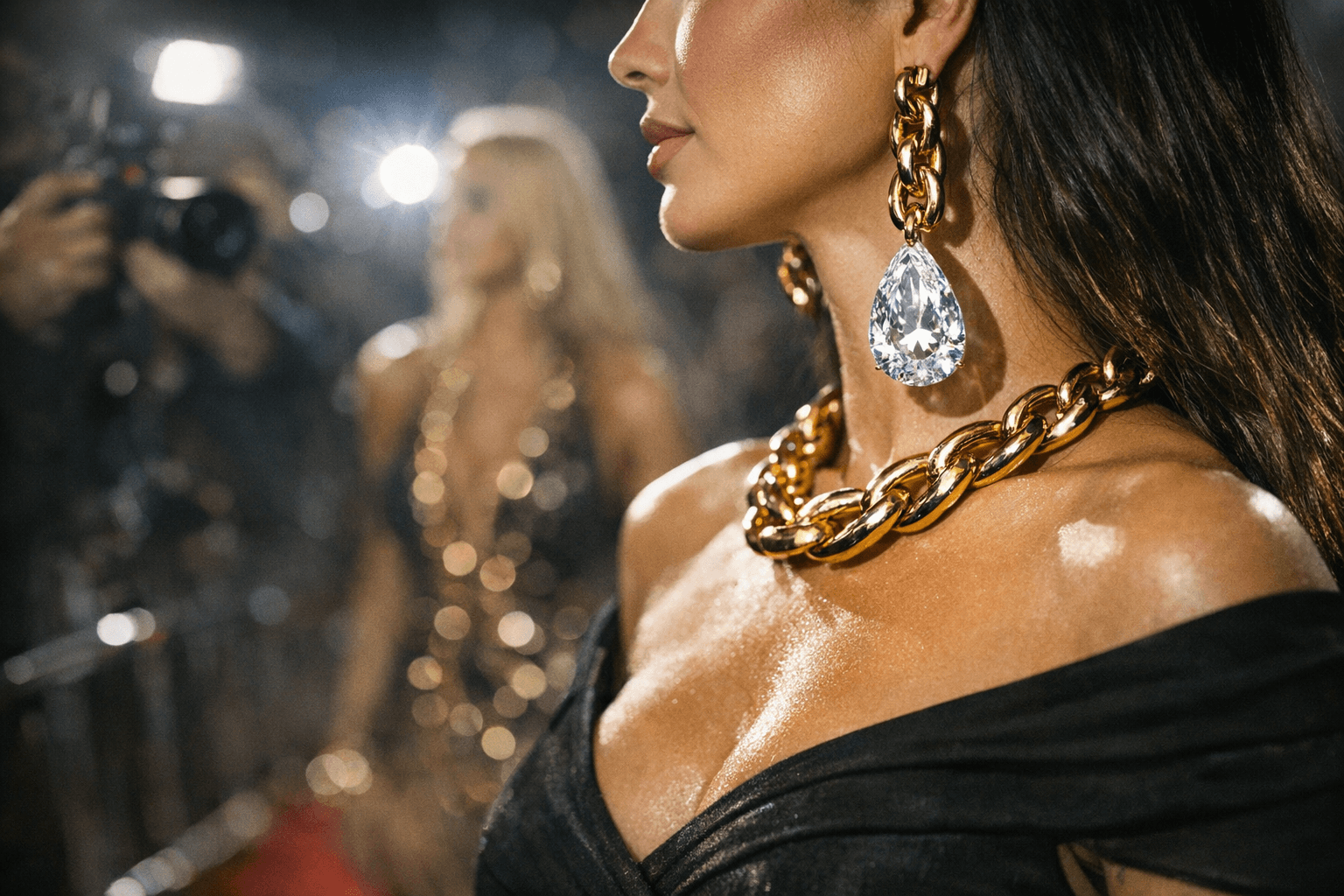
Brit’s red carpet leaned into heavy yellow gold chains and pear-cut diamond drops—sculptural, movement-forward pieces that read like bespoke commissions.
1. Statement chains and contemporary gold
Bold, weighty gold made a powerful return on the red carpet. That line—explicit in event coverage—captures the evening’s most immediate graphic moment: heavy yellow-gold chains and collars stacked or worn alone as architectural statements. These were not delicate layering pieces but purposefully scaled objects of presence, the kind of necklaces that raise questions about karat, weight and whether the metal is recycled or newly mined; the coverage supplied photography credits to Zak Hussein/Billboard and Getty Images for the imagery, though sourcing and certification details were not reported alongside the looks.
2. Pear-cut diamond showstoppers: Ella Thomas’s drop earrings
Ella Thomas wore diamond drop earrings at the Brit Awards featuring pear-cut diamonds arranged in a floral stud formation, with pear-cut diamond drops suspended beneath. The pairing of contrasting diamond shapes "added depth and brilliance," a visual technique that amplified movement and light on the carpet. Holtsgems summed the wider trend: "Pear cut diamonds are having a major moment in 2026 - the elongated silhouette adds softness, movement and brilliance - making it a standout choice for high‑impact evening jewellery," a framing that places Thomas’s earrings squarely within a season-long stylistic pivot toward elongated stones.
3. Dua Lipa’s serpent diamond statement necklace
Dua Lipa stepped out in a diamond statement necklace shaped as a serpent, the snake biting its tail in a somewhat ouroboros silhouette—an instantly recognisable motif translated into high jewellery. The coverage observed that "the fluid diamond setting elevated the symbolic motif into high jewellery territory," turning symbolism into technical display: pavé and articulated links that allow a necklace to read as both object and movement. Photographs credited the artist’s own Instagram account ("Photography Credit: Dua Lipa Instagram (dualipa)"), and the piece underscores how figurative motifs—serpents, animals, talismans—are being executed with diamond craft rather than costume bravado.
4. Mabel’s yellow‑gold asymmetrical bird choker
Mabel’s choker pushed the sculptural idea further: a yellow-gold asymmetrical piece featuring a bird motif, the bird’s head resting on one side of the neck and its feathered tail curving around the other. Coverage noted that "the asymmetry created movement and transformed the necklace into a sculptural centrepiece," which is precisely the point—this is jewellery conceived as a small wearable sculpture. Her photos were credited to her Instagram ("Photography Credit: Mabel Instagram (mabel)"), and the choker exemplifies how designers are using asymmetry to make a single necklace read like a full styling decision, not an accessory afterthought.
5. Sculptural and figurative high jewellery as a defining theme
"Jewellery as art was a defining theme this year," a succinct summary that ties the serpent, bird choker and many of the weightier gold collars together. The Brit looks favored narrative pieces—objects that tell a story on the body through silhouette, motif and craftsmanship—rather than anonymous sparkle. For collectors and buyers this raises familiar questions: were these one‑off high jewellery commissions or series pieces; what are the maker’s marks, metal assays (karat), and diamond certificates (GIA, IGI) accompanying each item? The coverage did not provide sourcing or certification details for the Brit pieces, so verification with houses or stylists remains essential before treating any of these statements as purchase‑ready provenance.
6. Heavy motifs pushing bespoke commissions and industry ripple effects
The event’s directional styling—"From heavy yellow gold chains to high‑impact diamond pieces," as an opening observation described the evening—strongly signals demand for bespoke and atelier work. When high profile artists wear ouroboros necklaces or asymmetrical sculptural chokers, private clients and stylists often ask for near‑replicas or bespoke iterations; that’s already reshaping commissions. But none of the pieces in the Brit coverage came with published supply‑chain notes, so for anyone planning a purchase or commission, insist on assay marks, diamond grading reports, and written statements about recycled metals or traceability before paying a premium for a "bespoke" label.
7. Awards‑season context: how the Brits fit into a larger jewellery moment
Across awards season other carpets delivered comparable spectacle—examples include Blackpink’s Lisa in a Bulgari High Jewelry necklace and Elle Fanning’s one‑of‑a‑kind Cartier creation at the Golden Globes—framing the Brit looks within a broader appetite for high‑impact jewels. Actor Awards coverage offered granular extremes: Michelle Monaghan’s Sabyasachi diamond and morganite chandeliers; Chase Sui Wonders’s Tiffany jewels including a Bird on a Rock by Tiffany necklace set with a 12‑carat rubellite and earrings totaling over 33 carats plus a Jean Schlumberger ring with a rubellite over 9 carats; and Keri Russell’s Buccellati suite—dangling earrings in 18‑karat white gold set with 220 round brilliant‑cut diamonds and a cocktail ring with a 23‑carat cabochon tanzanite—for a reported "Total? $223K of pure sparkle." These pieces (explicitly tied to other events) underline that the industry is offering both maximal coloured‑stone showpieces and sculptural gold work simultaneously.
8. What to look for if you want the look—and what the coverage omitted
The practical takeaway: heavy yellow‑gold chains and pear‑cut drops are design cues easy to replicate in tone but hard to match in craft. Look for karat and assay marks on gold, GIA or equivalent grading reports for diamonds, maker stamps for bespoke ateliers, and clear statements about whether metals are recycled or newly mined. The event coverage admirably catalogued forms and motifs—quoting that "Bold, weighty gold made a powerful return on the red carpet" and that "Pear cut diamonds are having a major moment in 2026"—but did not provide sourcing, certification, or sustainability claims for the items shown, so buyers should demand those details before paying high‑end prices.
9. Closing verdict: style that insists on scrutiny
The Brit Awards 2026 offered jewellery that speaks loudly—and because it does, it deserves scrutiny. These pieces read like commissions: sculptural, movement‑aware, and meant to be held to the same standards as bespoke objects—clear certification, assay marks, and transparent sourcing should follow the visual drama. As this season proves, beauty and responsibility must travel together; the most compelling red‑carpet jewels will be those you can admire for their design and verify for their provenance.
Know something we missed? Have a correction or additional information?
Submit a Tip