Build a Petite Capsule Wardrobe: 16 Core Pieces, Proportion Rules, Outfit Formulas
A petite capsule isn’t one-size-fits-all — sources range from an 11-piece mini capsule to a 16-piece core set; pick the template that matches your life and use proportion rules to make every piece sing.

“A capsule wardrobe is about more than just minimizing your closet—it’s about making getting dressed easy.” That line — from a shopping app briefing focused on petites — is the organizing idea here: select clothes cut and composed to elongate a smaller frame, so mornings stop feeling like a negotiation with ill-fitting hems and oversized sleeves. Across the guidance available, the exact piece-counts differ, but the goal is identical: clean lines, vertical cues, and intentional proportion.
How many pieces should your petite capsule include? Sources diverge, and that’s useful. One detailed petite-specific guide recommends a 16-piece “core” capsule made up of 6 tops, 5 bottoms, 3 layers, and 2 accessories. LookSky suggests a compact 11-piece mini capsule — 5 tops, 3 bottoms, and 3 outerwear pieces — promising “25–30 mix-and-match outfits.” A real-life example from a wardrobe blog shows 10 items (4 tops, 3 bottoms, 2 dresses, 1 jacket) producing 13 interchangeable outfits. Another method reframes the problem: build in modules of 7 pieces (2 pants, 3 tops, 1 outer layer, 1 pair of shoes) and multiply those blocks. Modernminimalism’s pragmatic refrain — “Don’t get stuck on a number” — is a strong reminder that the right count is the one that serves your life.
The 16-piece breakdown (and why you might choose it) If you like a deeper closet that still reads edited, the 16-piece core gives structure and flexibility: 6 tops to cover casual through dressy, 5 bottoms for variety of silhouettes, 3 layers for seasonal switching, and 2 accessories to change tone. That framework lets you assemble dozens of outfit formulas without impulse buying. Use it if you need weekday and weekend distinctions baked into the capsule, or you want more running-room for accent colors and textures.
- Fitted knit cami: the Meshki “Natalya Ribbed Knit Cami Top” is cited as a go-to — “Slim fits prevent fabric from overwhelming a smaller frame. Opt for body-skimming, not clingy.” A ribbed knit that hugs the torso gives shape and layers neatly under jackets.
- Square‑neck blouse: Sézane’s “Tess Top” is singled out because a square neckline “opens the neckline and lengthens the upper body. Avoid high necklines that can shorten.” Think of square necks as a frame that visually lifts the face and elongates the torso.
- Turtle necks and bodysuits: an ASOS “turtle neck for Petites” is recommended for cooler months — “The turtle neck is my new favorite for winter and spring when the weather is still cold. It has an elegant and sophisticated look!” Bodysuits (Dane Fashion bodysuits recommended in nude and black) “give an outfit a very clean and luxurious look!” and keep silhouettes tidy when paired with high rises.
- Midi skirts and maxi dresses with slits: “Midi skirt looks super flattering on a petite woman. However, choose one with a slit to make your legs look longer!” Glambutfirstcoffee repeats this insistently; she also warns that “Petites can disappear in maxi dresses, and therefore a slit is a must-have!” A vertical break — a slit or button-through opening — keeps long hemlines from swallowing you.
- Structured jacket and leather layer: a blazer (Glambutfirstcoffee prefers 2/3 sleeves for a flattering silhouette) and a leather jacket are musts — the latter “is great for jeans, as well as to style with spring dresses.” A jacket that lands at mid‑hip with an accentuated waistline is ideal, since Wonder-wardrobe notes that a jacket “will fit a petite right at the middle hip line, which is great, plus, it has an accentuated high waistline.”
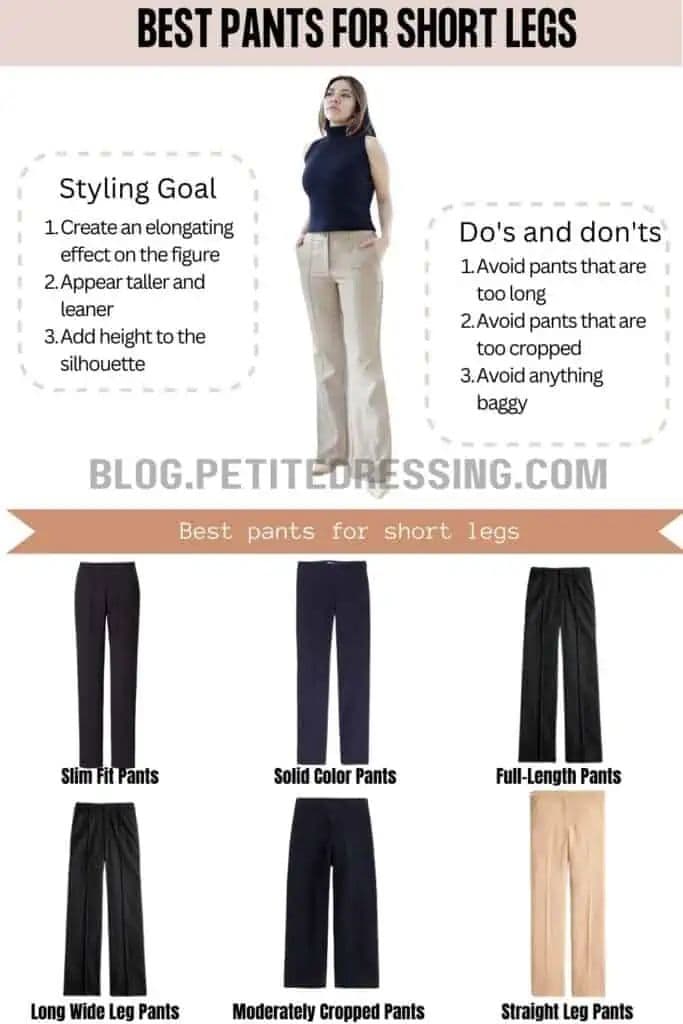
- Trousers and alterations: pants often “might be way too long for a petite, but it will be very easy to adjust their length and make them perfect without losing shape or design.” High-rise options and hems tailored to your inseam are the simplest path to visually longer legs.
- Shoes: Wonder-wardrobe keeps it minimal — two pairs, nude and black; “The nude ones fit every outfit,” and pairing black tights with black shoes helps elongate the silhouette.
Key pieces every petite should own (what to buy and why)
Proportion rules and outfit mechanics that actually work The sources converge on practical rules. Focus on vertical lines, cropped cuts, and tailored shapes to add height visually; balance volume (wide-leg trousers with a slimmer top; oversized sweaters with fitted bottoms); tuck boxier blouses to define waistlines; and favor high waists to lengthen legs. Use the rule of thirds when composing an outfit: a cropped jacket, tucked top, and mid‑rise skirt create separations that read taller. Modernminimalism’s operational checklist — “Does this fit my current lifestyle? Is it comfortable and easy to care for? Can I wear it in more than one way?” — is a quick vetting tool for adding anything new.
How to build your capsule — a short process 1. Audit what you wear: start with one favorite piece (a trouser or top) and map outfits around it to reveal gaps. 2. Visualize modules: recreate outfits on a board — Themomedit used Canva whiteboards to lay out the 2 pants / 3 tops / 1 outer / 1 shoes module and see what’s missing. 3. Shop intentionally: pick pieces that fit proportion rules and test length and rise — apps that offer “virtual try-on” can help you preview how a hem or rise will read on a petite frame before you buy.
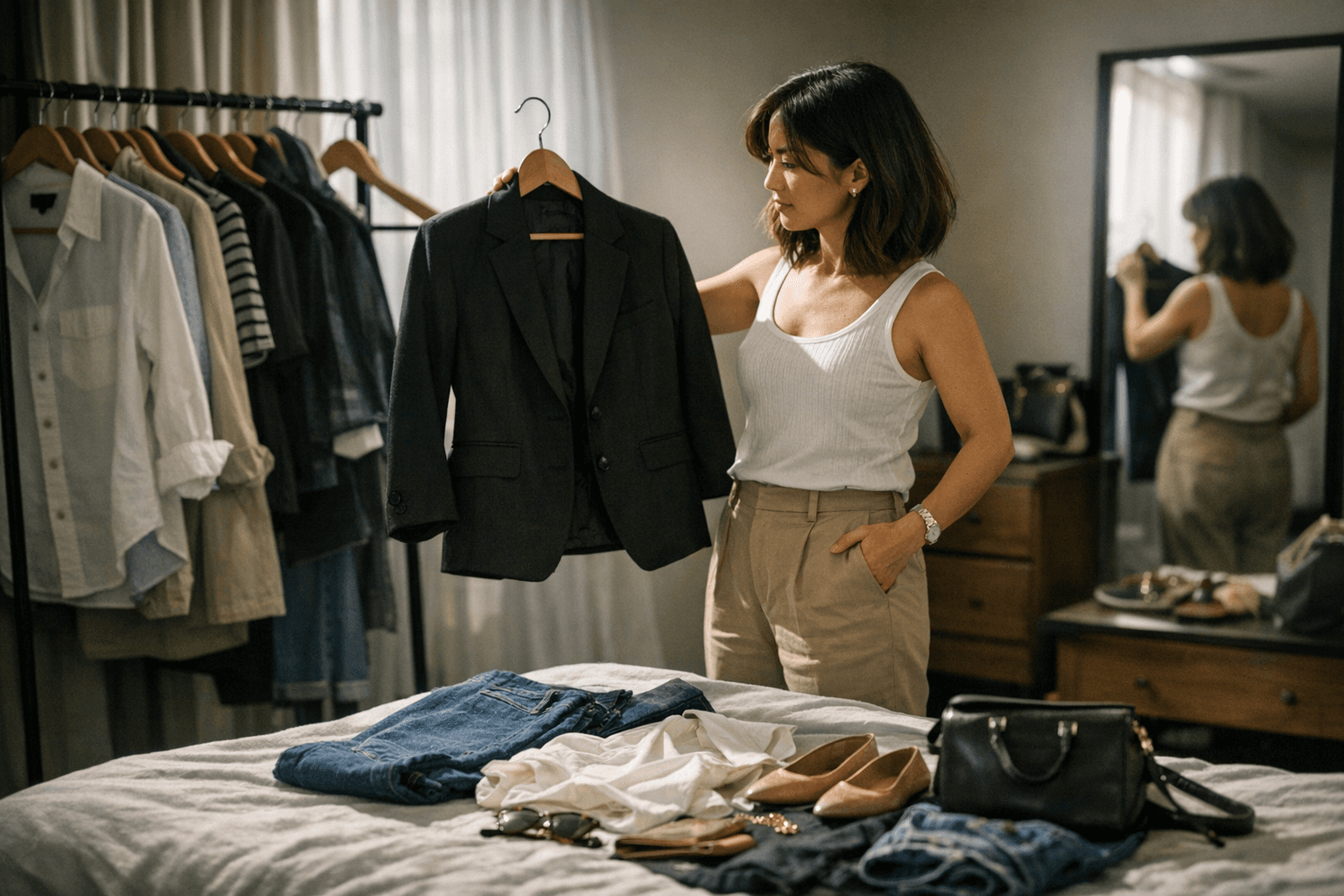
Tech and tools that save time (and returns) LookSky positions itself as “the shopping app that shows you what works for your height, shape, and color season, with virtual try-on before you commit,” and it even references a flat-lay artwork asset (petite-capsule-wardrobe-flat-lay.png). Themomedit’s Canva whiteboards are a low-tech, high-payoff alternative for visualizing what you already own. Wonder-wardrobe supplements its example with video content for people who prefer moving images to stills.
Budget and sourcing tips for petites Being petite often means tailoring, hunting off-season, or thrift shopping — Themomedit confesses buying out-of-season and saving for well‑constructed pieces, or altering finds to fit. If you want quick wins, Glambutfirstcoffee flags specific promotions: multiple Dane Fashion items (a midi skirt with a slit, a beige blazer, a leather jacket, and bodysuits) are paired with the code GLAMCOFFEE for 25% off in her notes. Spanx leather leggings are mentioned as a styling tool for sleek, fitted looks. Treat promo codes as opportunities, but let proportion rules govern purchases.
Template choices and what to expect If you want maximal outfit yield from minimal items, LookSky’s 11-piece mini capsule claims “That’s 11 essentials—enough for 25+ polished outfits without a closet full of ‘almost works.’” If you prefer a looser rotation, the 16-piece core gives more deliberate options across occasions. Or adopt the modular strategy and add blocks until your wardrobe fits your life. Wonder-wardrobe’s practical ten-item set proves you can get 13 fully interchangeable outfits from surprisingly few pieces — a reminder that thoughtful choices trump sheer volume.
Final word Petite dressing is less about shrinking or simplifying and more about composing: crisp necklines, clean verticals, higher waists, and the right jacket length. Whether you favor an 11-piece travel-ready mini capsule, a 16-piece core wardrobe, or repeatable seven-piece modules, the outcome is the same — a closet where every item does work it was bought to do. As Modernminimalism advises: “Don’t get stuck on a number.” Choose the framework that fits your calendar, then use proportion rules and a few deliberate purchases to make getting dressed feel, finally, easy.
Know something we missed? Have a correction or additional information?
Submit a Tip