California's Record Gas Prices Tied to Hidden Costs, Not Oil Company Gouging
California's $5.82-per-gallon average reflects a layered cost structure adding over $1.25 per gallon before market forces apply, not oil company gouging.

California's statewide average gas price reached $5.82 per gallon by March 2026, nearly $2 above the national average of $3.97, and the political explanation for years was simple: oil companies were cheating drivers. The reality, as a CBS News California investigation and the state's own watchdog agency confirmed, is considerably more structural.
Gov. Gavin Newsom spent much of 2023 and 2024 publicly accusing refiners of manipulating prices. He convened a special legislative session and signed SB X1-2, the California Gas Price Gouging and Transparency Law, creating the Division of Petroleum Market Oversight (DPMO) as an independent arm of the California Energy Commission. When the DPMO released its first full-year annual report in October 2025, the findings produced no smoking gun. The report confirmed what energy economists had argued for years: most of the price differential between California and other states traces to taxes, regulatory costs, and a uniquely isolated fuel market, not coordinated price manipulation.
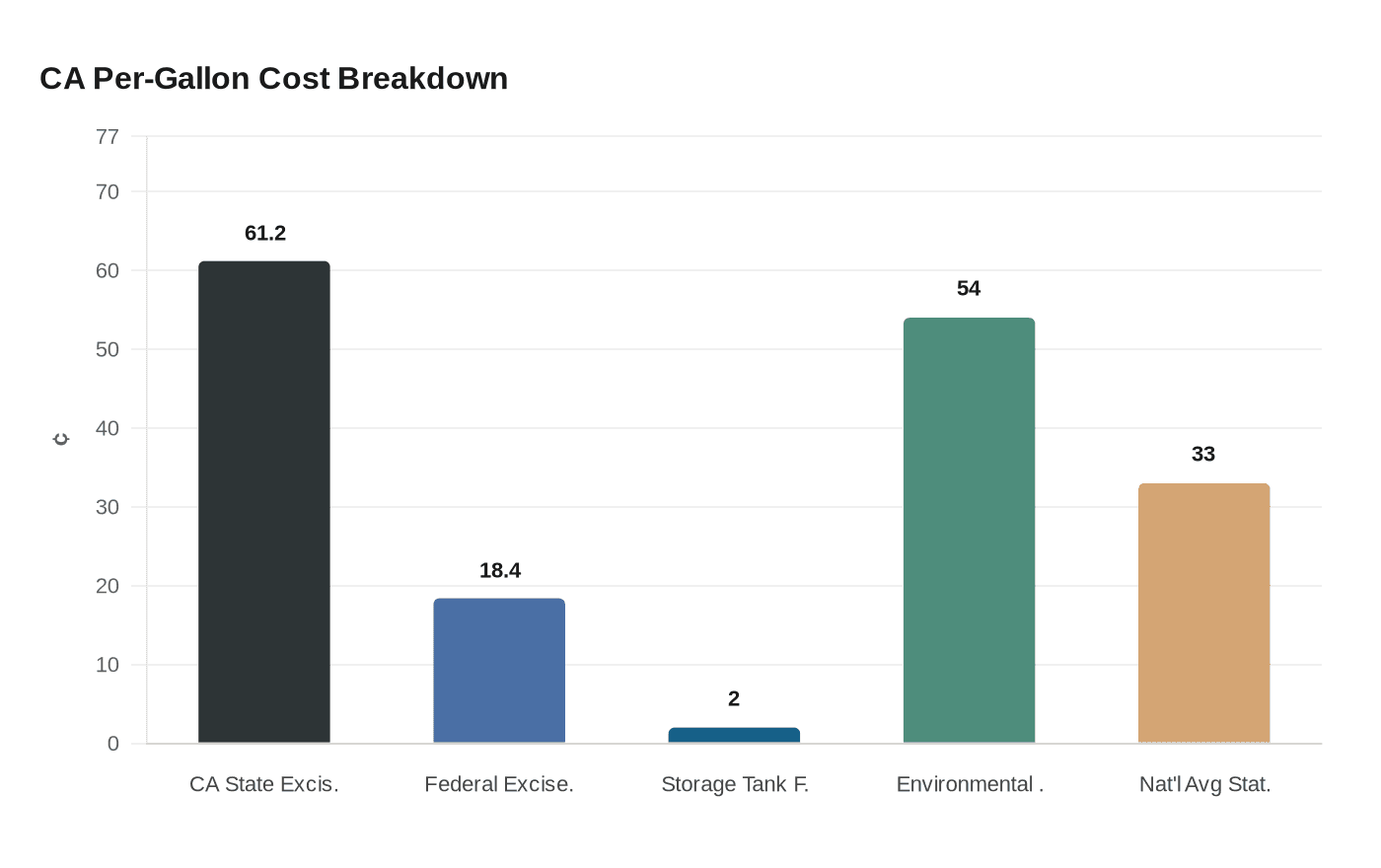
The tax burden alone is staggering. California levies the highest state gasoline excise tax in the nation at 61.2 cents per gallon, a rate that increased by 1.6 cents on July 1, 2025. Add the federal excise tax of 18.4 cents, a state underground storage tank fee of 2 cents, and state and local sales taxes, and California drivers pay roughly 90 cents per gallon before a drop of fuel is even refined. That compares with a national average state tax burden of about 33 cents per gallon.

On top of that, the California Energy Commission estimated that environmental compliance costs added as much as 54 cents per gallon as of March 2025. Those costs come from two programs: the Cap-and-Trade program, which prices carbon emissions from fuel suppliers, and the Low Carbon Fuel Standard (LCFS), which requires fuel sellers to hit carbon intensity benchmarks or buy credits from lower-carbon fuel producers. LCFS compliance costs for California reformulated gasoline rose from roughly 10 cents per gallon in 2015 to more than 30 cents per gallon by the fourth quarter of 2023. Together with excise taxes, the Independent Institute calculated the total regulatory and tax burden had reached $1.25 per gallon by April 2025, accounting for 27 percent of the retail price.
Then there is the fuel itself. California mandates a proprietary gasoline blend called CARBOB, short for California Air Resources Board Oxygenate Blendstock, designed to reduce smog-forming emissions. CARBOB is more expensive to produce than conventional gasoline, adding roughly 10 to 18 cents per gallon in refining costs. Critically, refiners outside the state only produce CARBOB to supply California, which means the state operates as a fuel island. There are no petroleum pipeline connections to the rest of the country that can move supply westward quickly, so when a California refinery goes offline, emergency replacement fuel must arrive by ship, a process that takes at least three weeks. During that lag, distributors bid up whatever supply remains on hand, and prices spike sharply.
Those spikes follow a predictable pattern. In May 2025, a fire at the Valero Benicia refinery triggered exactly that sequence, sending Northern California prices surging just as the region was recovering from a prior run-up. The summer-blend switchover, when refiners must transition to a cleaner-burning seasonal formulation each spring, is another reliable pressure point because the transition window shrinks available supply.
The refinery closures now accelerating those risks are the most consequential development in years. Phillips 66 completed the shutdown of its Los Angeles-area refinery in late 2025. Valero announced plans to idle its Benicia facility by the end of April 2026. Together, those two plants represented roughly 17 percent of California's total refinery capacity. With fewer in-state facilities able to produce CARBOB, any future disruption, whether from equipment failure, a labor dispute, or a seasonal demand surge, will hit a thinner supply cushion than at any point in the past decade.
The DPMO's first annual report did note a "mystery surcharge," an unexplained portion of the price gap between California and other states that taxes and regulatory costs alone do not fully account for. That finding left room for continued scrutiny of refiner margins in a market where five companies control nearly all of the state's gasoline production. But it falls well short of the coordinated price gouging narrative that drove California policy for two years. The harder truth is that the state's environmental ambitions, tax structure, and refinery policies have collectively built a price floor that no investigation is likely to dismantle.
This article was produced by Prism’s automated news system from verified source data, official records, and press releases, then run through automated quality and moderation checks before publishing. The system is built and supervised by the people who set the standards it runs under. Read our full AI policy.
Did this article answer your question?

