Carney cuts Canada deficit outlook, unveils billions in new spending
Carney lowered Canada’s deficit outlook to C$66.9 billion, but nearly C$55 billion in fresh spending will absorb most of the revenue windfall.

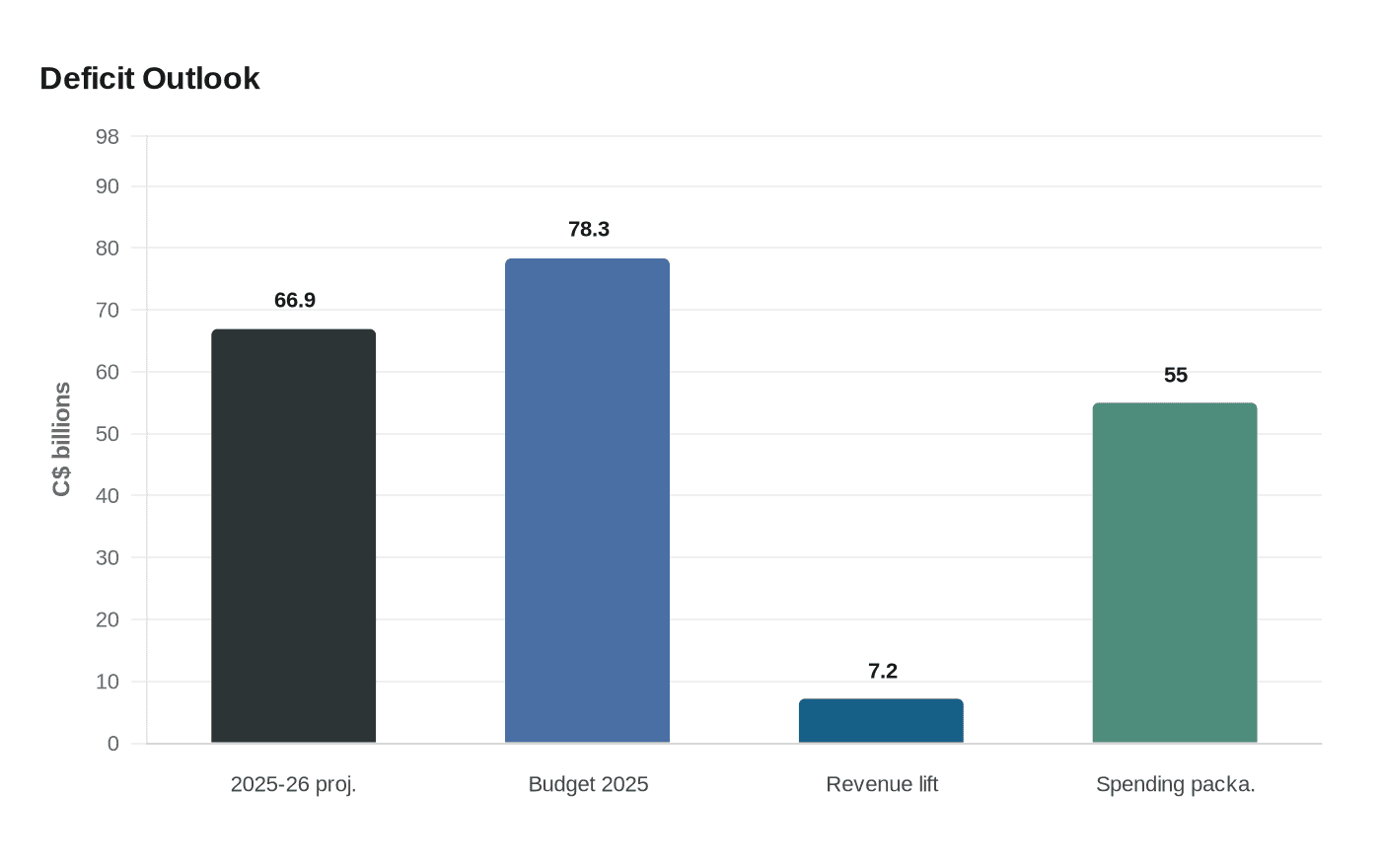
Mark Carney’s first fiscal update delivered a smaller deficit and a larger bill. Ottawa said the 2025-26 federal deficit was now projected at C$66.9 billion, down more than 14% from the C$78.3 billion forecast in Budget 2025, but the improvement arrived alongside nearly C$55 billion in new spending over five years that will wipe out much of the revenue gain.
Finance Minister François-Philippe Champagne said the better deficit outlook reflected a stronger economy, higher personal and corporate income-tax receipts and lower interest rates. The government said Canada’s economy grew 1.7% in 2025, avoided a recession and saw unemployment peak at 7.1% in September 2025 before easing to 6.7% in March 2026. Ottawa also said the Canada-U.S.-Mexico Agreement protected about 85% of Canadian goods exports from recent U.S. measures, a reminder that trade stability, not just domestic demand, helped keep the fiscal picture from worsening further.
The update projected an average annual revenue lift of C$7.2 billion from 2025-26 through 2029-30, with more than C$60 billion in additional five-year revenue from stronger income and corporate taxes, better financial-sector performance and higher oil prices. But those gains were almost matched by the new spending package, which includes money for a skilled-worker program, infrastructure, affordability benefits and other measures aimed at building a more resilient economy and reducing dependence on the United States.
That is the tension at the heart of Carney’s first fiscal statement: the government is arguing that the deficit is moving lower even as it opens new spending channels. Ottawa framed the package as part of a broader Canada Strong for All agenda and unveiled the Canada Strong Fund, which Finance described as the country’s first national sovereign wealth fund. It also said it would cut spending on external management and consulting services by 20% over three years, a move expected to save C$450 million in 2027-28 and C$900 million a year from 2028-29 onward.
The politics are familiar. Budget 2025 had already committed to higher defense and infrastructure spending, and Ottawa doubled investment in the Union Training and Innovation Program in February 2026. Scotiabank described the update as continuing a large, investment-heavy plan rather than a sharp fiscal reset, while Desjardins said the near-term improvement mostly reflected stronger economic performance that may not repeat. For households, the clearest gains should come through affordability measures and training support; for contractors, skilled-trades providers, defense suppliers and infrastructure firms, the spending pipeline remains open. For fiscal hawks, the message is harder to celebrate: lower deficits are coming, but they are being paired with a new round of promises that keeps Canada’s long-term borrowing path firmly in view.
This article was produced by Prism’s automated news system from verified source data, official records, and press releases, then run through automated quality and moderation checks before publishing. The system is built and supervised by the people who set the standards it runs under. Read our full AI policy.
Did this article answer your question?

