Centennial Continental Divide Monument Connects Water, History and Community Health
The Centennial Monument in Central Park, New York Mills, marks the town's incorporation and the exact line of the Continental Divide, using a fountain and bronze plaque to show how rain on either side flows to the Gulf of Mexico or Hudson Bay. For Otter Tail County residents the marker is more than a historical curiosity — it foregrounds practical issues around watershed management, public health, and equitable stewardship of local water resources.
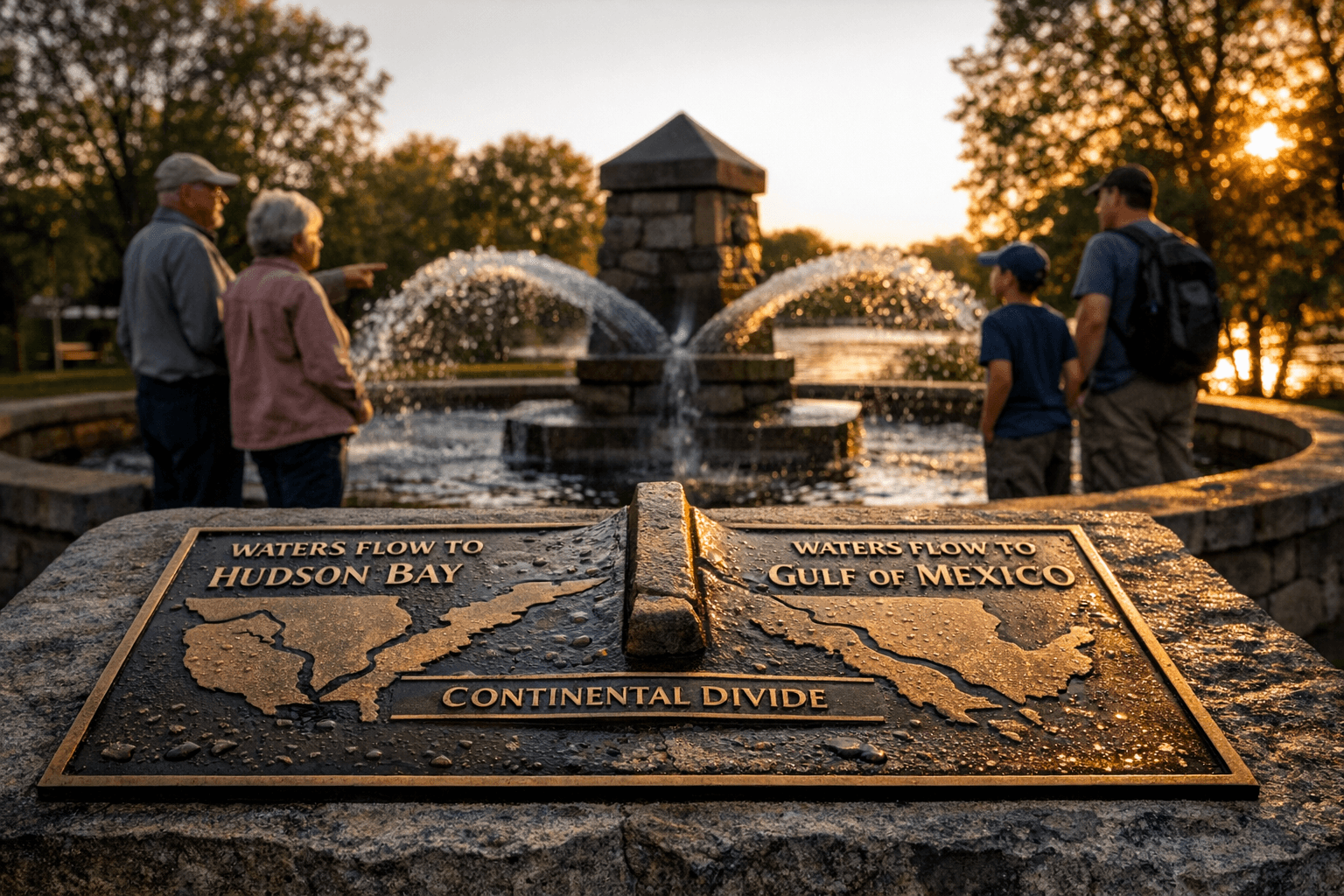
The granite Centennial (Continental Divide) Monument in Central Park sits precisely on the height of land that runs through New York Mills. A small fountain artistically represents rain falling on the town while a bronze plaque explains that water running from one side of the stone drains toward the Gulf of Mexico and water on the other side drains to Hudson Bay. The marker displays five historical flags — England, France, Spain, and two American flags — and interpretive text linking early colonial claims, Rupert’s Land, and the Louisiana Purchase to how drainage and national boundaries shaped settlement and control.
That combination of geology and history has practical implications for Otter Tail County residents. Watershed boundaries determine where rain and runoff travel, what rivers and aquifers may carry agricultural and septic contaminants, and which jurisdictions are responsible for flood control and water-quality monitoring. Local public health outcomes — from safe drinking water to the prevention of waterborne illness — depend on coordinated management across those invisible divides. Changing precipitation patterns driven by climate shifts make these issues more urgent, increasing flood risk, stressing septic systems in rural areas, and altering pollutant flows.
The monument also functions as a public teaching device and community gathering point. Otter Tail County’s history page provides photos of the monument, the bronze plaque text, and background on the marker’s purpose and symbolism, making the site accessible to residents and visitors planning educational visits. As a civic asset in Central Park, the marker contributes to local identity and small-scale tourism that supports downtown businesses in New York Mills.
At the same time, the monument’s emphasis on colonial-era flags and claims highlights broader questions about whose histories are centered in public spaces. Interpretive text about colonial powers and territorial purchases can obscure the centuries-long presence and stewardship of Indigenous peoples in the region. Local leaders, historians, and public health officials face an opportunity to expand interpretation and programming at the site so it reflects both environmental science and a fuller account of human history tied to these waters.
For public health and policy, the divide is a reminder that water management and environmental justice do not stop at municipal borders. County health departments, watershed districts, town governments, and state agencies share responsibility for monitoring water quality, funding infrastructure upgrades, and ensuring equitable access to safe water. The Centennial Monument makes visible the physical line on the ground and should prompt continued cross-jurisdictional collaboration to protect community health and sustain the lakes, rivers, and drinking water that define life in Otter Tail County.
Sources:
Know something we missed? Have a correction or additional information?
Submit a Tip