China Confirms Rare African Foot-and-Mouth Strain in Northwestern Herds
China's first-ever detection of the SAT-1 foot-and-mouth strain leaves 6,229 cattle in Xinjiang and Gansu exposed with no effective domestic vaccine available.
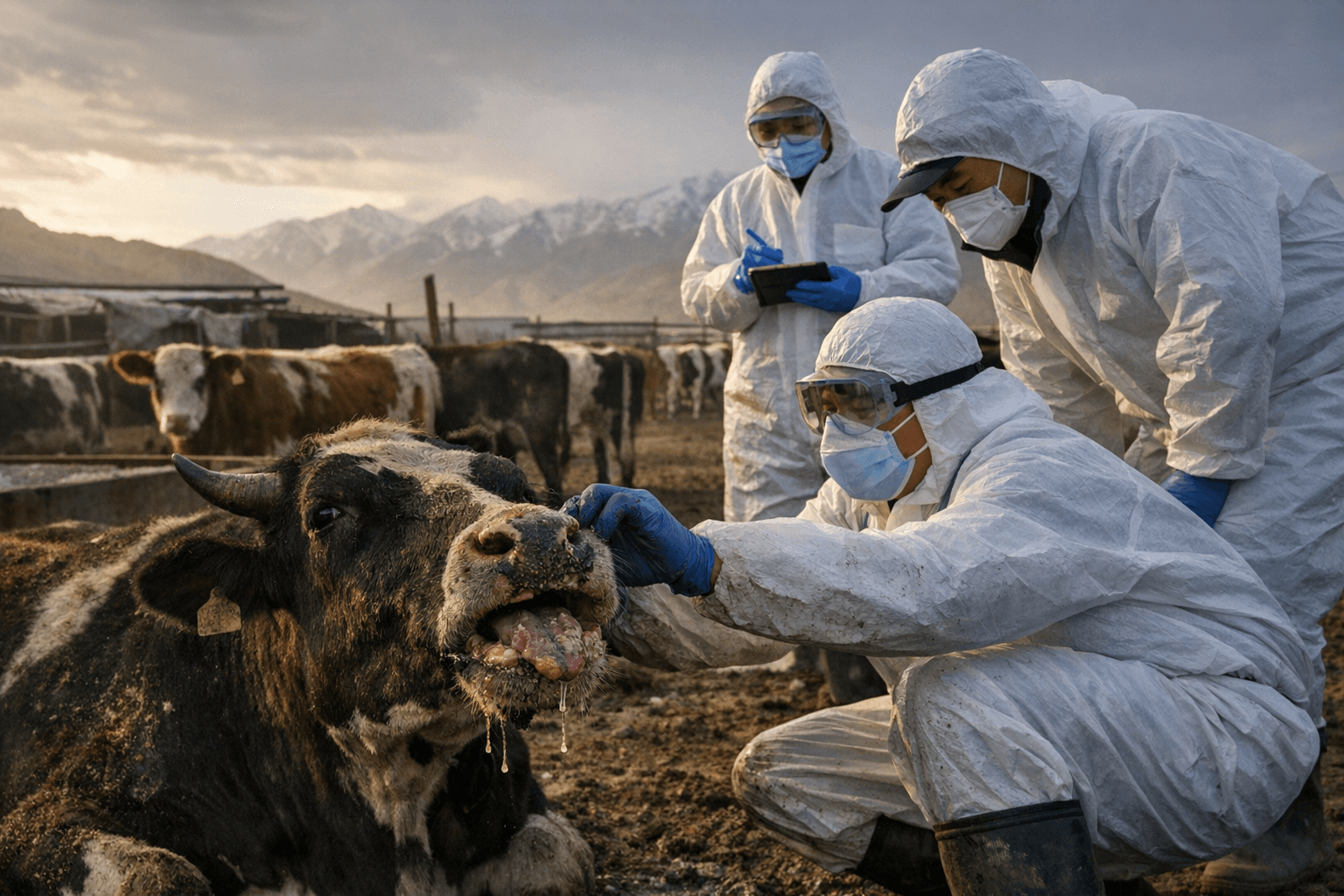
A strain of foot-and-mouth disease previously unknown in China has been confirmed in cattle herds across two northwestern border regions, exposing a critical gap in the country's livestock vaccine arsenal and raising fears of a far wider outbreak that existing immunization programs cannot contain.
China's Ministry of Agriculture confirmed SAT-1 serotype foot-and-mouth disease in 219 cattle spread across two herds totaling 6,229 animals in Gansu province and the Xinjiang Uyghur Autonomous Region. Local governments in both regions moved swiftly to cull infected animals, disinfect affected areas, and order neighboring jurisdictions to tighten inspections. Authorities said the outbreak entered China via the northwest border, a region that touches Kazakhstan, Mongolia, Russia, and other countries.
The vaccine problem is immediate and severe. Industry analysts said it was the first time the SAT-1 serotype, a type of the disease endemic in Africa, had been detected in China, and that existing domestic vaccines for the more common O and A serotypes do not provide protection. That leaves not just the two affected herds exposed, but the broader livestock population in the region without a reliable shield if the strain spreads beyond the currently identified sites. Rosa Wang of Shanghai JC Intelligence Co. warned that the outbreak "threatens a large region and prevention and control are under severe pressure."
Since 2025, SAT-1 has spread from Africa to parts of the Middle East, West Asia, and South Asia. Its appearance in northwestern China marks a significant geographic leap and suggests the virus is finding new transmission corridors, possibly through the movement of animals across porous border zones. Officials specifically flagged illegal livestock transport and smuggling as vectors that must be stopped, ordering border provinces to escalate patrols.
The timing draws a sharp line to events just across China's northern border. The outbreak follows the culling of roughly 90,000 head of cattle across nine Russian regions since February, with analysts estimating that around 80% were in the Altai region, which borders Xinjiang. Russian authorities attributed those losses to rabies, pasteurellosis, and other unspecified causes, a characterization that has drawn scrutiny from regional disease monitors who suspected foot-and-mouth may have played a role.
The economic stakes in China are substantial. Foot-and-mouth disease spreads rapidly among cloven-hoofed animals, and an uncontrolled outbreak in one of China's livestock-dense border corridors could trigger domestic movement bans, meat supply disruptions, and retaliatory import restrictions from trading partners. The vaccine gap compounds every dimension of the risk: without a SAT-1-specific immunogen, control depends entirely on culling, containment, and border enforcement, all of which carry enormous costs and logistical strain at scale.
For international veterinary bodies and China's livestock trading partners, the urgent questions now center on genetic sequencing of the detected strain, whether transmission chains beyond the two confirmed herds can be established, and how quickly a targeted vaccine can be developed or sourced. The World Organisation for Animal Health maintains a registry of SAT-1 strains circulating in Africa and the Middle East, and matching China's isolate to known lineages could clarify how far the virus has traveled and through which pathways. Until that picture sharpens, the pressure on Gansu and Xinjiang provincial authorities to hold the line with culling and patrol will only intensify.
This article was produced by Prism’s automated news system from verified source data, official records, and press releases, then run through automated quality and moderation checks before publishing. The system is built and supervised by the people who set the standards it runs under. Read our full AI policy.
Did this article answer your question?


