China Eases Planned Gas Price Hike, Citing Burden on 300 Million Drivers
China cut a planned $5.10/gallon gas cap to $4.70, nearly halving the increase for 300 million petrol drivers after long queues and fuel shortages hit cities over the weekend.
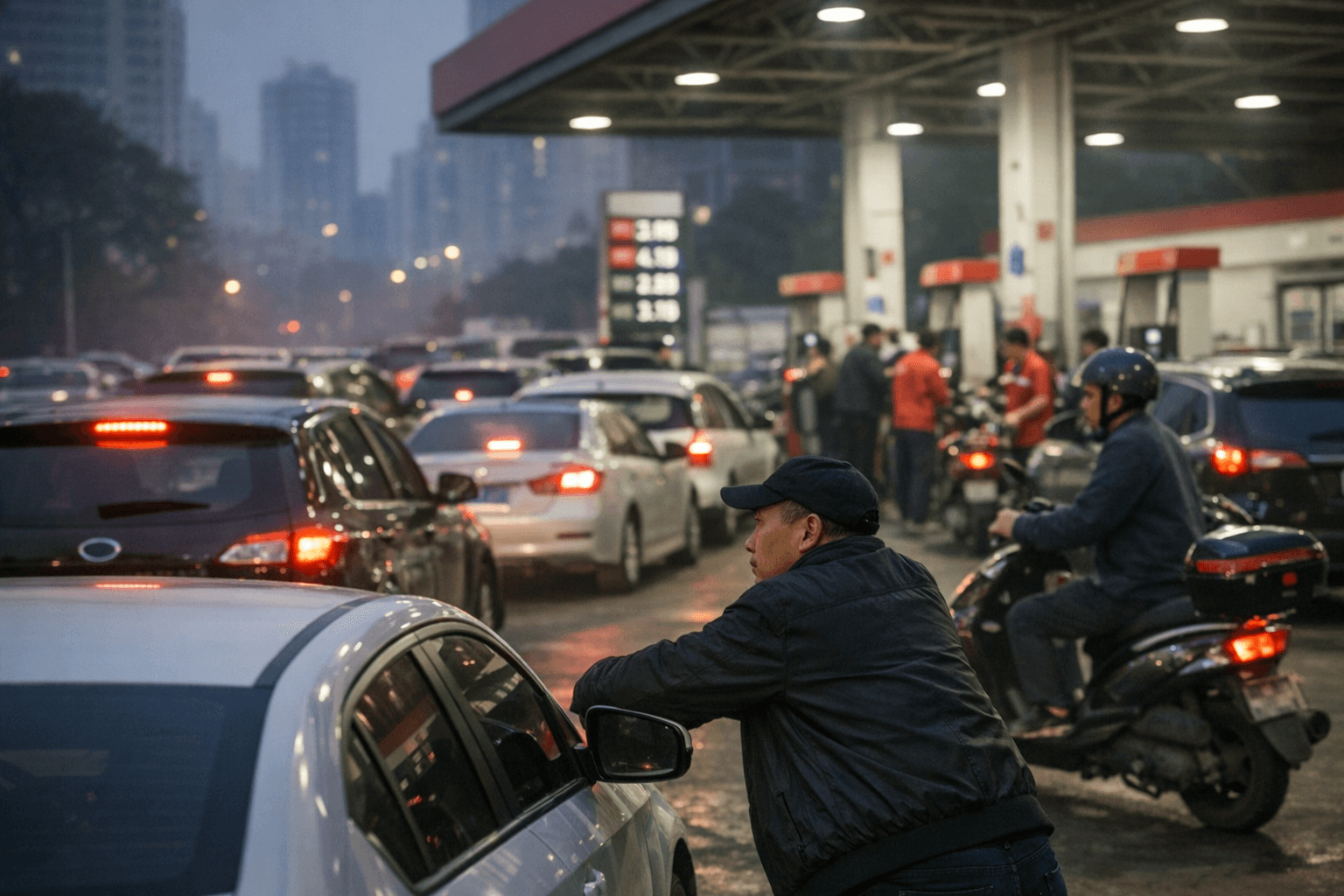
Cars were already lined up around the block at petrol stations across multiple Chinese cities when Beijing moved Monday to pull back from what would have been its largest fuel-price increase of the year.
China's National Development and Reform Commission intervened to cushion rising fuel prices, limiting a planned hike to roughly half of what would normally have been applied under the country's standard pricing formula. The agency said it would raise the maximum retail prices for gasoline and diesel by 1,160 yuan and 1,115 yuan per tonne respectively, effective from Monday midnight.
In per-gallon terms familiar to international markets, the average pump price will now be set at $4.70 a gallon, up from $4.20 but well below a planned cap of $5.10 a gallon. Under the current pricing mechanism, gasoline and diesel prices would have been set to rise by 2,205 yuan per metric ton and 2,120 yuan per metric ton respectively. The decision to intervene rather than let the formula run its course surprised oil analysts who watch China closely.
The NDRC cited the war in Iran as the source of the market disruption requiring an exceptional response. "To mitigate the impact of abnormal increases in international oil prices, ease the burden on downstream users and ensure stable economic operations and public welfare, temporary regulatory measures have been adopted," the agency said in its statement. The price adjustment was the country's fifth of the year and the largest, even after the reduction.
The scale of the political pressure behind the decision is visible in the numbers: long queues formed at fuel stations across China after panic buying was triggered by a price hike alert from state oil giant Sinopec, which had warned of a "meaningful" increase in fuel prices effective March 24. Some stations posted notices that they had run out of fuel entirely.
Iran's closure of the Strait of Hormuz disrupted roughly 20% of global oil supplies, in what the International Energy Agency described as the most severe global supply disruption since at least the 1970s. Gulf countries are a major source of China's crude oil, and the blockade has severed a critical artery. Even with the government's intervention holding the line at $4.70 a gallon, gasoline prices in China have still risen about 20% since the start of the war.
The NDRC ordinarily reviews petrol and diesel prices every 10 working days, adjusting them to reflect changes in international crude benchmarks. While the government can cap retail prices and intervene during extreme volatility, sustained global price surges force partial pass-through to consumers to prevent severe losses for refiners and preserve market stability. That tension, between absorbing costs politically and passing them to consumers, has made what is normally a formulaic administrative process economically and politically fraught.
Crude markets remained volatile on Tuesday. Following the closure of the Strait of Hormuz on March 4, Brent crude surged past $120 per barrel before pulling back sharply as conflicting accounts emerged of potential diplomatic talks between the United States and Iran. By Tuesday, Brent had climbed back above $100 a barrel.
The relief measure lands against an unusual backdrop for a country whose auto fleet is rapidly electrifying. In China, where half of new cars are electric vehicles or hybrids, more than 300 million people still drive cars that run on petrol or diesel. For that population, the gap between $5.10 and $4.70 a gallon is not an abstraction; it is the difference between manageable and untenable at the pump, at a time when the region's energy disruption shows no clear end.
Know something we missed? Have a correction or additional information?
Submit a Tip

