China exports surveillance state model, deepening global authoritarian control
China’s domestic control system is now an export product, pairing cameras and facial recognition with censorship tools and political know-how for governments that want tighter control.
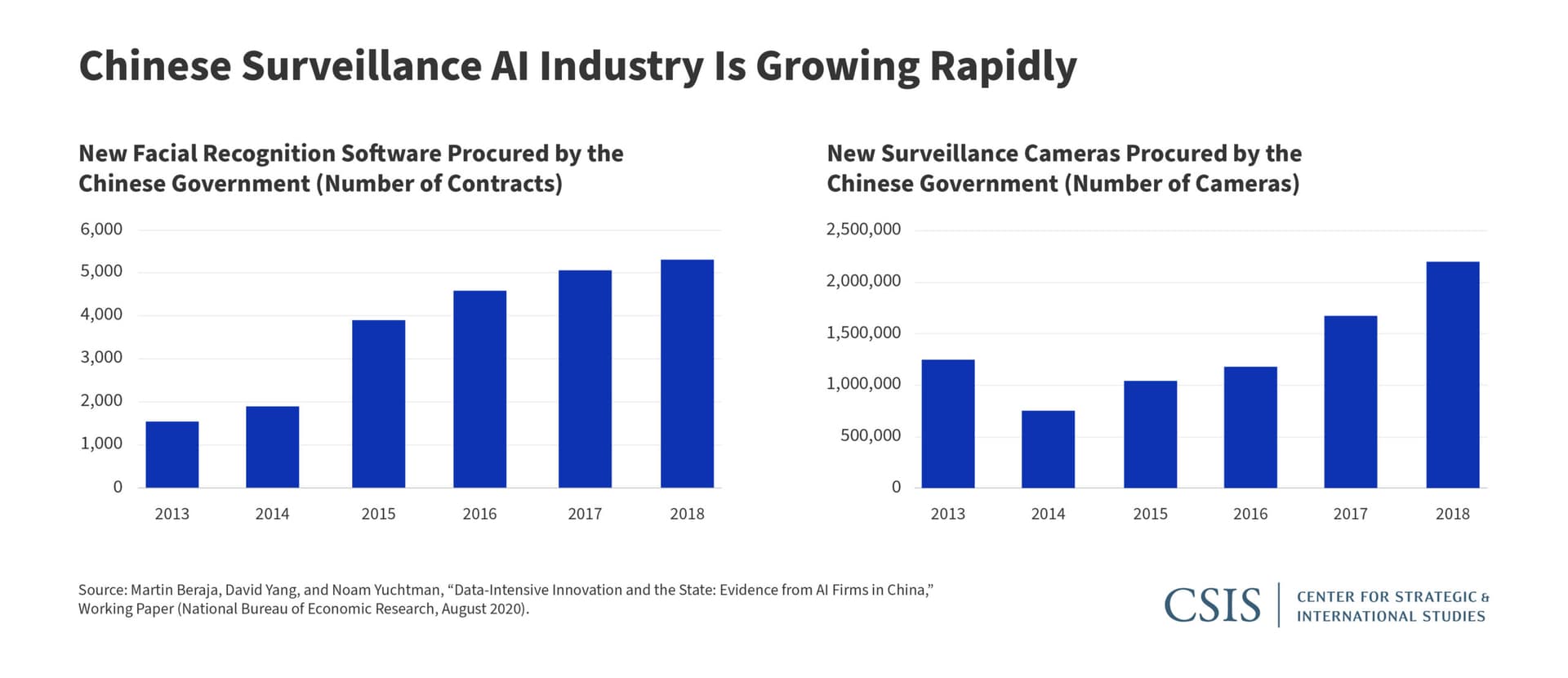
China’s surveillance model is no longer confined to its own borders
China has spent decades building one of the world’s most intrusive systems of digital control at home: real-name internet registration, dense camera networks, facial-scanning requirements tied to telecom services, and strict data-localization and security-review rules. That apparatus is now being packaged for export, turning surveillance into both a governance strategy and a global business.
The result is not just more technology sales. It is the spread of a political model in which the state sees more, blocks more, and answers to fewer democratic checks. Researchers and rights groups say the appeal is especially strong for governments that want social control without the scrutiny that usually comes with open political systems.
What China is exporting
The most visible exports are public-security and AI-surveillance tools. Brookings research has found that autocracies and weak democracies are more likely to import facial-recognition AI from China, especially when domestic AI investment is weak or political unrest is high. That pattern matters because the buyers are not just purchasing software or hardware; they are often buying a ready-made system for monitoring dissent, identifying people in crowds, and tightening state control over public space.
Leaked evidence reported in 2026 showed that a major Chinese company connected to Great Firewall development exported censorship and monitoring tools abroad, including to Myanmar, Pakistan, Ethiopia, and Kazakhstan. That is a powerful reminder that the export package goes beyond cameras and algorithms. It also includes the tools to filter information, track behavior, and reshape the information environment itself.
Why recipient governments want it
The demand is straightforward: surveillance systems are politically useful. They can help governments monitor protests, track activists, identify speakers at rallies, and build databases that make routine dissent easier to punish. In countries where political unrest is high, those tools can look like a shortcut to control, especially when domestic tech industries are too weak to build comparable systems on their own.
Brookings’ findings point to an important economic and political logic. When local AI investment is limited, imported Chinese facial-recognition systems become more attractive because they are available, operational, and often backed by a broader state-to-state relationship. In practice, that means the market for surveillance technology overlaps with the market for political influence.
The civil-liberties cost
The rights consequences are immediate and severe. Freedom House rated China 9 out of 100 in its 2024 Freedom on the Net report and said Chinese internet users have faced the world’s worst conditions for internet freedom for a decade. That domestic baseline matters because it shows how thoroughly the control model has been tested inside China before being marketed abroad.
Human Rights Watch and Freedom House both describe a system that keeps intensifying rather than easing. The model combines technical monitoring with legal and administrative pressure, creating a broad environment in which online speech, movement, and association can all be tracked or constrained. Once exported, those same tools can be used to normalize surveillance in places that lack strong courts, independent regulators, or meaningful press scrutiny.
Tibet, Xinjiang, and the logic of coercive technology
The international concern is sharpened by how these tools are used inside China. In January 2024, Human Rights Watch reported that Thermo Fisher Scientific said it would no longer sell human DNA identification technology to Chinese police in the Tibet Autonomous Region. That decision underscored how biometric and forensic technologies can become part of a wider architecture of repression when deployed by security forces.
The U.S. Department of State’s 2024 human rights report said China continued mass abuses in Xinjiang and used surveillance and other coercive tactics against targets abroad. That combination is significant. It shows a state that does not treat surveillance as a narrow policing tool, but as a governing method that can operate both domestically and transnationally.
Transnational repression reaches students overseas
Amnesty International reported on May 13, 2024, that Chinese and Hong Kong students abroad faced intimidation, harassment, and surveillance in transnational repression campaigns. That extends the reach of the surveillance state far beyond China’s borders and into universities, dormitories, and diaspora communities.
The implications are broader than one community. When students believe they are being watched by agents of a distant government, speech narrows, organizing becomes riskier, and academic life itself changes. The message is clear: the same machinery used to police dissent at home can be adapted to pressure citizens and residents overseas.
The market is wider than China alone
It is tempting to treat Chinese exports as the whole story, but the global surveillance market is broader. Privacy International has noted that a Danish company was authorized to export an internet surveillance system to China for a field acceptance test, showing that surveillance trade has also involved non-Chinese suppliers. That matters because it places China’s exports inside a larger international marketplace where states shop for monitoring capacity wherever they can find it.
Brookings and Privacy International both frame surveillance exports as part of a global market in control technologies, not simply a China-specific phenomenon. But China remains distinctive because its domestic model is so comprehensive: infrastructure, legal controls, and political discipline are bundled together and then offered as a template.
Why this export model is so durable
The durability of China’s model comes from scale and integration. Cameras, facial recognition, telecom-linked identity checks, data localization, and censorship systems reinforce one another. Once that stack is installed, it becomes easier for governments to deepen surveillance over time rather than roll it back.
That is why the export of surveillance technology should be understood as an export of governance. Governments do not just buy hardware from Chinese firms such as Geedge Networks or other linked suppliers. They buy a method for ruling, one that favors opacity over accountability and coercion over consent.
As long as political leaders see surveillance as a solution to instability, the market will keep growing. The danger is not only that more countries will copy China’s tools, but that more will copy the logic behind them: control first, oversight later, if ever.
This article was produced by Prism’s automated news system from verified source data, official records, and press releases, then run through automated quality and moderation checks before publishing. The system is built and supervised by the people who set the standards it runs under. Read our full AI policy.
Know something we missed? Have a correction or additional information?
Submit a Tip