China new home prices fall again as annual decline quickens to five‑month high
Official data show new home prices slipped 0.4% month‑on‑month in December, with annual declines accelerating to about 2.7%, deepening risks for growth.
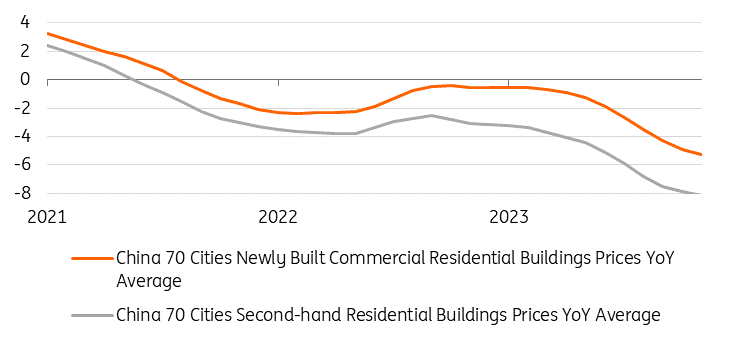
China’s housing market showed fresh signs of strain as official figures released by the National Bureau of Statistics on Jan. 19, 2026, recorded a 0.4% month‑on‑month decline in new home prices for December, matching November’s pace and extending a near‑term downtrend. On an annual basis the series registered a roughly 2.7% drop, the fastest year‑on‑year fall in five months and an acceleration from a 2.4% fall in November.
The NBS survey covered 70 cities. Six cities posted month‑on‑month price gains in December, while 58 recorded declines, underscoring a broad geographic pattern of weakening demand. Price softness was not limited to lower‑tier markets; existing or secondary market prices in tier‑one, tier‑two and tier‑three cities were reported to be falling faster year‑on‑year, suggesting weakness across urban segments rather than a simple shift from smaller to larger cities.
Some published compilations of the same NBS release show a slightly different annual figure, with a 3.0% year‑on‑year decline reported in one series versus the widely cited 2.7% number. Analysts attribute the discrepancy to rounding and aggregation differences in public data series rather than divergent underlying trends.
The persistence of falling prices has major macroeconomic implications. The property sector remains a critical engine for investment, consumption and local government revenues in China. Continued price declines can erode household wealth and confidence, suppress consumption, and sustain pressure on local government financing that depends on land sales and construction activity. Jeff Zhang, an equity analyst at Morningstar, said the continued weakness in the property sector "is broadly in line with our expectations and is likely to remain a major drag on China’s growth over the next two to three years."

Market participants and analysts warn the downturn could persist into 2026 absent more forceful policy support. Beijing has repeatedly pledged to stabilise the sector and some local authorities have eased purchase restrictions and cut mortgage costs, but those measures have so far failed to generate a sustained rebound in demand. Centaline Property analyst Zhang Dawei forecasts divergent trajectories will deepen this year, with prices in major cities potentially stabilising while smaller cities without strong industrial bases and experiencing population outflows face a prolonged process of inventory reduction.
Government‑linked researchers also highlight the limits of current policy tools. Li Yujia, chief researcher at the Guangdong Housing Policy Research Institute, notes that employment and consumption fundamentals remain weak and that those pressures are constraining households’ ability and willingness to buy, undermining expectations for a rapid recovery.
For markets and policymakers the challenge is twofold: short‑term support to arrest the slide and longer‑term structural measures to rebalance supply, stem population and industrial shifts, and ease financing constraints. Absent a clearer turn in housing prices, the sector is likely to remain a drag on domestic demand and local fiscal health, complicating China’s broader growth picture in 2026.
This article was produced by Prism’s automated news system from verified source data, official records, and press releases, then run through automated quality and moderation checks before publishing. The system is built and supervised by the people who set the standards it runs under. Read our full AI policy.
Did this article answer your question?

