China's Space Program Is Growing Fast, and These Photos Prove It
China set a national record of 90+ orbital launches in 2025 and is racing to put boots on the moon by 2030, backed by $3.81 billion in commercial space investment.
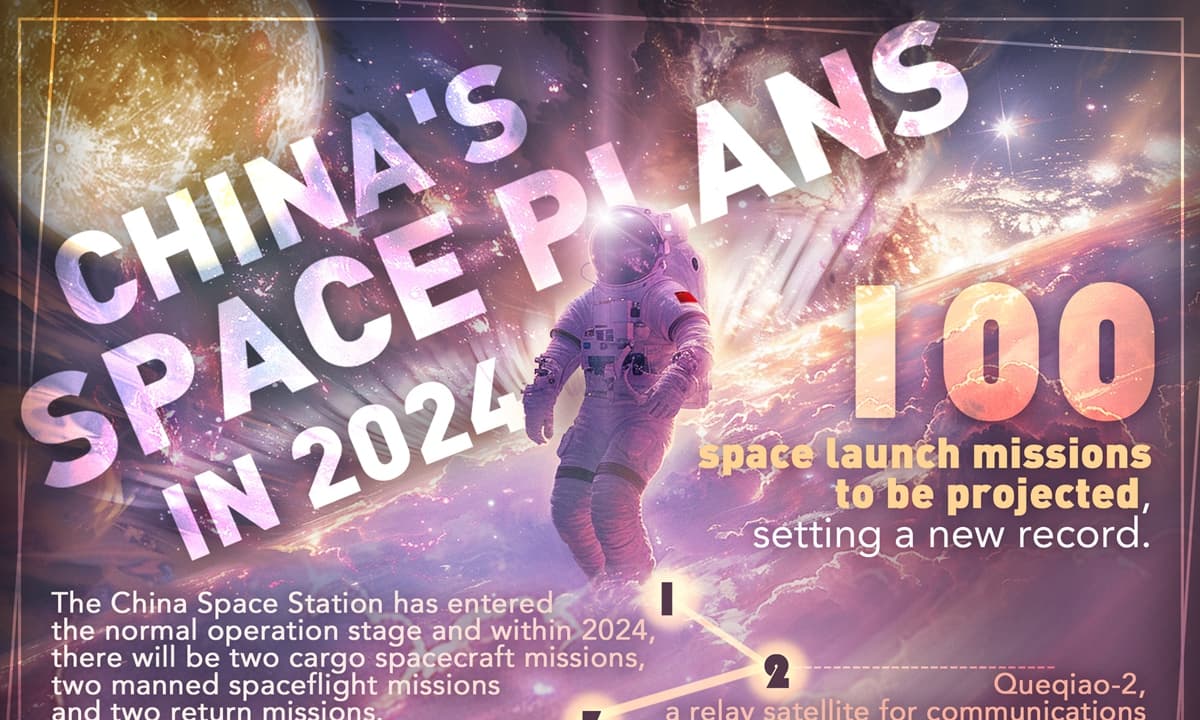
A Space Power Built on Momentum
While NASA made headlines with a lunar flyby this week, China's space program has been quietly assembling one of the most ambitious expansion campaigns in the history of rocketry. The numbers alone are striking: in 2025, China executed more than 90 orbital launches, setting a new national record that surpassed even its own previous high of 68 launches set the year before. That pace is not a fluke. Chinese investment in commercial space, drawing from both private and government sources, climbed from $340 million in 2015 to approximately $3.81 billion in 2025, a tenfold increase that has redrawn the competitive map of the industry.
The Tiangong Station: A Nation's Permanent Foothold in Orbit
China's Tiangong space station, orbiting continuously since 2021, has matured into an operational research outpost with a rhythm of its own. The Shenzhou 21 crew launched on October 31, 2025, aboard a Long March-2F rocket from the Jiuquan Satellite Launch Center. But the mission's defining chapter came from an unexpected crisis: suspected space debris struck the Shenzhou 20 spacecraft while it was docked at Tiangong, rendering it unsafe for the crew's return. China responded by launching Shenzhou 22 on November 25, 2025, an uncrewed rescue vessel that served as a lifeboat for the stranded taikonauts. It was the first major human spaceflight emergency in China's crewed program, and officials resolved it without losing a single crew member.
Looking ahead to 2026, the China Manned Space Agency has scheduled two crewed missions and one cargo resupply mission to Tiangong. In a milestone that reflects the program's growing reach, astronauts from Hong Kong and Macao special administrative regions are expected to fly, alongside a planned Pakistani astronaut mission that would make China a partner in international human spaceflight alongside, rather than simply behind, the United States and Russia.
The Long March 10: Engineering China's Path to the Moon
The most consequential test of the year so far came on February 11, 2026, at the Wenchang Spacecraft Launch Site on the southern island province of Hainan. China's China Manned Space Engineering Office (CMSEO) conducted two simultaneous critical evaluations: a low-altitude demonstration and verification flight test of the Long March 10 rocket, and a maximum dynamic pressure abort test of the Mengzhou crewed spacecraft. Both systems performed as designed.
The Long March 10 is a next-generation super-heavy carrier rocket built specifically for crewed lunar missions. Its first stage completed a controlled descent and splashed down in a predetermined sea area, a recovery demonstration that echoes the ambitions of SpaceX's Falcon 9 program and signals China's intention to build reusable architecture into its lunar infrastructure. Program officials confirmed the test verified the first-stage ascent and recovery phases while demonstrating the Mengzhou spacecraft's Max-Q escape and sea recovery capabilities.
The Mengzhou spacecraft, whose name translates to "dream vessel" in Chinese, is the crew vehicle that will carry taikonauts to the moon's surface. Its abort system was put through a punishing high-speed escape scenario, verifying that astronauts could survive a launch emergency at the moment of peak aerodynamic stress. The first orbital mission of the Mengzhou spacecraft, likely uncrewed, is expected within 2026 itself. China's stated target remains a crewed lunar landing before 2030, a timeline that puts it in direct competition with NASA's Artemis program.
Commercial Rockets: Landspace and the Reusability Race
China's state-owned launch providers are not the only players pushing the program forward. On December 3, 2025, Beijing-based startup Landspace launched the maiden flight of its Zhuque-3 rocket, marking the first Chinese attempt at recovering a stage from an orbital launch vehicle. The stainless-steel rocket, reminiscent in design philosophy to SpaceX's Starship system, represents a wave of commercially backed reusability ambitions that are diversifying China's launch portfolio beyond the traditional Long March family.
Other commercial developers are moving in parallel. Space Pioneer has displayed a revised version of its Tianlong-3M rocket configured for crewed vehicles. Multiple companies are developing new engines, with firms static-firing propulsion systems capable of powering future reusable vehicles. With demand at Tiangong now exceeding 500 kilograms per month for food, supplies, and scientific experiments, the commercial logistics market for the station is real and growing, driving investment into dedicated cargo spacecraft like the Qingzhou "Light Ship" vehicle, whose first operational flight to Tiangong is expected in the final quarter of 2026.
Deep Space: Asteroids, the Moon's South Pole, and Mars
China's ambitions stretch well beyond Earth orbit. In May 2025, the country launched Tianwen-2, a mission directed at the near-Earth asteroid 469219 Kamoʻoalewa, a small object believed to be a fragment of the moon. The probe represents China's first dedicated asteroid rendezvous mission and will test technologies that feed directly into future sample-return programs.
At the lunar surface, China's Chang'e program is preparing its next chapter. Chang'e 7, expected to launch in 2026, will target the moon's south pole with an orbiter, lander, and a small flying probe designed to investigate permanently shadowed craters for water ice and other resources. Its successor, Chang'e 8, will follow with further surface operations. Beyond the moon, China has its eye on Mars: the Tianwen 3 mission, a Mars sample return effort, is targeting a launch around 2028, which would make China the second nation after the United States to attempt bringing Martian material back to Earth.
What the Photos and Data Reveal
The imagery that has emerged from China's space program over the past 18 months paints a picture of industrialized ambition. Launch pads at Wenchang, Jiuquan, and the new commercial zones are in near-constant use. Rocket stages have been photographed descending on controlled trajectories toward the sea. Taikonauts wave from inside Tiangong's modules in orbit while engineers below manage simultaneous crewed and cargo missions on overlapping schedules.
The rate of progress is structural, not episodic. China is not celebrating single historic moments; it is normalizing high-tempo operations across crewed spaceflight, deep space exploration, and commercial infrastructure all at once. Every new record, every recovered booster, and every successfully tested abort system narrows the gap between where China's space program stands today and where it intends to be when the decade closes.
This article was produced by Prism’s automated news system from verified source data, official records, and press releases, then run through automated quality and moderation checks before publishing. The system is built and supervised by the people who set the standards it runs under. Read our full AI policy.
Did this article answer your question?