Chinese investment pledge faces backlash over U.S. security concerns
Trump wants more foreign capital, but his own order put Chinese money under a tighter national-security lens in tech, farmland, energy and healthcare.

Donald Trump’s push to make the United States a premier destination for foreign investment collided with the same national-security machinery that has kept Chinese money on a short leash for years. His February 21, 2025 memorandum directed the Committee on Foreign Investment in the United States to keep Chinese investment out of strategic sectors, including technology, critical infrastructure, healthcare, agriculture, energy, raw materials, farmland, real estate near sensitive facilities and greenfield projects.
That split helps explain why any new appeal to Chinese capital would draw immediate pushback from lawmakers, security officials and skeptics of technology transfer and supply-chain dependence. Even as the administration signaled openness to foreign investment, it also said it would consider tighter limits on U.S. money flowing to China in semiconductors, artificial intelligence, quantum computing, biotechnology and aerospace.
The review system is not theoretical. The Treasury Department said CFIUS handled 342 notices and declarations in calendar year 2023, cleared 66% of distinct transactions that did not require mitigation measures, and assessed or imposed four civil monetary penalties for violations of mitigation agreements. Those numbers show a gatekeeper that is active, expansive and willing to enforce the rules when it sees risk.
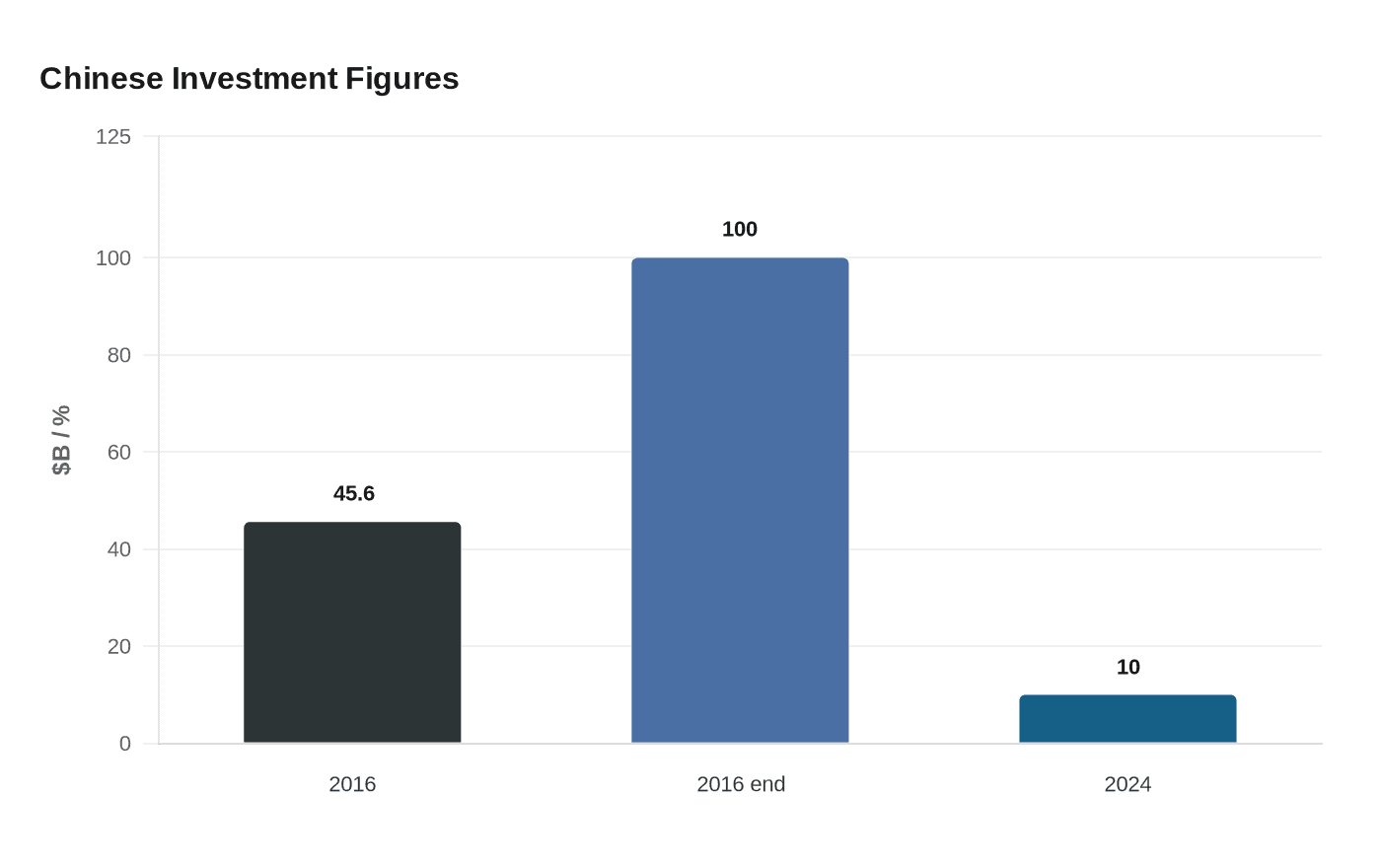
Chinese investment in the United States once surged to a record $45.6 billion in 2016, and cumulative Chinese direct investment in the country topped $100 billion by the end of that year. Since then, Rhodium Group has tracked a sharp retreat. Newly announced overseas investment by Chinese companies fell 10% in 2024, completed Chinese overseas investment came in at about $58 billion worldwide, and Chinese investment in North America and Europe dropped to its lowest level since 2010.
The geography matters as much as the politics. Chinese capital has shifted toward Asia, while North America and Europe have cooled, leaving the most likely openings in places hungry for outside money, including agriculture, energy and materials-heavy regions. But the same sectors that might welcome funding are also the ones most likely to trigger a national-security review if a deal touches farmland, grid assets, industrial supply chains or facilities near sensitive sites.
Brookings has said Chinese investment in U.S. clean energy carries layered risks, and that experts disagree on how much of that risk can be managed with guardrails. That disagreement sits at the center of the debate now: the White House says foreign investment can still be welcomed if the guardrails are strong, but the country’s security apparatus remains poised to stop deals that cross the line.
This article was produced by Prism’s automated news system from verified source data, official records, and press releases, then run through automated quality and moderation checks before publishing. The system is built and supervised by the people who set the standards it runs under. Read our full AI policy.
Did this article answer your question?

