Chinese team reports millimetre-sized, phase-pure lonsdaleite confirmed by diffraction
A Chinese team led by Ho-kwang Mao reports millimetre-sized, phase-pure hexagonal diamond from highly oriented pyrolytic graphite, confirmed by X-ray and electron diffraction.
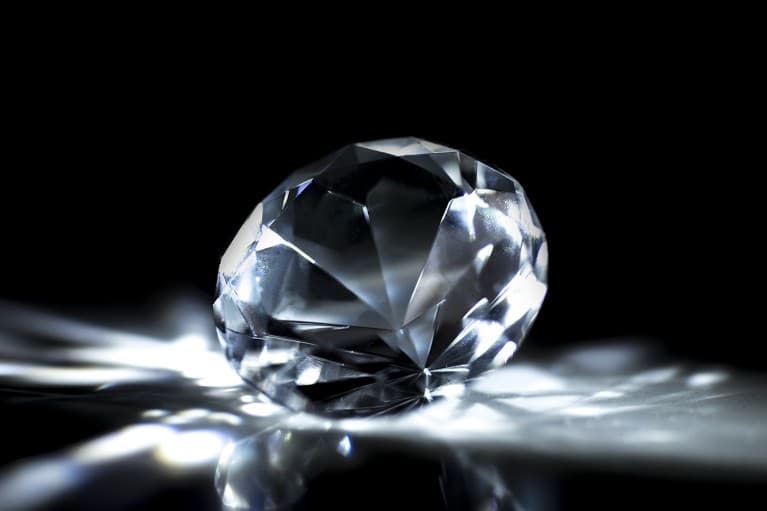
A Chinese materials group reports millimetre-sized crystals of phase-pure hexagonal diamond, or lonsdaleite, produced from highly oriented pyrolytic graphite and confirmed with X-ray diffraction, electron diffraction, and atomic-resolution microscopy. Crystals range from about 0.1 mm to 1.0 mm in size, and the authors say the samples show minimal defects and measurable differences in mechanical behaviour compared with cubic diamond.
The team, led by Ho-kwang Mao at the Center for High Pressure Science and Technology Advanced Research with co-lead Chongxin Shan of Zhengzhou University, compressed HOPG to roughly 20 gigapascals—about 200,000 times atmospheric pressure—and applied laser heating at temperatures between 1,300 and 1,900 degrees Celsius. A key experimental detail reported by the authors was uniaxial loading from the top rather than lateral loading, which they say helped produce phase-pure hexagonal crystals in the high-pressure, high-temperature apparatus.
Structural confirmation rests on multiple complementary probes. The group used X-ray diffraction and electron diffraction to establish hexagonal stacking, and atomic-scale microscopy to assess defect density. The paper places the material on the Vickers hardness scale after multi-anvil press testing, though explicit Vickers-number values were not supplied in the reported material. The authors report that hexagonal diamond was slightly harder and measurably stiffer than cubic diamond in their tests, and that the new phase showed greater resistance to oxidation under the conditions they examined.
The work cites longstanding theoretical interest: hexagonal bonding shortens and strengthens interlayer bonds in the buckled honeycomb arrangement, a structure long hypothesized to yield much higher hardness than conventional cubic diamond. Mao and colleagues write, "HD [hexagonal diamond] is indeed the hexagonal counterpart of cubic diamond, with shortened and strengthened bonding between buckled honeycomb layers. These findings open new exploration of HD as a potentially superior technological material."
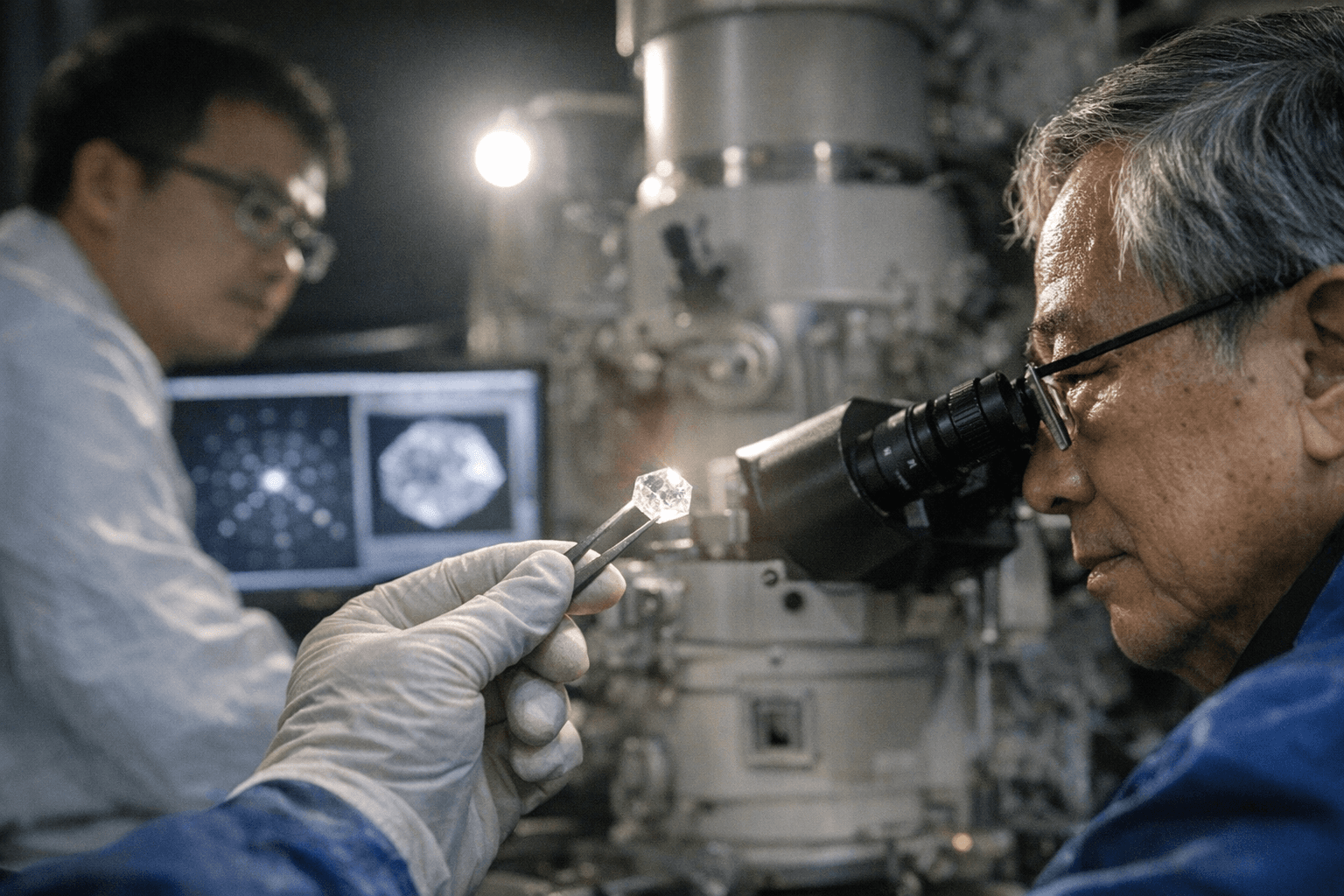
The new paper follows multiple, independent attempts over the past two years to replicate lonsdaleite in the laboratory. Two groups in 2025 reported similar products but with weaker X-ray signatures, and a Jilin University team published a method earlier in the year that produced only minute quantities. Oliver Tschauner, a mineralogical crystallographer at the University of Nevada, Las Vegas who reviewed the manuscript, said, "There are hundreds of claims from people who believe they have seen it. But this is the first very accurate characterization of this elusive material."
Parallel work in the United States offers a different synthesis route and stronger mechanical claims. Yogendra Gupta of the Institute for Shock Physics at Washington State University reports producing hexagonal diamond by shock compression and states, "Now we have made the hexagonal form of diamond, produced under shock compression experiments, that is significantly stiffer and stronger than regular gem diamonds." Travis Volz, lead author on that work and now at Lawrence Livermore National Laboratory, cautioned that hardness inferences can be indirect: "Generally stiffer materials are also harder. While it is not possible to scratch the diamonds to test hardness directly, it is possible to make inferences about their hardness."
For gem and technology markets the immediate implications are clear but measured: the Chinese team has scaled single-crystal size into the sub-millimetre to millimetre range and produced what they characterize as phase-pure lonsdaleite, yet empirical hardness gains so far are modest relative to the historical >50 percent theoretical projection. Next steps are quantitative cross-comparisons of Vickers numbers, full diffraction datasets, and yield and scalability metrics to determine whether hexagonal diamond will move from laboratory curiosity to an industrial or gem-quality material.
Know something we missed? Have a correction or additional information?
Submit a Tip