Choosing and Caring for Vintage Rings: Inspecting Hallmarks, Shanks, Prongs
Vintage rings give you a slice of history and meaningful sustainability—but they demand careful inspection of shanks, prongs, hallmarks, and stone stability.

There is an uncomplicated pleasure in wearing a ring that has been worn before: “It’s easy to forget, but authentic antique and vintage engagement rings are secondhand rings. Which means they’re an extraordinarily sustainable option for the eco-conscious buyer,” writes Greenweddingshoes, capturing both the romance and the responsibility of buying used jewelry. That duality—heritage and required care—frames every sensible purchase of a vintage ring.
What vintage and antique mean (a quick era primer) Greenweddingshoes maps the broad eras collectors use to date rings, and those categories are useful when assessing construction and expected fragility: Georgian (1714–1830), Victorian (1837–1901), Edwardian (1901–1914), Art Nouveau (1890–1914) and Art Deco (1920–1935). Each period has distinct design languages—hand-forged foibles in Georgian work, lace-like platinum filigree in Edwardian examples, and geometric, machine-friendly details in Art Deco—that affect how a piece will wear and what to inspect before buying.
Why buy vintage: provenance, personality, and planet There’s a practical sweetness to the argument: “No new ring has to be manufactured and no new stones have to be mined. And on top of that, you get to wear a little piece of history. It really doesn’t get any better,” Greenweddingshoes writes. Beyond the environmental case, many vintage rings are one-of-a-kind: “Antique and vintage engagement rings are made for those who want to stand out,” and, as the guide nicely puts it, “Let’s be honest, how cool is it to know that you’re the only person wearing your specific style of antique or vintage engagement ring?” That uniqueness is also why provenance and condition matter—your purchase is both an aesthetic choice and a conservation project.
The essential inspection checklist Evergreen’s practical buyer checklist is compact and unforgiving: “What to inspect—shank condition, solder seams, prong security, and stone stability.” Begin with the shank: look for thinning, flex, hairline cracks or previous solder repairs that interrupt the band. Solder seams deserve close scrutiny—visible, amateur repairs can indicate past structural problems and will affect how safely a jeweler can resize or restore the piece. Prong security is the next priority: loose, worn or replaced prongs are the most common cause of stone loss. Finally, test stone stability visually and tactilely; a well-set stone should not rock or shift in its setting.
Hallmarks and maker’s marks: an indispensable authentication step Evergreen signals that hallmarks matter, listing “Hallmarks & maker marks—how to rea…” (the source’s fragment appears truncated), but that fragment confirms an important point: stamped marks are often the clearest clues to metal content, origin, and, sometimes, maker. When hallmarks are present, they can corroborate the claimed date or metal purity and strengthen provenance. If stamps are faint, worn, or absent, ask for magnified photos or a professional inspection; a reputable dealer should be able to explain any missing or obscure marks.
Condition and maintenance: set expectations “It’s important to note that if you’re buying an authentic antique or vintage engagement ring, you’re buying an older piece of jewelry that will likely require gentler care and more maintenance,” Greenweddingshoes advises. Older settings—filigree, millegrain, collet or low-profile bezels—can trap dirt and suffer from accumulated wear, so cleaning and service routines will often differ from modern mass-produced rings. “You should be aware of the condition of the piece before purchasing,” and, crucially, “check in with the jeweler on the best ways to clean and maintain your ring going forward.” Build the cost of regular inspections and potential stabilization into your ownership plan.
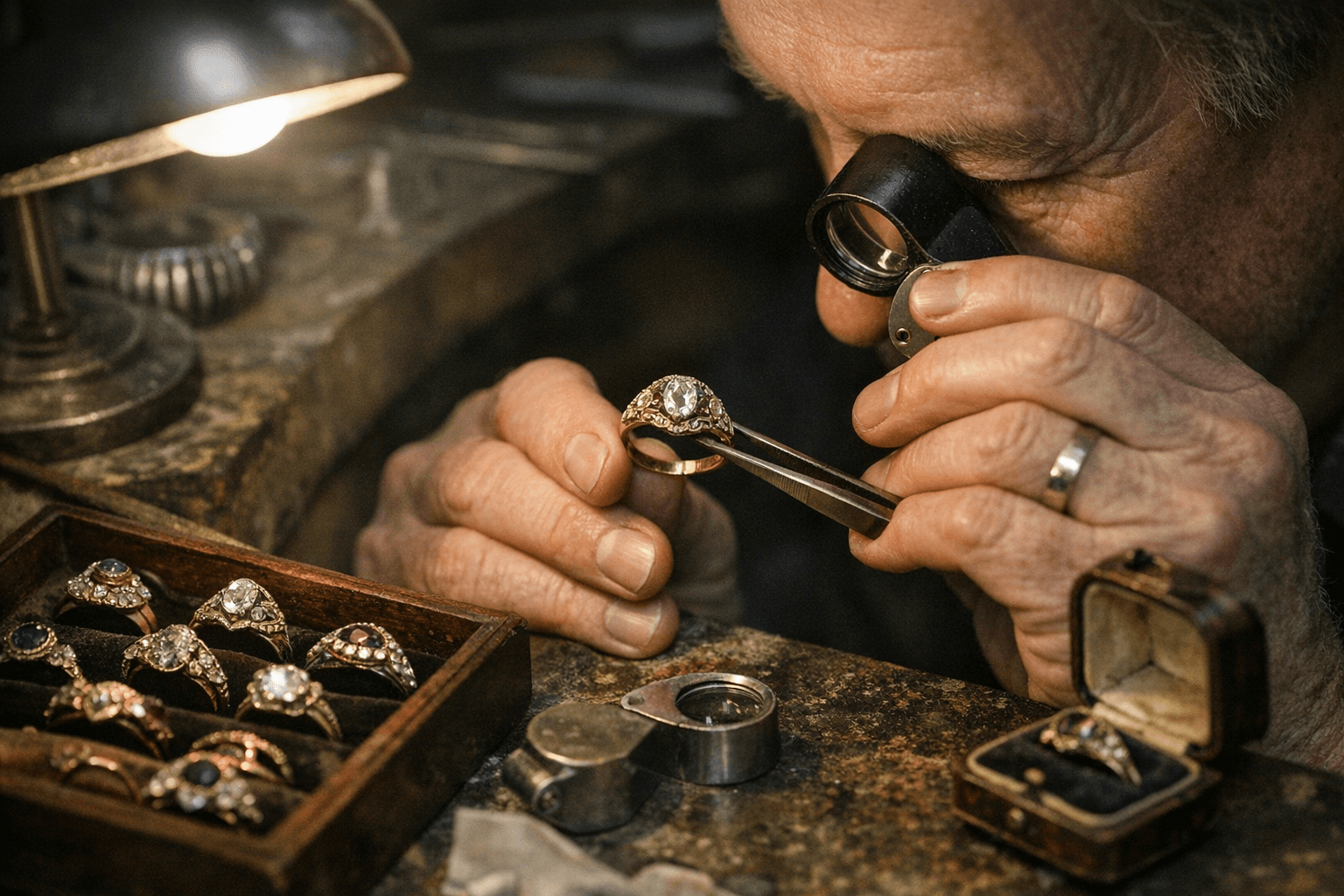
Settings, stones and why design matters A ring’s setting is not only decorative; it’s protective engineering. Prong settings show more of a diamond or colored stone and can be spectacularly delicate—prongs thin over decades and need periodic re-tipping. In contrast, bezel settings encircle the gem and provide superior protection against knocks and loss; however, they also conceal more of the stone and are harder to alter without re-cutting. When you evaluate a vintage stone, consider the gem’s type—softer materials or historically common treatments will affect both cleaning method and long-term durability—and match restoration choices to the original design language so that character is preserved rather than erased.
Sizing, repairs and working with a conservatory-minded jeweler Evergreen lists sizing and materials among its core topics, and sensible action follows: resizing vintage rings can stress shanks and solder seams—items the Evergreen checklist flags for inspection—so always consult a jeweler experienced in antique work. Repairs ought to respect original components; for example, replacing a prong with a modern, heavier profile can change the visual balance. Ask the seller or conservator for documentation of previous repairs and for a clear description of what a recommended stabilization will entail.
Reading style as a clue to construction and value Image fragments in the Greenweddingshoes excerpt—such as an “elaborate Art Deco diamond vintage engagement ring sitting inside a peach color blooming flower” or a “notebook sketch of ruby vintage engagement rings”—remind us that style cues convey construction cues. Edwardian platinum work will often have finer, mil-grained settings and ultra-fine prongs; Art Deco pieces tend toward stepped geometry and more robust channels or bezels. Use era and design as shorthand to anticipate which structural features merit extra scrutiny.
- Inspect the shank closely for thinning, dents, or visible solder seams; ask for macro photos if buying remotely.
- Confirm prong security and stone stability by sight and, when possible, in-hand inspection; enquire about any loose stones.
- Request documentation of hallmarks and maker’s marks; note that the Evergreen guide lists “Hallmarks & maker marks—how to rea…” (truncated) as a dedicated section.
- Ask the seller to describe prior repairs and to recommend a local conservatory-minded jeweler for routine care.
- Factor in maintenance: vintage pieces commonly require gentler cleaning and regular professional checks—Greenweddingshoes reminds buyers that older rings “will likely require gentler care and more maintenance.”
- If sustainability is a key motivation, remember Greenweddingshoes’ point: buying vintage means “No new ring has to be manufactured and no new stones have to be mined.”
Practical steps to take before you buy
A final, essential note A vintage ring is both a piece of jewelry and a small archive: it carries age in patina, repairs and hallmarks. Approach it with the curiosity of a historian and the rigor of a conservator—inspect shanks and solder seams, confirm prong security and stone stability, and treat hallmarks as leads rather than ornaments. Do this and you will not only wear a “little piece of history,” as Greenweddingshoes puts it, but also keep it singing for the next person who will love it.
Know something we missed? Have a correction or additional information?
Submit a Tip

639070277227915106.jpg&w=1920&q=75)