Climate warning says 2026 World Cup faces dangerous heat risks
Southerly U.S. and Mexican venues face the sharpest heat risk, with about a quarter of 104 World Cup matches likely to breach safety limits.
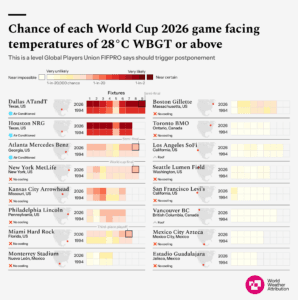
The hottest risk in the 2026 World Cup is concentrated in southerly and inland venues in the United States and Mexico, where temperatures may frequently approach or exceed 30C. World Weather Attribution said northern and coastal cities, especially in Canada and along the Pacific coast of the United States, are likely to be milder, but it warned that roughly a quarter of the tournament’s 104 matches could still cross FIFPRO’s recommended safety limits.
That matters because the expanded tournament will run from June 11 to July 19, 2026, across 16 host cities in the United States, Canada and Mexico, with the final scheduled for New York. FIFA’s official schedule sets the field at 48 teams and 104 matches, turning what would normally be a straightforward summer event into a complex heat-management exercise across three countries and multiple time zones.
The analysis used kickoff times and the Wet Bulb Globe Temperature index, a measure that combines humidity, radiant heat and air movement to capture how well the body can cool itself. Under FIFPRO guidance, cooling breaks are recommended once WBGT reaches 26C, and postponement is advised at 28C. The researchers said about five matches could fall into conditions severe enough that delay would be the safer option.
The warning also underscores how much the climate context has changed since the 1994 World Cup in the United States. The researchers said the risk of dangerously hot conditions is nearly twice what it was then, a shift that will force organizers to balance player safety, broadcast windows, stadium operations and fan conditions in real time.
Vincent Gouttebarge of FIFPRO said the calculations were consistent with the union’s own work published in 2023, which said hot and humid conditions impair performance and raise the risk of heat illness. FIFA has already prepared heat-risk measures that include three-minute hydration breaks in each half, cooling infrastructure, adapted work-rest cycles and enhanced medical readiness that can be scaled to conditions on the day.
Chris Mullington of Imperial College London said the extreme heat is more likely to change how matches are played than to trigger widespread medical emergencies, because elite players will pace themselves. Even so, the scale of the tournament means organizers will need to decide quickly whether kickoff times, venue choices and player-safety rules can keep pace with a summer World Cup that now carries a clear climate warning.
This article was produced by Prism’s automated news system from verified source data, official records, and press releases, then run through automated quality and moderation checks before publishing. The system is built and supervised by the people who set the standards it runs under. Read our full AI policy.
Did this article answer your question?