CNIC to Provide Training and Isotope Support to IAEA Rays of Hope
CNIC met with IAEA in Vienna (20–23 February 2026) to outline in‑kind support, including a Bruce Power‑hosted isotope production and radiation safety training in 2026 and e‑learning by end of 2026.
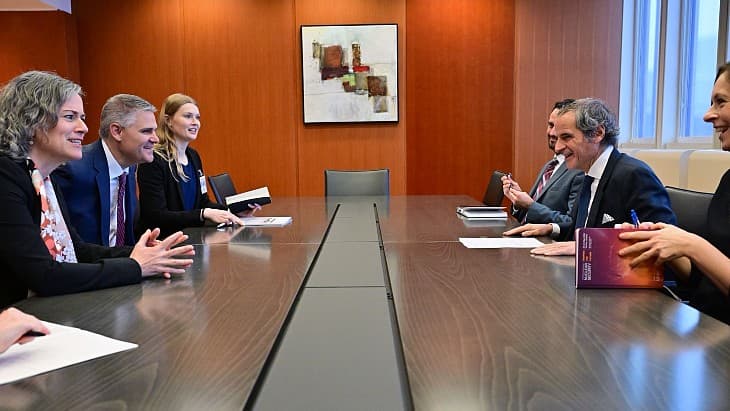
Canada’s Nuclear Isotope Council met with International Atomic Energy Agency leadership in Vienna between 20 and 23 February 2026 to outline the country’s first in‑kind contributions to the IAEA’s Rays of Hope cancer initiative, announcing a Bruce Power‑hosted isotope production and radiation safety training in 2026 and a technical working group tasked to deliver training programs and e‑learning materials toward the end of 2026. CNIC Chair James Scongack travelled to IAEA headquarters and met with Director‑General Rafael Mariano Grossi as part of the delegation’s discussions.
The collaboration builds on Practical Arrangements signed on March 4, 2025, when Hua Liu, Deputy Director General and Head of the Department of Technical Cooperation of the IAEA, and James Scongack, Chair of the Canadian Nuclear Isotope Council, “signed historic Practical Arrangements (PAs) highlighting a new collaboration effort between the two organizations.” The PAs state CNIC will leverage its network across federal and provincial governments, industry partners and hospitals and integrate the agreement into CNIC’s advocacy and government relations strategy while aligning with CNIC’s stated goal to double the production of isotopes in Canada by 2030.
CNIC’s initial, named in‑kind contribution is a hands‑on training program hosted at Bruce Power in 2026. As CNIC posted on social media, “Among these first contributions is an isotope production and radiation safety training program hosted at Bruce Power in 2026, welcoming representatives from LMICs to learn about the technical fundamentals of isotope production, processing, and radiation safety.” CNIC also signalled that its members will provide expert resources to support IAEA training programs for low‑ and middle‑income countries and help develop associated E‑learning content.
“To support next steps, the CNIC and IAEA have established a technical working group to advance on the three areas of activity, working to deliver the training programs and E‑learning materials toward the end of 2026,” a Kincardinerecord account states, setting the near‑term delivery milestone for the partnership. The composition of that working group and the list of participating low‑ and middle‑income countries have not been published in CNIC materials released to date.

CNIC framed the Vienna engagement within its broader membership and strategic ambitions. Sources describe CNIC as an independent, not‑for‑profit advocacy and member services organization formed in 2018 that now counts “over 100 members,” “nearly 115 members,” and in some accounts “more than 115 members” spanning isotope producers, researchers, radiopharmaceutical firms, logistics and hospitals. Ontario political posts highlighted provincial support: Stephen Lecce wrote that “Canadian CANDU technology is among the world’s top producers of life‑saving medical isotopes” and noted Ontario’s Nuclear Isotope Innovation Council of Ontario, launched to double medical isotope production by 2030.
The IAEA’s Rays of Hope campaign already has financial and country reach: Innovatingcanada reports that “since Rays of Hope began, more than 20 countries have contributed over $80 million USD in total to start delivering tangible projects and results in 30+ countries.” Alison Grant, Canada’s Ambassador to the United Nations in Vienna, framed the partnership in diplomatic terms: “As Ambassador of Canada to the United Nations in Vienna, I can confirm our strong commitment to strengthening global health through collaboration and technical expertise,” she said, adding that Canada is proud to support Rays of Hope in expanding access to cancer diagnostics and treatment.
If CNIC and the IAEA meet the stated timelines, the Bruce Power training and the joint e‑learning effort aim to turn Canada’s isotope production expertise into classroom and online capacity for LMIC representatives by the end of 2026, while feeding into CNIC’s domestic target to double isotope output by 2030. For further contact, CNIC lists Melody Greaves, Executive Director & Vice President, Government Relations, at melody.greaves@canadianisotopes.ca.
Know something we missed? Have a correction or additional information?
Submit a Tip
_82415.jpg&w=1920&q=75)
