College of Menominee Nation Debuts Half-Mile Phenology Path Through Campus Forests
Black ash harvesters and CMN students can now follow seasonal cues along a half-mile path on the Keshena campus, using red-and-white phenology stations, green Menominee-language signs, QR codes and Nature’s Notebook.
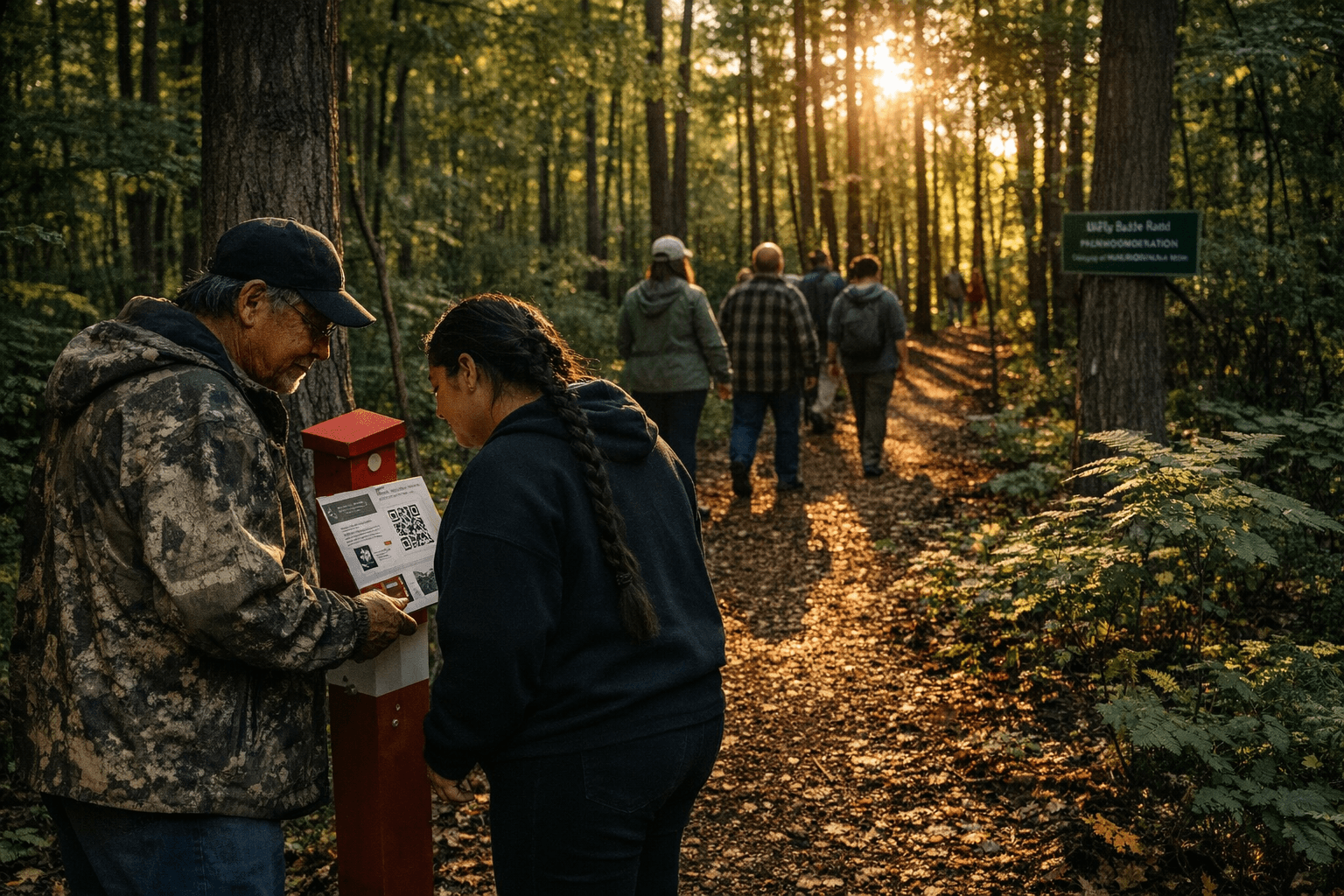
Black ash basket makers and students at the College of Menominee Nation now have a half-mile Phenology Learning Path running along the east side of the Keshena campus through mixed northern hardwood, old-field forest succession, and a wetland edge, intended to let visitors document seasonal shifts and climate-driven timing changes. “The goal is for visitors to follow the phenological stages of various plants and trees along the path and for their observations to document phenological responses to climate change over time,” the project description states.
Signage on the path is organized into two types: small green Learning Path signs that list the Menominee name first, followed by the scientific and common names with a brief description, and larger red-and-white Phenology Stations that include leaf, flower, and fruit phenophases with descriptions and accompanying photographs. Plants along the trail are marked with both red and green signs; media files associated with the project include a campus map image and a “Phenology Station Sign of yarrow” that illustrate the installed assets.
Digital tools are built into the trail experience. QR codes that can be accessed by a smart phone, iPad or iPhone link visitors to additional digital media, the Path uses GPS mapping tools, and the project includes Nature’s Notebook integration so observers can submit phenology records. Guidance for study is explicit: “As you study phenology, you would want to come and observe from when the plant emerges in the spring until the plant dies back in the fall,” project materials advise.
The Path intentionally braids Menominee language and seasonal knowledge with Western scientific practice. Menominee names appear on signs and the trail frames seasonal cues around a 13-moon calendar, including Sugar Making Moon (April), Budding Moon (May), Strawberry Moon (June), Blueberry Moon (August), Rice Threshing Moon (September) and Falling Leaves Moon (October). “Phenology is the study of life cycles through seasons,” Angela says; “The phenology trail brings the two together,” she adds, noting the project’s effort to “braid” Indigenous ways of knowing and Western science. Local practitioners already report climate-linked timing mismatches, including black ash bark harvesters noting shifts relative to wild strawberry ripening.
The Path grew from longer-term work by the College of Menominee Nation Sustainable Development Institute with faculty, students and SDI staff; Cathy Munson, an SDI intern funded by the Northeast Climate Adaptation Science Center, coordinated development from Fall 2015 through Summer 2016. The Measuring the Pulse multi-year project (USDA-NIFA TCRGP-003648, 2012-2015) provided earlier grant-funded research links and named partners including Michigan State University Native American Institute, the Smithsonian Institute, Menominee Tribal Enterprises, the Menominee Indian Tribe of Wisconsin and the Menominee community.
Research and monitoring complement the trail: three 1-hectare forest monitoring plots on the reservation, two on lands managed under Menominee sustained-yield timber practices and one on CMN property, provide longer-term context for observations. CMN-SDI materials note the Path can be adapted to the needs of a group and can provide a comprehensive overview in as little as a few hours, tying classroom time, community practice and visitor-collected data to ongoing efforts to track phenological responses to climate change.
Know something we missed? Have a correction or additional information?
Submit a Tip