Communities Form Walking Bus Groups to Safely Escort Kids to School Amid ICE Fears
Parents, teachers, and volunteers in four states formed "walking bus" escort groups after ICE operations kept families home, leaving schools scrambling as first responders to federal policy.

A five-year-old named Liam Conejo Ramos was detained by federal immigration agents before a judge ordered his release. That single fact, documented in Minnesota, captures the atmosphere that has driven parents, teachers, and community volunteers across four states to organize informal escort groups, known as "walking buses," to get children to school safely.
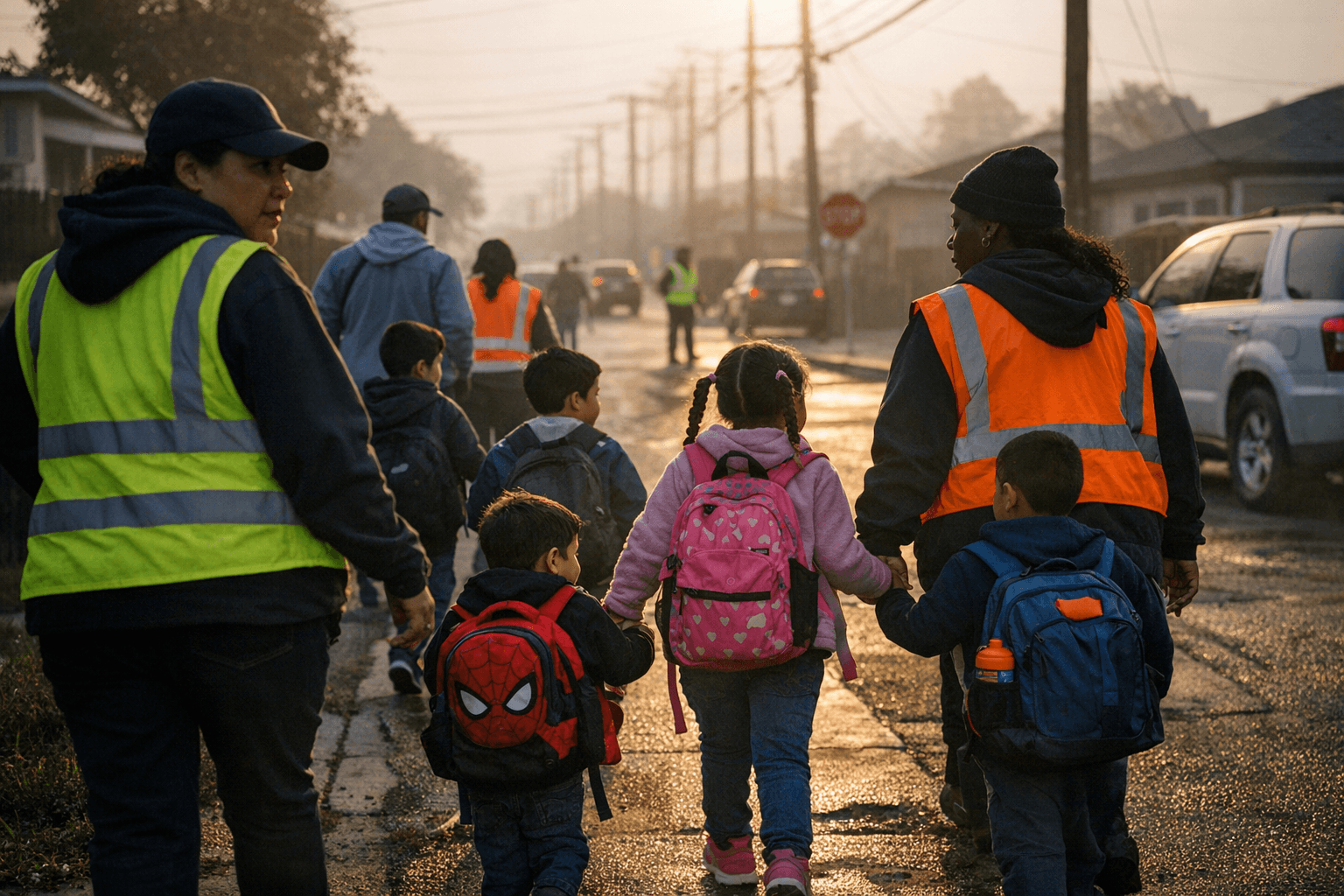
The walking-bus model has taken hold in Minneapolis and greater Minnesota, Lewiston, Maine, Hyattsville, Maryland, and Cedar Rapids, Iowa, as Immigration and Customs Enforcement operations surged through predominantly immigrant neighborhoods in early 2026. In each city, the pattern is similar: adults form rotating groups to walk children to school in numbers, reasoning that visible community presence makes families feel safer navigating streets where federal agents have been operating.
Jaye Riche, a multilingual teacher in Lewiston, Maine, described exactly how the improvisation has unfolded on the ground. "We have walking groups up at the high school, we have folks giving rides," Riche said, sketching a picture of a school community that has reorganized its daily routines around the threat of enforcement actions.
At Valley View Elementary in Minnesota, principal Jason Kuhlman described detention actions that left students and families terrified. The psychological toll reaches into classrooms: teachers across multiple districts reported students asking directly whether ICE would come for their parents, a question no curriculum prepares educators to answer.
The fear feeding those questions has been amplified by footage spreading through communities. In Minneapolis, a viral video captured Aliya Rahman being confronted by enforcement officers while she screamed, "I am autistic and I have a brain injury. Put me down." In Hyattsville, a separate video showed a man pinned to the ground by two officers, pleading for help in both English and Spanish. Both videos circulated widely in immigrant neighborhoods, accelerating the retreat of families from public spaces.
The legal ground beneath those families shifted sharply on January 20, 2025. The Trump administration revoked a longstanding "sensitive locations" memorandum that had previously barred ICE from conducting immigration enforcement at schools, hospitals, and churches. ICE agents can now enter public areas of school campuses, though they still require either authorization from school officials or a valid judicial warrant to access classrooms, private offices, and restrooms.
The Department of Homeland Security, in a statement, said "ICE is not going to schools to arrest children, we are protecting children," adding that it would not "tie the hands of our brave law enforcement" and instead trusted agents "to use common sense."
That assurance has done little to slow the grassroots organizing. Enforcement actions have in some instances involved the detention of U.S. citizens and long-term residents, deepening fear well beyond undocumented communities. School staff in affected districts have taken on roles far outside traditional job descriptions, providing transportation, meals, and emotional support to students whose parents are afraid to leave home.
The costs of that improvisation are falling squarely on local institutions. School systems in Minneapolis, Lewiston, Hyattsville, and Cedar Rapids are effectively acting as first responders to a federal enforcement policy, absorbing financial and staffing burdens with no federal reimbursement and no clear end in sight. Advocates warn that sustained fear suppresses attendance, impedes learning, and corrodes the long-term trust in public institutions that healthy civic life depends on. When a principal becomes a transit coordinator and a teacher becomes a counselor on call for immigration trauma, the gap between federal policy and its local consequences becomes impossible to ignore.
This article was produced by Prism’s automated news system from verified source data, official records, and press releases, then run through automated quality and moderation checks before publishing. The system is built and supervised by the people who set the standards it runs under. Read our full AI policy.
Did this article answer your question?

