Crews Pour Massive Sorting Channel for FishPass at Union Street Dam
Crews poured 3,130 cubic yards of concrete into a dewatered section of the Boardman River to form FishPass’s twin 400-foot sorting lanes at the former Union Street Dam in downtown Traverse City.
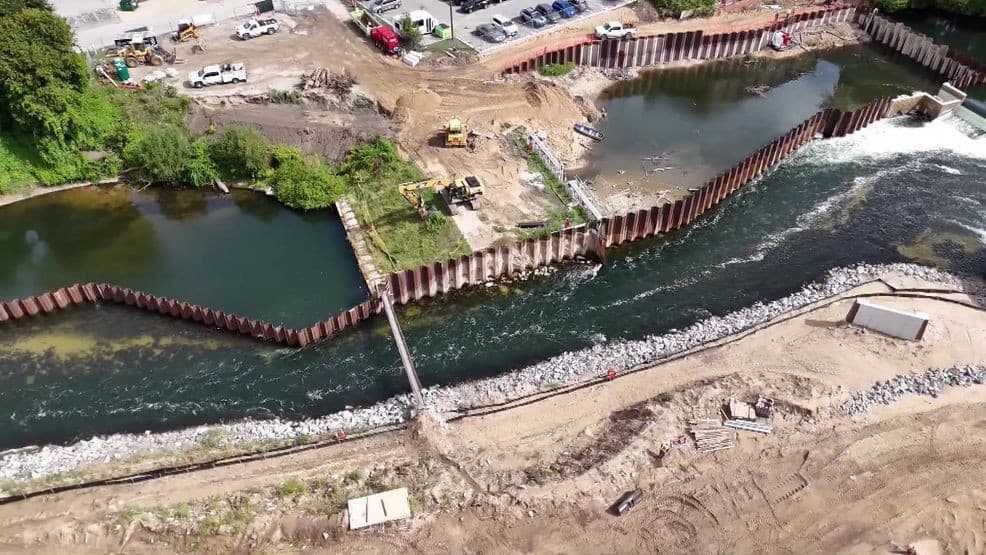
Crews in downtown Traverse City poured 3,130 cubic yards of concrete into a dewatered section of the Boardman River to form the core sorting channel for FishPass at the former Union Street Dam. The pour creates twin 400-foot lanes that will be the operational pathway for the experimental selective fish passage structure reconnecting the river to Grand Traverse Bay.
The sorting channel will include more than 1,000 anchors and 13 separate gates to attach and deploy obstacles that guide and contain fish as they move upstream. Leah Bagdon McCallum, community engagement officer for the Great Lakes Fishery Commission, said, "This is kind of the heart and soul of FishPass," and called it "the most important piece of the actual infrastructure." McCallum likened the obstacle layout to "an American Ninja Warrior course."
FishPass is designed to allow native species to move upstream while blocking invasive sea lamprey and other harmful species through behavior-based sorting. The facility is being built as a global test of selective fish passage technology and is framed locally as the capstone of roughly two decades of restoration work that followed removal of Brown Bridge Dam in 2012, Sabin Dam in 2017, and Cass Road Dam in 2018.
Monitoring and research systems will be layered into the concrete lanes. FishPass plans to use RFID Passive Integrated Transponder (PIT) telemetry with more than 20 stationary antennas to track movement, and project documents identify four passage stages to be sampled: approach, entry, passage or blockage, and fate. FishSens reporting notes that image recognition will assist monitoring; Zielinski said, "For example, image recognition tools will permit the dual benefit of fish identification as well as photographic records of all fish that are interrogated."
Field sampling in fall 2025 provides baseline context for FishPass tests. Great Lakes Fishery Commission notes reference electrofishing on Sept. 10, 2025, and FishSens cites a data table listing 11 fish species sampled in October 2025, naming brown trout, common carp, golden shiner, largemouth bass, Northern pike, rainbow trout, rock bass, round goby, smallmouth bass, and white sucker among those captured.
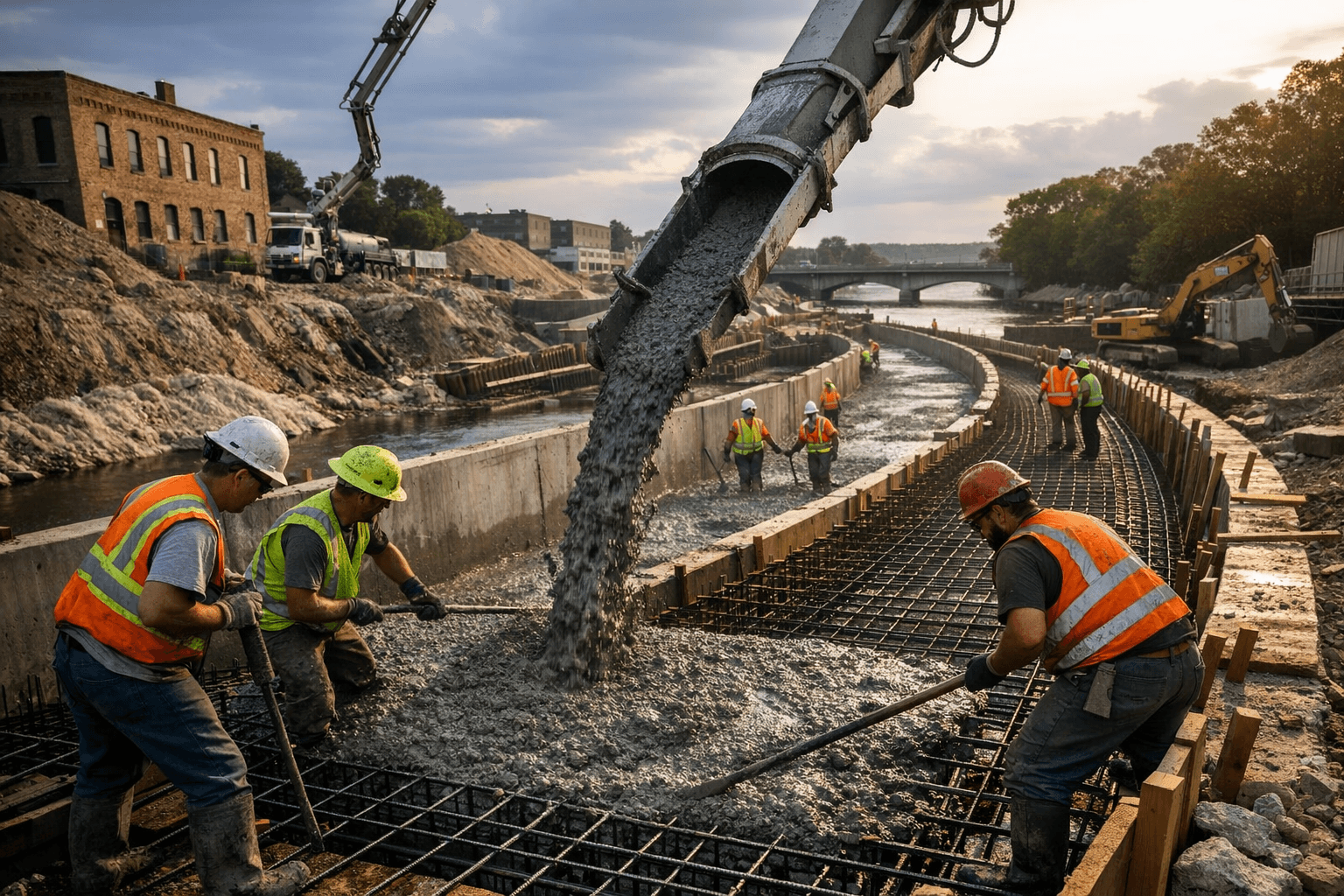
Project managers and contractors completed the pour inside a cofferdam to keep the work area dewatered; a GLFC time-lapse image from Sept. 30, 2025 documented earlier construction stages. McCallum said, "So we're anticipating having this wet work all the things in stream done about this time next year," and local coverage notes onshore work is expected to finish in 2027. The project is reported to be on schedule and within budget as crews press through winter work.
Public interest has been visible along the riverbank in downtown Traverse City, where locals have been gathering to watch progress during lunch breaks and from nearby perches. Zielinski captured the community moment in FishSens coverage: "Every day, FishPass construction advances. So far, the daylighting of the river has been not only exciting to see, but to hear! For more than a century, the river was buried and pushed through culverts. Seeing and hearing it flow has forever changed the heart of downtown Traverse City." As the twin lanes cure and anchors and gates are installed, the concrete channel will become the testbed for the selective-sorting experiments that proponents say could reshape how Great Lakes tributaries balance native restoration with invasive control.
Know something we missed? Have a correction or additional information?
Submit a Tip