Dangerous heat to grip eastern U.S. through July Fourth weekend
Relief will reach the Great Lakes and parts of the Northeast, but the Mid-Atlantic and Southeast stay in the danger zone as heat indices climb to 115.
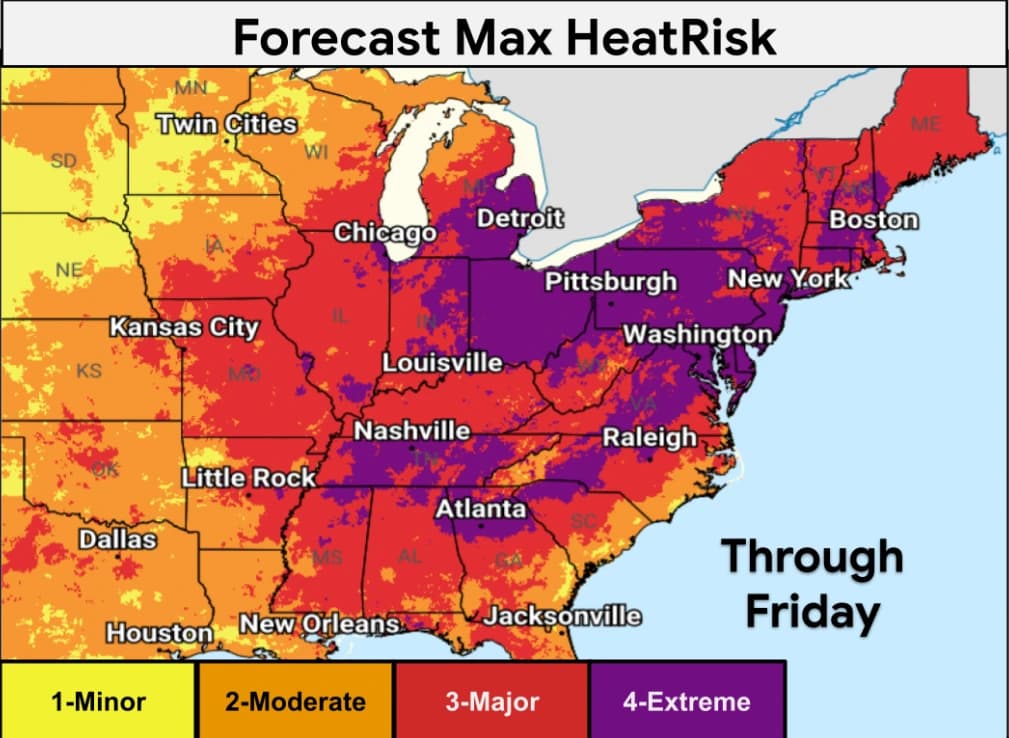
Relief will be uneven across the eastern U.S. this holiday weekend, with the Great Lakes and parts of the Northeast expected to ease while the Mid-Atlantic and Southeast stay locked in dangerous heat. The National Weather Service expects record-breaking temperatures to continue across most of the central and eastern U.S. through Friday, then shift across the eastern U.S. through the Independence Day holiday weekend, with peak heat indices of up to 115 degrees possible.
A slow-moving frontal boundary will gradually sink south across the north-central and northeastern U.S. through the weekend, giving those areas a better shot at showers and storms and helping break some of the heat. That same boundary will keep precipitation chances focused near it, which means some communities will see brief relief while others remain under oppressive conditions.
The Weather Prediction Center forecasts widespread moderate to extreme HeatRisk, and the National Weather Service is using the HeatRisk tool to flag potentially dangerous heat over the next seven days. HeatRisk combines National Weather Service forecasts with heat-health data from the Centers for Disease Control and Prevention, giving decision makers guidance beyond official watches, warnings and advisories.

The National Weather Service counts extreme heat as the deadliest weather phenomenon in the last 10 years, and NOAA estimates about one-third of the U.S. economy is sensitive to weather and climate. That puts added pressure on power grids, outdoor work crews, transit systems and public health responders as households decide whether to travel, reschedule gatherings or stay indoors during the hottest parts of the day.
NOAA issues excessive-heat outlooks 8 to 14 days ahead, then 3 to 7 day forecasts and watches or warnings as danger becomes more likely or imminent.
This article was produced by Prism’s automated news system from verified source data, official records, and press releases, then run through automated quality and moderation checks before publishing. The system is built and supervised by the people who set the standards it runs under. Read our full AI policy.
Did this article answer your question?