Democratic Led Attorneys General Sue to Block CFPB Defunding
A coalition of 21 Democratic led state attorneys general filed suit to stop the White House from withholding funds to the Consumer Financial Protection Bureau, arguing the move is unconstitutional and disrupts vital consumer protections. The case could determine whether the executive branch may selectively starve independent agencies of resources, a decision with direct consequences for consumers, state law enforcement, and communities already facing economic and health disparities.

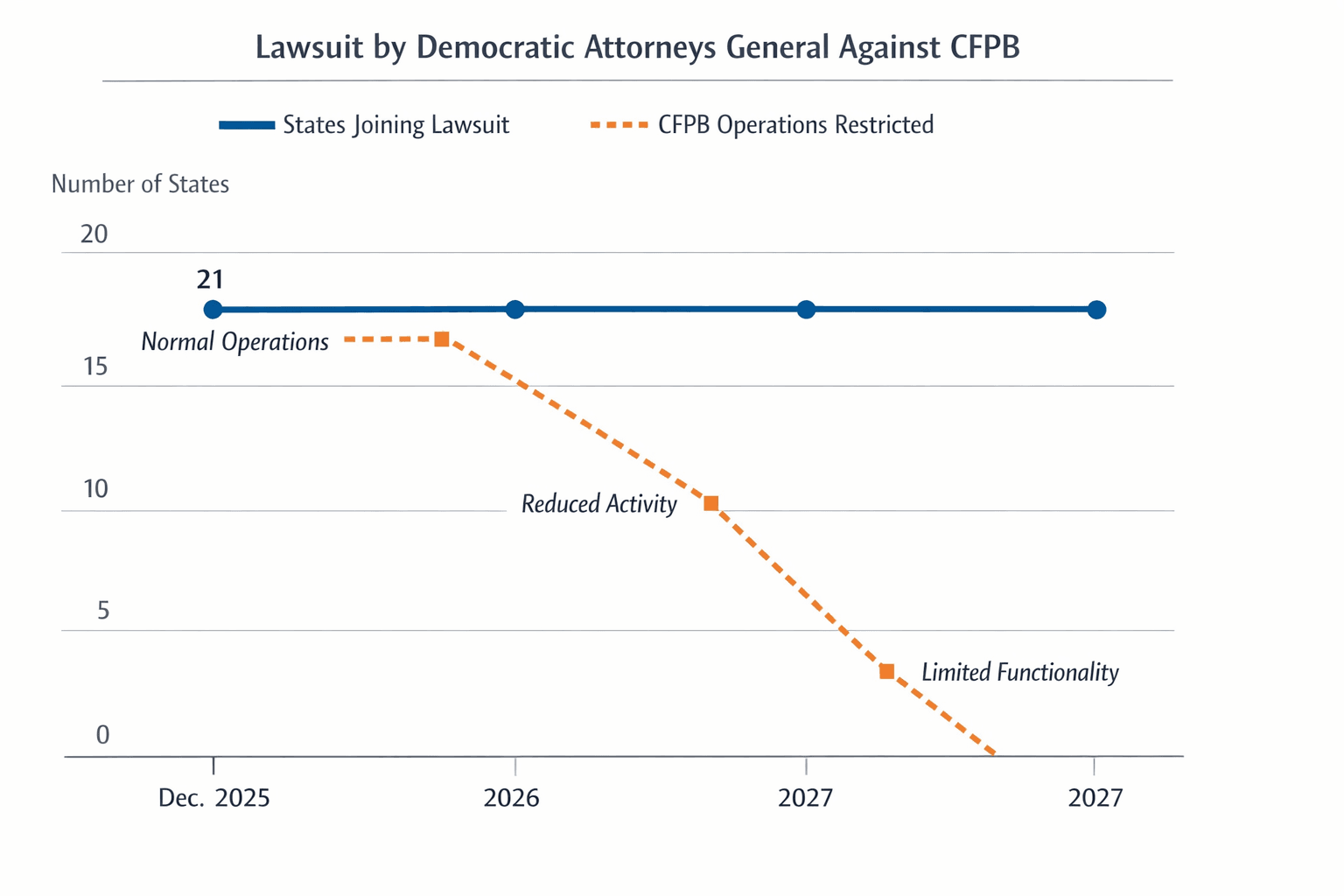
On December 23, 2025, a coalition of 21 state attorneys general led publicly by New York Attorney General Letitia James filed a federal lawsuit against the Consumer Financial Protection Bureau and its director, Russell Vought, challenging an effort by the White House to withhold funding from the bureau. The complaint asserts that the administration lacks authority to effectively defund an agency that Congress lawfully created, and that curtailing the bureau’s operations prevents it from meeting statutory obligations that states rely on.
The suit names as plaintiffs the attorneys general of Arizona, California, Colorado, Connecticut, Delaware, Hawaii, Illinois, Maine, Maryland, Massachusetts, Michigan, Minnesota, Nevada, New Jersey, New Mexico, North Carolina, Oregon, Rhode Island, Vermont, Wisconsin, and the District of Columbia, joined by New York. The complaint emphasizes that the CFPB is required by statute to collect and share consumer complaint information with state authorities, information the attorneys general say they depend on to detect fraud and protect residents.
“My office and attorneys general across the country rely on the CFPB for consumer complaints and other data to get justice for consumers,” Attorney General James said at a press conference announcing the filing, characterizing the administration’s action as “a handout to those who drive up costs by cheating hardworking Americans.” California Attorney General Rob Bonta added, “We’re asking the court to order the Consumer Financial Protection Bureau to seek available funding and do its job.”
The litigation arrives amid an unsettled appellate landscape. In August, a three judge panel at the U.S. Court of Appeals cleared the way for the administration and the bureau’s director to press efforts to limit or halt the agency’s operations, but that panel stayed its ruling pending review. The D.C. Court of Appeals has agreed to hear the case en banc, an uncommon step that signals broad judicial interest, with the full court scheduled to convene in late February.
Legal scholars and state officials frame the lawsuit as a test of constitutional limits on executive power to selectively withhold funding from independent agencies. For state attorneys general, the practical stakes are immediate. The CFPB’s complaint database and consumer reports feed state investigations into predatory lending, unlawful debt collection, and other schemes that disproportionately harm low income communities, communities of color, and people in precarious health.
Public health and social equity advocates say the dispute goes beyond administrative law. Financial abuse and unchecked consumer fraud can force families into medical debt, disrupt access to care, and exacerbate chronic disease by diverting resources from housing and nutrition. Limiting the CFPB’s capacity to gather and share data with states could hamper local enforcement at a moment when economic strain is already deepening health inequities.
The CFPB, the Office of Management and Budget, and the White House did not respond to requests for comment. The case now moves into federal court where its outcome could reshape the balance between presidential control of budgets and Congress’s power to create and fund independent watchdogs that safeguard consumers and vulnerable communities.
This article was produced by Prism’s automated news system from verified source data, official records, and press releases, then run through automated quality and moderation checks before publishing. The system is built and supervised by the people who set the standards it runs under. Read our full AI policy.
Did this article answer your question?

