Disneyland Paris Opens World of Frozen in Billion-Euro Park Transformation
Disneyland Paris opened its €2 billion World of Frozen Sunday, capping a park transformation that promises 1,000 jobs and tickets at roughly half the price of a day at Disney World.

Thirty-four years after Euro Disney opened to ridicule in the French press and half-empty hotel corridors, Emmanuel Macron stood inside Disneyland Paris and declared it "the leading tourist destination in Europe." The occasion was the public debut of Disney Adventure World and its centerpiece, World of Frozen: the culmination of a €2 billion ($2.18 billion) bet that a Norse fairy-tale village in Marne-la-Vallée can anchor France's claim on continental tourism.
The new land transforms what was formerly the Walt Disney Studios Park, which opened in 2002. More than 90% of the park's guest offerings have been redesigned since its original debut, and the park's footprint will have roughly doubled upon the completion of its full transformation. At the heart of the overhaul sits an immersive Arendelle environment: a wooden Nordic village surrounding a lagoon, the Frozen Ever After boat ride, and character encounters with Anna and Elsa. A new Tangled attraction, roughly 15 dining locations, a 7.5-acre central lake, and a nighttime spectacular billed as the world's first combined aquatic-and-aerial drone show complete the transformation.
For Disney, the economics of the bet are deliberate. The €2 billion commitment is part of a broader $60 billion global parks-and-experiences expansion, a strategy built on the conviction that IP-driven lands raise average guest spending and lengthen stays. The expansion was supported by nearly 400 suppliers, 82% of them French or European, and will create more than 1,000 new direct jobs. The resort already supports roughly 70,000 positions and has drawn 445 million cumulative visitors since 1992. The old Walt Disney Studios Park was widely regarded as a half-day diversion; Disney Adventure World is designed to capture a full day of spending.
For American travelers weighing Paris against Orlando, the price difference is striking. In the lowest-demand windows, one-day, one-park adult prices at Disneyland Paris run around €50 to €60, roughly $60 to $72. On the busiest dates, the same basic ticket can climb well past €100. A two-park ticket in Paris adds just $37 for the second park, while Disney World's Park Hopper ticket in Orlando costs between $280 and $380 per person per day. A round-trip commuter rail journey on the RER A from central Paris to Chessy runs roughly €8 to €10 per person, making a Frozen-themed day in Marne-la-Vallée substantially cheaper than an equivalent visit in Florida. The offset, predictably, is the transatlantic flight: a family of four from New York to Paris runs approximately $2,794, compared with $786 to Orlando.
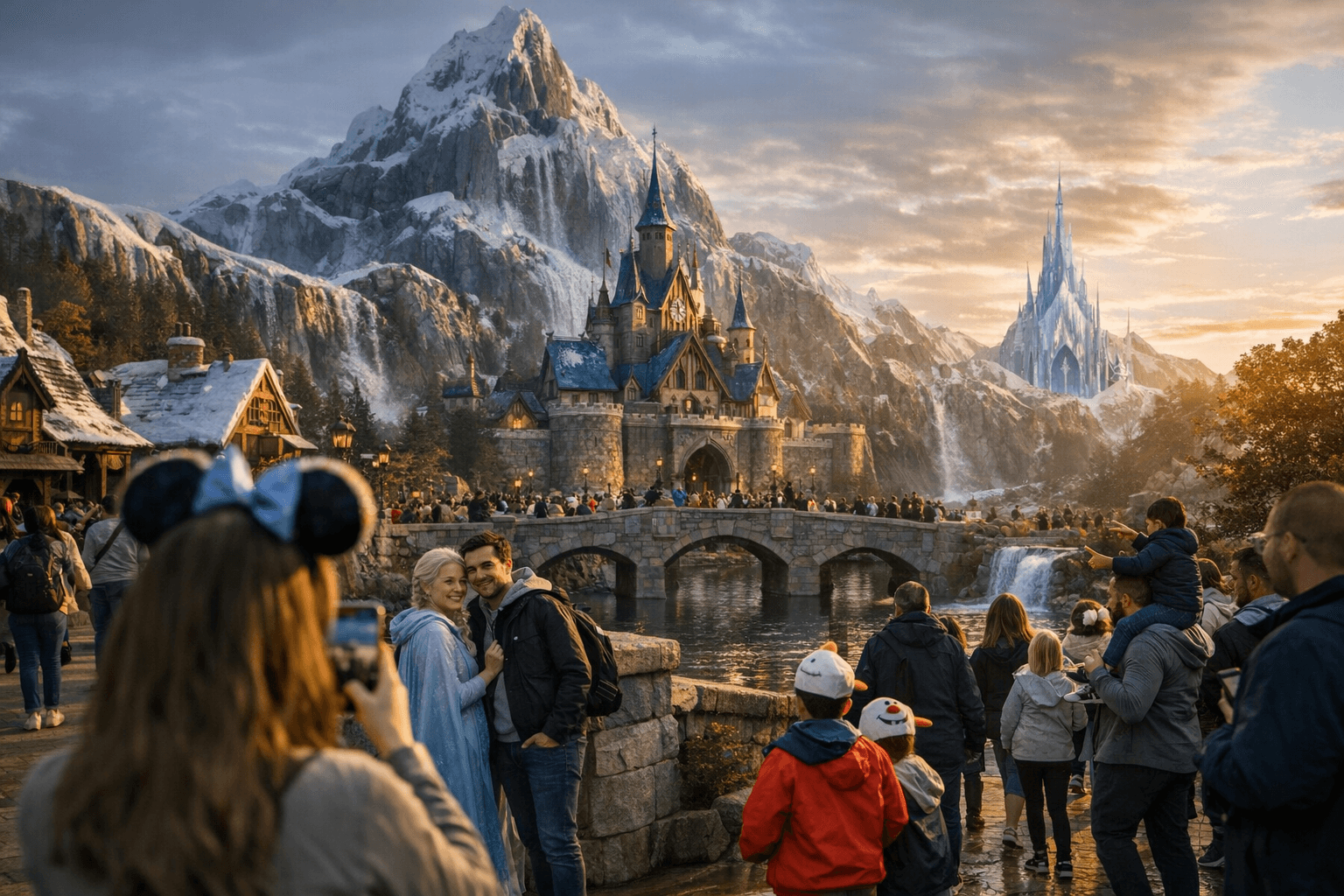
The cultural logic behind the investment is deliberately local. "'Frozen' has its roots in European storytelling," said Michel den Dulk, vice president and creative director at Walt Disney Imagineering. "To have a northern European, charming wooden little village here in Disneyland Paris just made sense." Disney has pointed to Frozen's loose origins in the work of Danish author Hans Christian Andersen as a way to make the Arendelle land feel rooted in the continent it was built for, rather than simply transplanted from its American parent.
Competing European theme parks will watch the experiment closely. The aquatic-and-drone nighttime spectacular also functions as a global prototype: if it draws audiences at scale in Marne-la-Vallée, the format becomes a candidate for deployment at Disney parks worldwide. For a resort that spent its first decade fighting the perception that America had exported a cultural intrusion onto French soil, that is a substantial reversal of fortune.
This article was produced by Prism’s automated news system from verified source data, official records, and press releases, then run through automated quality and moderation checks before publishing. The system is built and supervised by the people who set the standards it runs under. Read our full AI policy.
Did this article answer your question?