DOL and IRS Clarify Worker Classification Guidance Implications for Nintendo Employers
DOL rescinded the 2021 independent contractor rule and returned to a totality-of-the-circumstances test, a change that affects Nintendo employers and contract workers' classification and liability.

A federal policy shift is forcing companies that hire freelancers and contractors to reassess who should be treated as an employee. The Department of Labor’s Wage and Hour Division announced a final rule that rescinds the 2021 Independent Contractor Rule and restores the long-standing economic reality test used to determine whether a worker is an employee under the Fair Labor Standards Act.
“This final rule, announced on January 9, 2024, revises the Department’s guidance on how to analyze who is an employee or independent contractor under the Fair Labor Standards Act (FLSA). Specifically, the final rule rescinds the 2021 Independent Contractor Rule that was published on January 7, 2021 and replaces it with guidance for how to analyze employee or independent contractor classification that is more consistent with the FLSA as interpreted by longstanding judicial precedent. The Department believes that this final rule will reduce the risk that employees are misclassified as independent contractors, while at the same time providing greater consistency for businesses that engage (or wish to engage) with individuals who are in business for themselves.”
The Federal Register commentary framed the change as a return to a “totality-of-the-circumstances analysis” in which economic reality factors “are not assigned a predetermined weight and each factor is given full consideration.” The department said this approach aligns with decades of appellate case law and the Act’s text and purpose, and that it will provide more consistent guidance to employers and workers on whether a worker is economically dependent on an employer or in business for themselves.
Tax and administrative guidance from other federal actors remains consequential for employers. Industry guides reference an IRS 20-point checklist to assess classification, noting that “All of these factors—broken into more detailed points— make up the 20-point IRS checklist that you’ll find at the end of this guide.” The guide also cautions, “This checklist aligns with the IRS guidance for determining employee/contractor status. It isn’t a substitute for legal advice but rather a resource to enhance your understanding of worker classification.” Sample checklist items include whether “The worker can make a profit or suffer a loss as a result of the work, aside from the money earned from the project (5 points)” and whether “The worker has invested in the equipment and facilities used to do the work (5 points).”
Employers and workers have administrative options. “Workers and employers may file Form SS-8 with the IRS, permitting the IRS to make a decision, which may be either binding or nonbinding (depending on the decision of the IRS). Obtaining the view of the IRS assists businesses in obtaining certainty with respect to classification.” Companies that discover misclassification can consider the Voluntary Classification Settlement Program. “Voluntary Classification Settlement Program (VCSP) allows businesses to voluntarily reclassify workers as employees for future tax periods. If eligible, businesses can benefit from significantly reduced penalties and avoid audits related to past misclassifications.” Plantemoran and other advisers warn that “the Department of Labor (DOL) and the Internal Revenue Service (IRS) have been diligent in monitoring and auditing businesses for compliance with proper worker classification. Misclassification lawsuits, like class-action suits, can result in significant financial and reputational damages.”
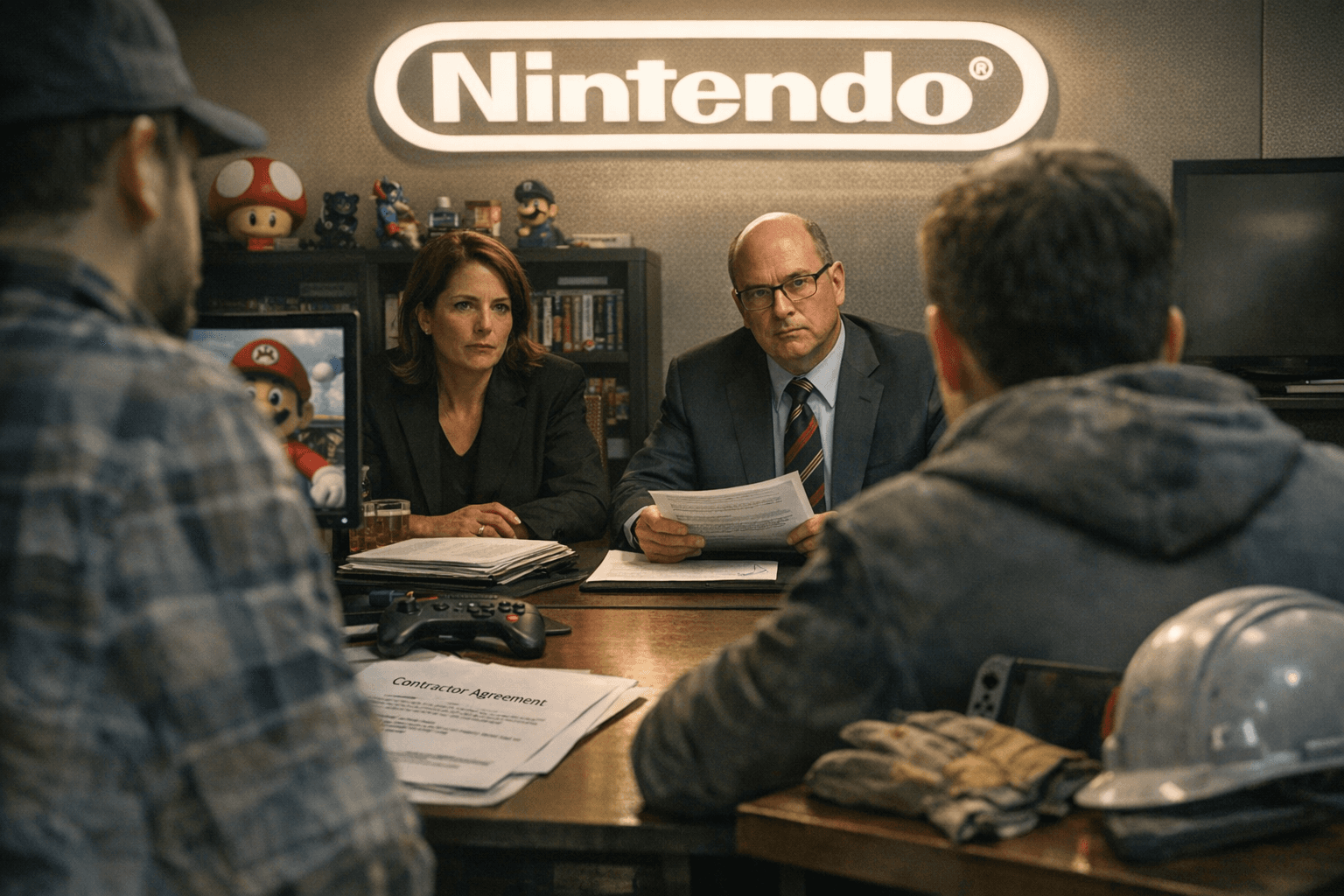
Practical steps recommended by advisers for employers include a careful roster review and outside counsel. Solvehr advises: “Review Your Rosters: Look at your current independent contractors. If you are controlling their hours, providing equipment, or training them, they may actually fit the W2 employee definition.” It also recommends filing Form SS-8 for unclear cases and considering the VCSP when misclassification is found.
Nintendo employers should treat the change as a compliance and workplace dynamic issue: teams that centrally schedule, train, or supply equipment to off-payroll workers may need to shift roles, payroll, and benefits to avoid back taxes, penalties, and litigation. The DOL lists multiple guidance tools, including Fact Sheets and employer resources, and the Wage and Hour Division can be contacted at: Wage and Hour Division, An agency within the U.S. Department of Labor, 200 Constitution Ave NW, Washington, DC 20210, 1-866-4-US-WAGE 1-866-487-9243.
For Nintendo managers and in-house HR, the immediate priorities are to inventory contractor roles, document degree of control and business independence, and consult tax and labor counsel. With both enforcement agencies signaling scrutiny, classification decisions will shape payroll costs, worker protections, and how the company structures freelance and contract work going forward.
Know something we missed? Have a correction or additional information?
Submit a Tip