Dollar drops to one-week low as tariff threats roil markets
The dollar slid to a one-week low as tariff threats and geopolitical uncertainty boosted safe-haven demand. Swiss franc, yen and gold rose while equities declined.

The U.S. dollar slipped to its weakest level in about a week as investors shifted into safe-haven assets after President Donald Trump threatened steep tariffs on eight European countries tied to a dispute over Greenland. The U.S. Dollar Index traded around the 99.11–99.18 range, down roughly 0.20% in early trading, while the franc and yen strengthened and precious metals pushed higher.
Over the weekend, Trump posted on Truth Social that the United States would impose a 10% import tariff from Feb. 1 on Denmark, Germany, France, the United Kingdom, Sweden, Norway, the Netherlands and Finland unless “a deal is reached for the complete and total purchase of Greenland.” He added the tariff would rise to 25% from June 1 if no agreement is reached and argued Greenland was strategically vital, saying there is “not a thing” Denmark can do about it in one report. Markets interpreted the move as a renewed use of tariffs as a policy weapon, reviving fears of a broader trade confrontation with Europe.
Currency markets reflected risk aversion. USD/CHF traded near 0.7975 in one set of quotes and around 0.7993 in others, down between roughly 0.36% and 0.70% on the day. The dollar was quoted near 157.74 yen in another report. Gold and silver rose to fresh highs as investors sought stores of value, while most equity indexes fell amid the spike in geopolitical and trade tensions.
European governments reacted sharply. A joint statement from the eight affected countries said, “Tariff threats undermine transatlantic relations and risk a dangerous downward spiral.” French officials proposed a range of economic countermeasures, and German Foreign Minister Johann Wadephul said, “I don't believe that this agreement is possible in the current situation.” Officials warned the tariff threat could imperil a U.S.-EU trade deal signed last year and complicate already fragile diplomatic ties.
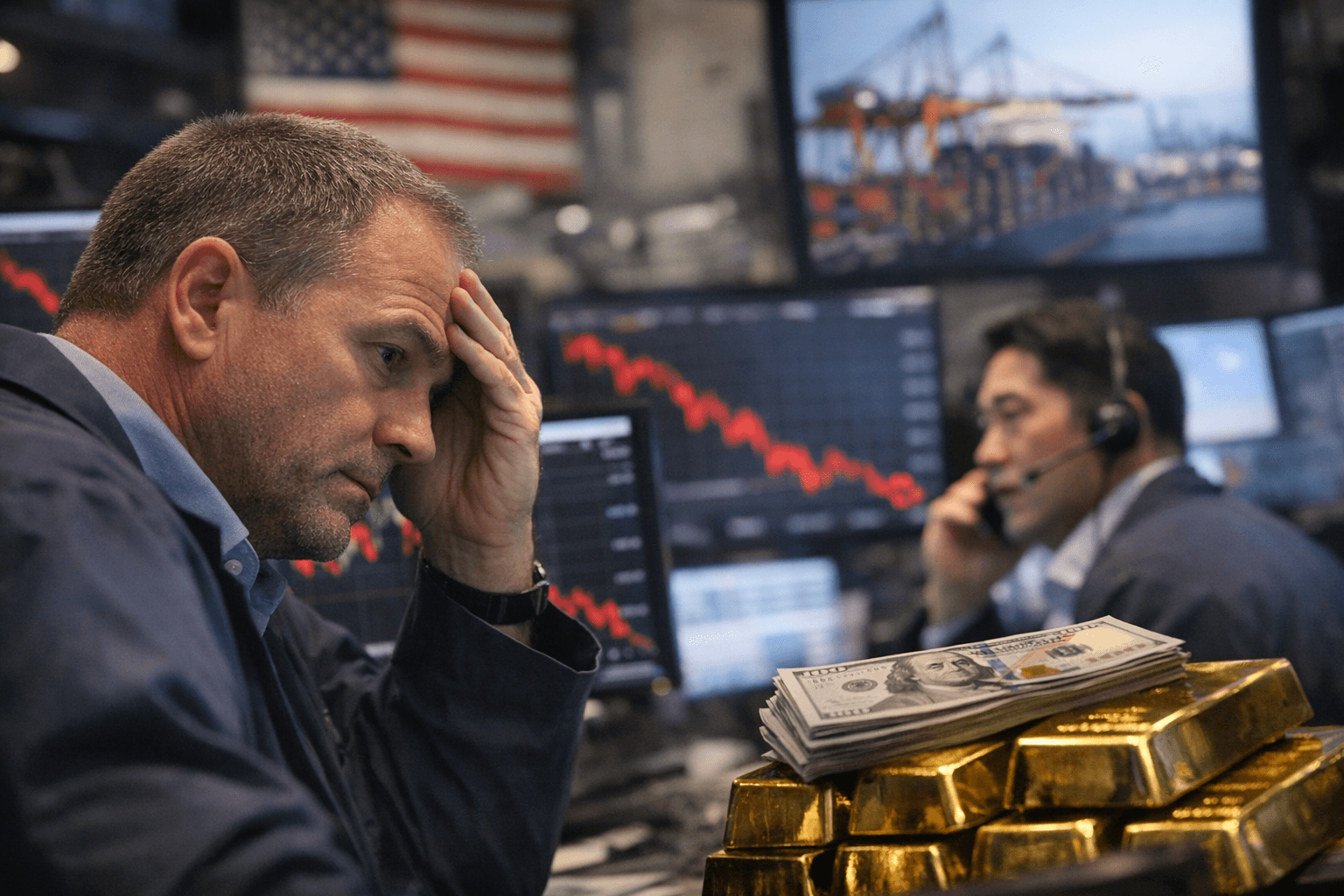
Analysts said the dollar’s weakness stemmed less from outsized gains in European currencies than from elevated policy uncertainty originating in Washington. Khoon Goh, head of Asia research at ANZ, noted that “tariff threats and policy uncertainty have tended to drive dollar weakness and safe‑haven demand in past episodes, including after last April’s ‘Liberation Day’ tariff announcements that triggered a crisis of confidence in U.S. assets.” Market participants described the moves as reviving a “sell America” dynamic that squeezes demand for U.S. assets when policy unpredictability rises.
Liquidity factors could amplify moves later in the week. U.S. markets were closed Monday for Martin Luther King Jr. Day, and attention is set to return to a slate of U.S. data that includes delayed Personal Consumption Expenditures inflation figures and the annualized third-quarter GDP estimate, both due Thursday, followed by preliminary purchasing managers indexes and the University of Michigan consumer sentiment reading on Friday. Swiss producer and import price data were also flagged as a watchpoint for safe-haven demand.
The near-term outlook hinges on whether the tariff threats lead to reciprocal measures or a rapid de-escalation. If tensions persist, analysts say the dollar could face continued pressure as investors rotate into francs, yen and precious metals, while equity market volatility and commodity price swings feed through to global growth and trade forecasts.
This article was produced by Prism’s automated news system from verified source data, official records, and press releases, then run through automated quality and moderation checks before publishing. The system is built and supervised by the people who set the standards it runs under. Read our full AI policy.
Did this article answer your question?

