Don’t let an old money judgment surprise you, renewal deadlines matter
An old judgment can still be enforced if it is renewed on time. In California, renewal can extend collection rights for another 10 years and keep interest running on unpaid principal.
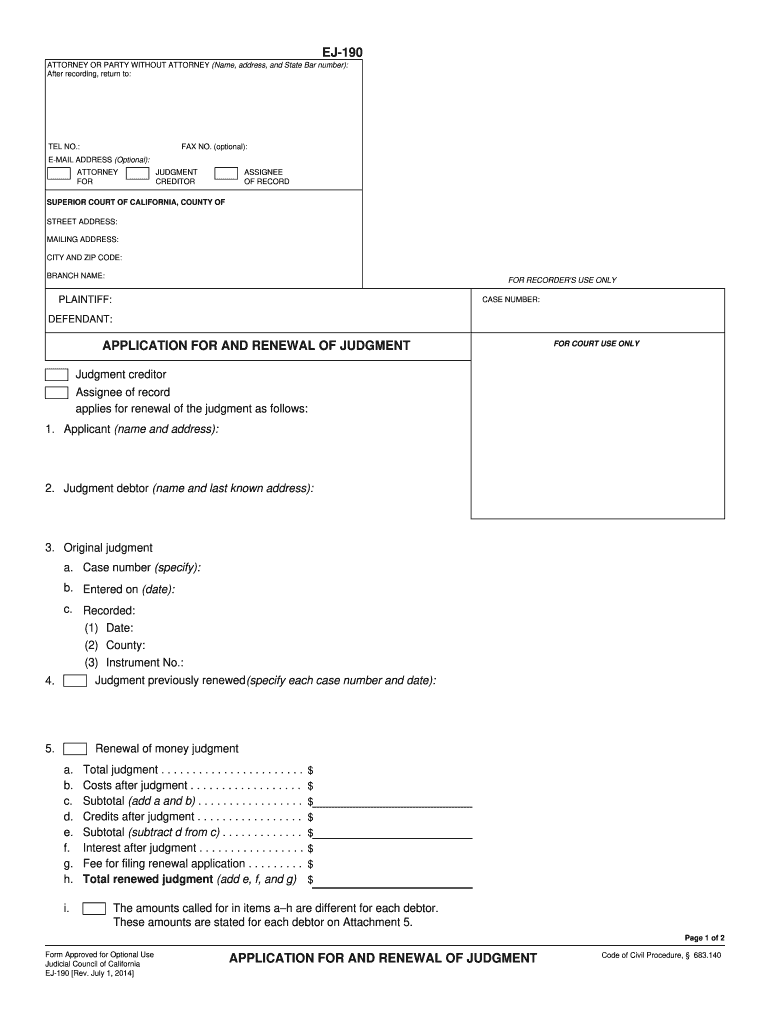
Form EJ-190 can keep a California money judgment alive for another decade if it is filed before the 10-year deadline. In California, a renewal can preserve the creditor’s ability to collect or enforce a money judgment for another decade.
How the 10-year clock works
A California money judgment expires after 10 years unless it is renewed. Under a March 13, 2020 checklist from the Superior Court of California, County of San Francisco, money judgments automatically expire after 10 years and are no longer enforceable once they expire, which means unpaid amounts cannot be collected after that point.
Timing matters before the deadline arrives. An application for renewal of judgment, form EJ-190, can be filed after a judgment is 5 years old and before it is 10 years old, a rule effective January 1, 2024. CCP 683.020 is the statute referenced for the 10-year enforcement period, so the judgment date and any prior renewal date are the first numbers to check.
California’s current framework did not appear overnight. The Enforcement of Judgments Law was being developed in 1980 and became operative July 1, 1983.
Why renewal changes what a creditor can do
A renewal extends how long someone can collect or enforce the judgment, and during the renewed period any unpaid principal balance continues to collect interest. That means an unpaid balance can keep growing even while the case looks dormant from the debtor’s side.
A renewed judgment stays alive for collection tools that depend on an enforceable court order. After a writ of execution is obtained, money can be taken from a bank account through a bank levy, so allowing the judgment to expire can shut off that path entirely. The same basic logic applies to wage garnishment in states that permit it, because those remedies depend on a judgment that still has legal force.
How to check whether your state allows renewal
Do not assume your state follows California’s timeline. Many states give a money judgment a 10-year life, while others allow a shorter period. North Carolina is one example on the 10-year side: a judgment is valid for 10 years from the date it is awarded and can be renewed for another 10 years.
Maryland shows the other side of the state-by-state divide. In Maryland, debt collection time limits generally run 3 years, or 4 years for sale-of-goods debts, while the court usually does not collect the money for the winning party after a judgment is entered. Those are different concepts, so it is important not to confuse a debt collection deadline with the lifespan of a judgment itself.
To check your own state, use the court’s self-help page, the statute in your state code, or the clerk’s office that handles judgment records. Look for three pieces of information: the length of the enforcement period, whether renewal is allowed, and the deadline for filing the renewal before expiration.
A practical roadmap before the deadline passes
1. Find the judgment date and any renewal dates.
The original entry date usually controls when the enforcement clock starts, and a prior renewal can reset the calendar.
2. Confirm the state rule, not just the debt rule.
A state may have one limit for collecting an unpaid consumer debt and another rule for enforcing a court judgment.
3. If you are the creditor, file the renewal before the deadline.
In California, that means watching the 5-year to 10-year window for EJ-190 and making sure the filing happens before the judgment expires.
4. If you are the debtor, watch for renewed enforcement activity.
A renewed judgment can reopen collection efforts tied to wages, bank accounts, or other assets, and unpaid principal can keep accruing interest during the renewal period in California.
5. If the deadline is close, act before the judgment expires.
Once expiration hits, the creditor loses the ability to collect unpaid judgment amounts unless renewal was completed on time.
Why lawmakers keep revisiting judgment rules
California’s renewal system has also been part of broader policy debate. In a California Senate Judiciary Committee analysis of SB 1200, the proposal would have restricted renewal of money judgments to those tied to a lien and reduced the interest rate on certain outstanding money judgments.
This article was produced by Prism’s automated news system from verified source data, official records, and press releases, then run through automated quality and moderation checks before publishing. The system is built and supervised by the people who set the standards it runs under. Read our full AI policy.
Did this article answer your question?