DR Congo’s leopard-print suits celebrate World Cup return and national pride
DR Congo's leopard-print arrival suits turned a World Cup return into a cultural statement, linking Sape style, diaspora pride and a 52-year wait.

The Democratic Republic of the Congo walked into the World Cup in more than a suit. Black tailoring with leopard-print panels, gold lapel pins, white shirts, black ties and polished shoes turned the team’s arrival into a declaration of identity, one that linked fashion to national pride, diaspora visibility and a long-awaited return to football’s biggest stage.
A look designed to say something bigger
The outfits were created by Congolese designer Alvin Junior Mak of JMAKxPARIS and built around asymmetric leopard-print panels that cut across sharp black suits. The styling was deliberate from head to toe: gold lapel pins added polish, while the white shirts and black ties kept the silhouette formal and controlled, giving the animal-print details even more force.
The choice of leopard imagery was not decorative excess. It was designed as a tribute to the Congolese Sape tradition, the elegant, self-conscious fashion culture that has long treated dress as a form of social expression and pride. In that sense, the arrival suits did what great tournament fashion often does: they made a football team into a visual symbol before a ball had even been kicked.
A return 52 years in the making
For DR Congo, the clothing carried historical weight because it accompanied a World Cup return 52 years after the nation’s last appearance. This is only the country’s second World Cup, and the gap stretches back to 1974, when Zaire became the first sub-Saharan African nation to qualify for the FIFA World Cup.
That earlier milestone still matters because it placed Congolese football in a broader continental story. The team’s current return is not just a sporting achievement, but a restoration of visibility after decades away from the tournament. In that context, the suits read like an announcement that the country is back on the world stage and intends to be seen on its own terms.
Why the leopard matters
Mak has said the leopard spirit in Congolese culture symbolizes strength, and that message sits at the center of the design. The animal motif also connects neatly to the team’s nickname, the Leopards, giving the outfit a direct line from cultural symbolism to football identity.
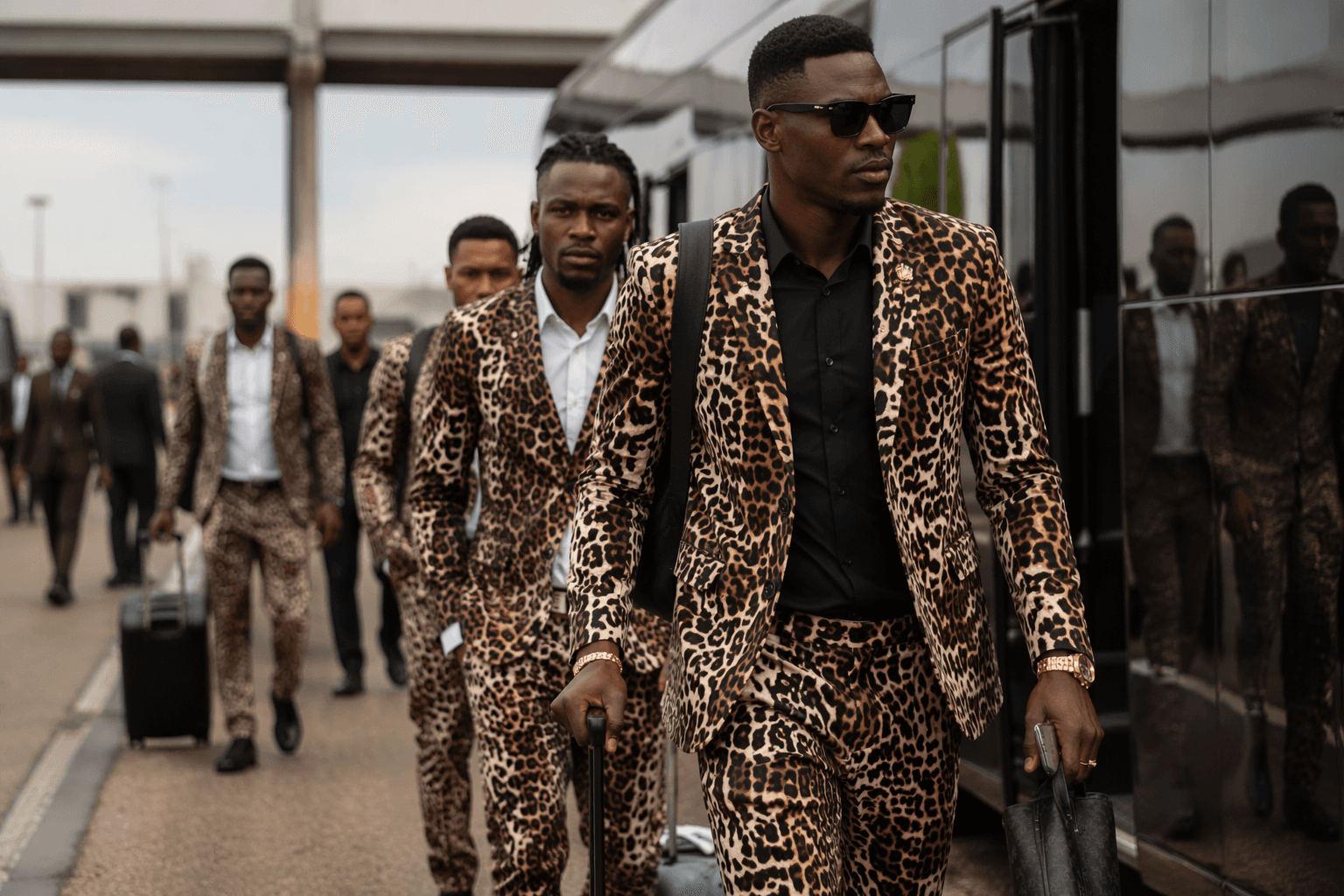
That matters because national teams often borrow power from images that already live in the public imagination. Here, the leopard print does not just decorate the squad; it reinforces a larger story about resilience, confidence and self-presentation. The visual language is bold because the moment itself is bold: a team from Kinshasa arriving in Houston after ending a 52-year absence from the World Cup.
From Kinshasa to Houston, and onto the timeline
The arrival in Houston was quickly noticed online, where the suits became part of the pre-tournament conversation before the first match was played. The attention reflected more than appreciation for good tailoring. It showed how modern tournament fashion travels instantly, especially when it carries clear cultural codes that are easy to recognize and share.
That online response also reveals something important about African design at major global events. When a national team brings a distinct aesthetic to a tournament hosted across the United States, Mexico and Canada, it reaches audiences far beyond the stadium. For DR Congo, the look became an early example of how African style can command attention on a global stage, not as an accessory to football, but as part of the competition’s narrative.
More than a uniform, a national statement
DR Congo are one of ten African nations at the 2026 FIFA World Cup, and their arrival clothes helped set them apart within that group. In a tournament field crowded with sporting ambition, the black-and-leopard ensemble gave the team a recognisable visual identity before kickoff, tying together memory, pride and contemporary design.
That is why the outfit resonated so widely. It connected the 1974 generation of Zaire’s breakthrough with today’s squad, while also speaking to the Congolese diaspora and to viewers who understand fashion as a language of belonging. The result is a rare kind of pre-match impact: a national team return that is being read not only through results and qualification, but through style, symbolism and cultural power.
For DR Congo, the World Cup is now a football story and a fashion story at the same time. The leopard-print suits do more than mark an arrival in Houston. They announce a country determined to be seen again, and to be remembered on its own terms.
This article was produced by Prism’s automated news system from verified source data, official records, and press releases, then run through automated quality and moderation checks before publishing. The system is built and supervised by the people who set the standards it runs under. Read our full AI policy.
Did this article answer your question?