Dubai Property Market Shows Early Weakness as Middle East Conflict Dampens Investment
Emaar Properties shares fell over 26% and transaction values halved in early March as the U.S.-Israeli war on Iran pierced Dubai's safe-haven reputation.
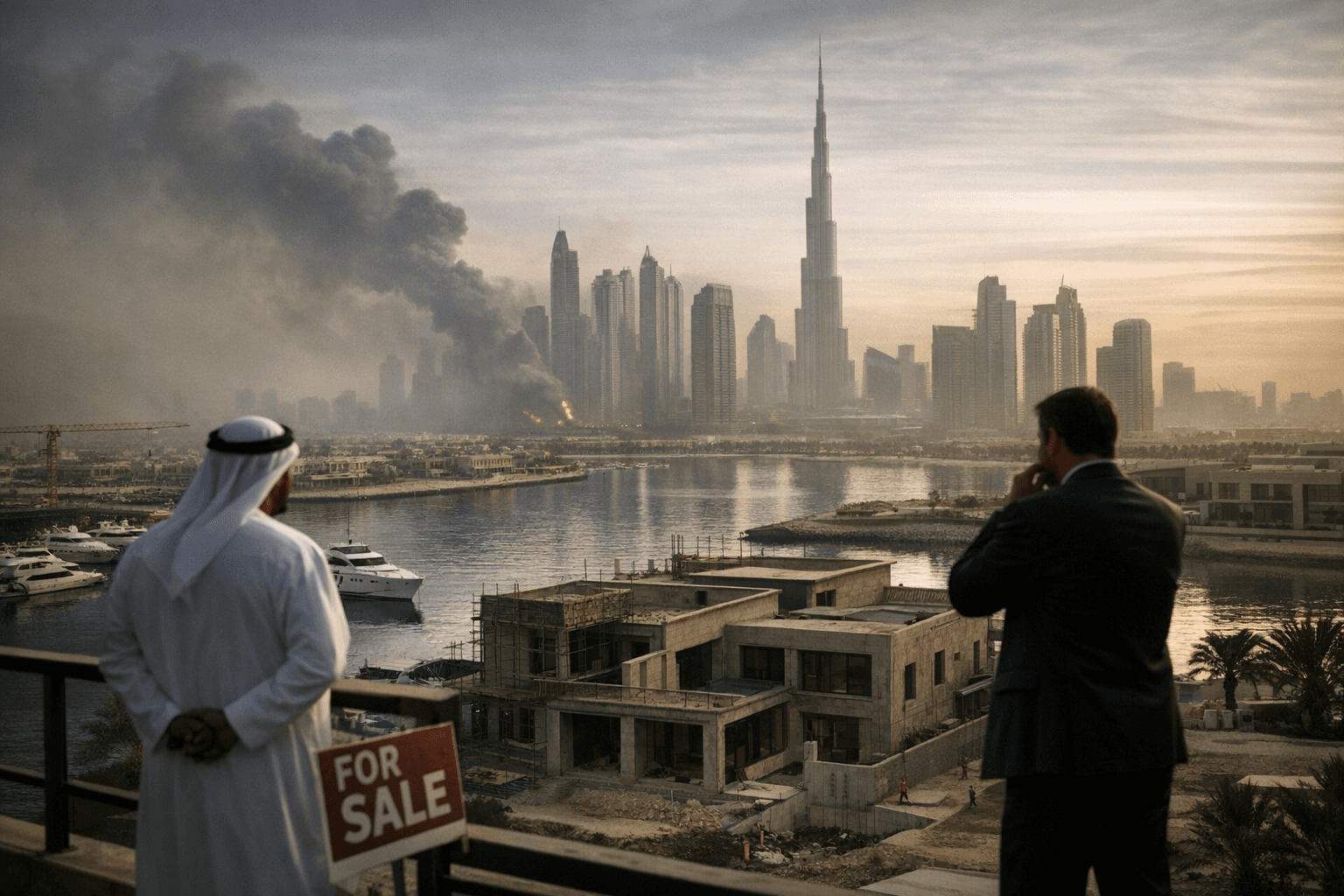
Iranian strikes on Gulf states including the UAE have cracked Dubai's carefully cultivated image as a refuge for the world's wealthy, with Goldman Sachs data showing the total value of completed property transactions fell by half in early March compared with February. That decline, measured through mid-month, was larger than the market absorbed during the 2024 Dubai floods or the Iran-Israeli flare-up last June.
Shares in Emaar Properties, the developer behind the Burj Khalifa, fell more than 26% on the Dubai bourse since the war began, the most visible financial signal of how deeply the conflict has rattled investor confidence in one of the region's most closely watched real estate markets.

Goldman Sachs noted the median transacted price was down only 3% on a year earlier, suggesting sellers have not yet capitulated on headline valuations even as activity has collapsed. That gap between stubborn asking prices and sliding volume is a tension playing out in real time. Emaar founder and Chair Mohamed Alabbar told CNBC this month that "nobody wants to budge" on price.

On the ground, some agents are reporting discounts of 12% to 15%, with one property near the Burj Khalifa listed at $650,000 after being offered at $735,000. An off-plan apartment on Palm Jumeirah was reportedly reduced to around $2 million. Those reductions remain anecdotal, but they are consistent with the behavior described by Himanshu Khandelwal, CEO of Dubai-based investment firm Asas Capital. "There are many investors who are calling us to ask if you have clients who want to sell at distress or anybody who sells at a discount, (and say) we're ready to buy it," Khandelwal said, identifying Emirati clients and Indian family offices as the buyers circling for bargains.
Analysts at Citi framed the longer-term risk in demographic terms. The war introduced "considerable risk" for Dubai's future population growth expectations, Citi said, cutting its assumption for this year to 1% and projecting annual growth of just 2% to 2.5% between 2027 and 2031. That compares with the roughly 4% annual population expansion Dubai recorded in recent years, which served as the underlying engine of housing demand across the market's boom period.
Not all segments are retreating equally. Developer Arada confirmed a sale of a circa-$25 million off-plan unit on Palm Jumeirah to former UFC heavyweight champion Francis Ngannou, saying the deal "underscores continued investor appetite for branded luxury residences in Dubai." The ultra-prime end of the market, anchored by trophy assets and brand cachet, has so far held a different profile than the broader transaction collapse suggests.
Whether that luxury resilience persists depends heavily on how the conflict evolves. Citi's bearish scenario projects annual price declines of up to 7%, a figure that would represent a sharp reversal after several years of price appreciation driven by an influx of wealthy buyers drawn to Dubai's tax advantages. The early March data, with its historically large month-on-month swing, indicates the market moved fast once sentiment shifted.
This article was produced by Prism’s automated news system from verified source data, official records, and press releases, then run through automated quality and moderation checks before publishing. The system is built and supervised by the people who set the standards it runs under. Read our full AI policy.
Did this article answer your question?

