Education scorecard finds U.S. learning decline began before pandemic
U.S. students were sliding before COVID-19, with a Harvard-linked scorecard dating the learning recession to 2013 and chronic absenteeism still dragging recovery.
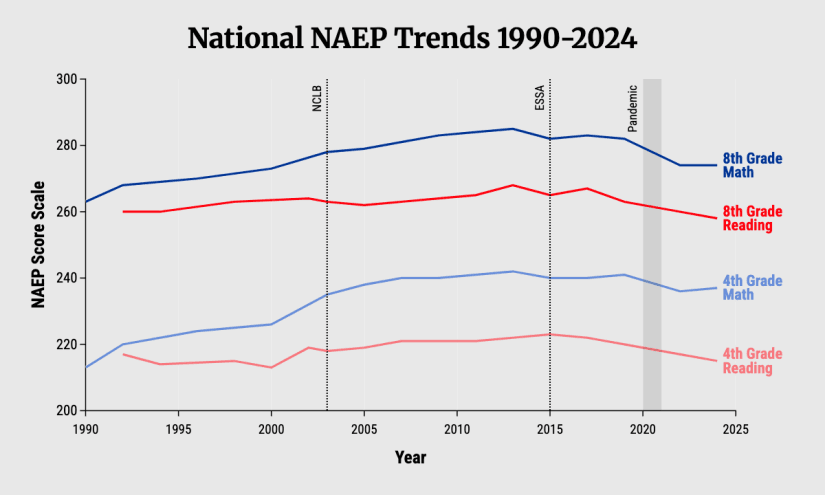
America’s learning decline did not start with school closures. A new Education Scorecard says the country entered a “learning recession” in 2013, years before the pandemic, as math and reading gains stalled and then reversed roughly two decades of progress.
The findings sharpen a growing argument inside education policy circles: the pandemic intensified a problem that was already compounding. The scorecard, which draws on Stanford Education Data Archive data covering roughly 35 million students in grades 3 through 8 from 2022 to 2025, bases this year’s results on data through the 2024-2025 school year. Researchers say the average annual loss in reading achievement during 2017 to 2019 was about as large as the loss during 2019 to 2022, a sign that the slide was already underway before COVID-19.
The pattern is not limited to one dataset. The National Center for Education Statistics reported that long-term trend scores for 13-year-olds fell 4 points in reading and 9 points in mathematics from the 2019-20 to 2022-23 assessments. Compared with a decade earlier, the declines were 7 points in reading and 14 points in math. NAEP’s 2024 grade 4 and grade 8 results also showed continued reading declines and only limited improvement in math, reinforcing the picture of a nationwide slowdown rather than a brief pandemic-only shock.
Attendance remains one of the biggest barriers to recovery. The U.S. Department of Education defines chronic absenteeism as missing 10% or more of school days, and a 2024 analysis put national chronic absenteeism at 23.5%. Another 2025 analysis found that in roughly half of urban school districts, more than 30% of students were chronically absent in the 2024-2025 school year. Missing that much class time has been closely tied to weaker academic performance, and education leaders say it has blunted gains even where districts have reopened and stabilized staffing.
There are, however, some early signs of improvement in literacy. The scorecard points to a link between “science of reading” policies and the first signs of a turnaround, suggesting that curriculum changes and early-grade instruction reforms may be starting to matter. Even so, the recovery has been uneven. The Education Recovery Scorecard found that middle-income districts have lagged while high-income and low-income districts improved more quickly since 2022, leaving the center of the system stuck with the weakest rebound.
The broader message is stark: the learning recession is not a single post-pandemic hangover. It is a long-running failure shaped by absenteeism, instability, and unequal recovery, with the deepest losses still concentrated where students can least afford another year of drift.
This article was produced by Prism’s automated news system from verified source data, official records, and press releases, then run through automated quality and moderation checks before publishing. The system is built and supervised by the people who set the standards it runs under. Read our full AI policy.
Did this article answer your question?