Elon Musk's Terafab Chip Megafactory Plan Faces Investor and Industry Scrutiny
Tesla shares dropped 17% after Musk unveiled Terafab, a $20-$25B chip megafactory in Austin — and the full cost isn't even in Tesla's existing capital plan.
On the night of March 21, Elon Musk took the stage at Austin's Seaholm Historic Power Plant and announced the largest chip manufacturing project in history. He called it a necessity, not a choice: "We either build the Terafab or we don't have the chips, and we need the chips, so we build the Terafab." The market's initial answer came swiftly. Tesla shares dropped 17% post-announcement, signaling market skepticism over execution risks and capital strain amid declining revenue.
Terafab is a planned semiconductor fabrication plant jointly developed by Tesla, xAI, and parent company SpaceX, announced by Musk on March 21, 2026. The facility will be built on the North Campus of Giga Texas, adjacent to Tesla's existing Austin manufacturing base, and will consolidate every stage of semiconductor production under one roof: chip design, lithography, fabrication, memory production, advanced packaging, and testing. Musk clarified the structure in a post on X: "Terafab will technically be two fabs, each making only one chip design."
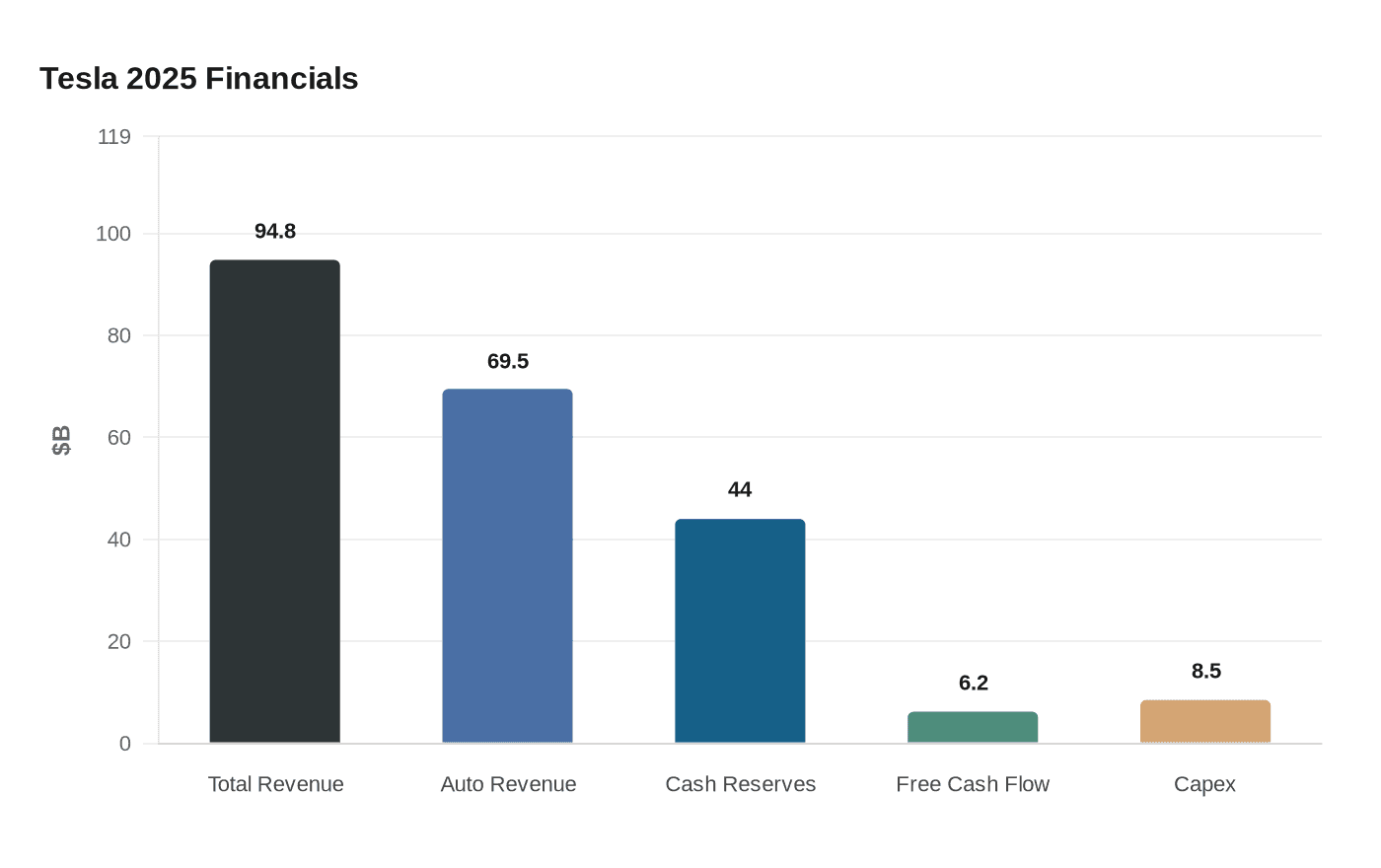
The financial exposure at the center of investor concern is stark. The project is estimated to cost between $20 and $25 billion, and Tesla's CFO confirmed at the event that this figure is not yet incorporated into Tesla's 2026 capital expenditure plan, which already exceeds $20 billion on its own. Tesla ended 2025 with $44 billion in cash, but its 2025 revenue declined 3% to $94.8 billion, with automotive revenue down 10% to $69.5 billion, and free cash flow of just $6.2 billion on $8.5 billion in capex. Morgan Stanley analyst Andrew Percoco, who carries a hold rating on the stock, called Terafab a "Herculean task" and estimated the full cost could run $35 to $40 billion, cautioning that even under an optimistic scenario the facility would not actually produce chips until 2028.
The production targets are extraordinary in scale. Terafab is designed for an initial output of 100,000 wafer starts per month, with ambitions to scale to 1 million wafer starts per month at full capacity, a figure that would represent roughly 70% of TSMC's entire current global output from a single facility. The goal is to manufacture chips that can support 100 to 200 gigawatts of computing power per year on Earth, along with a terawatt in space. The project targets 2-nanometer process technology and an initial output of 100,000 wafer starts per month.
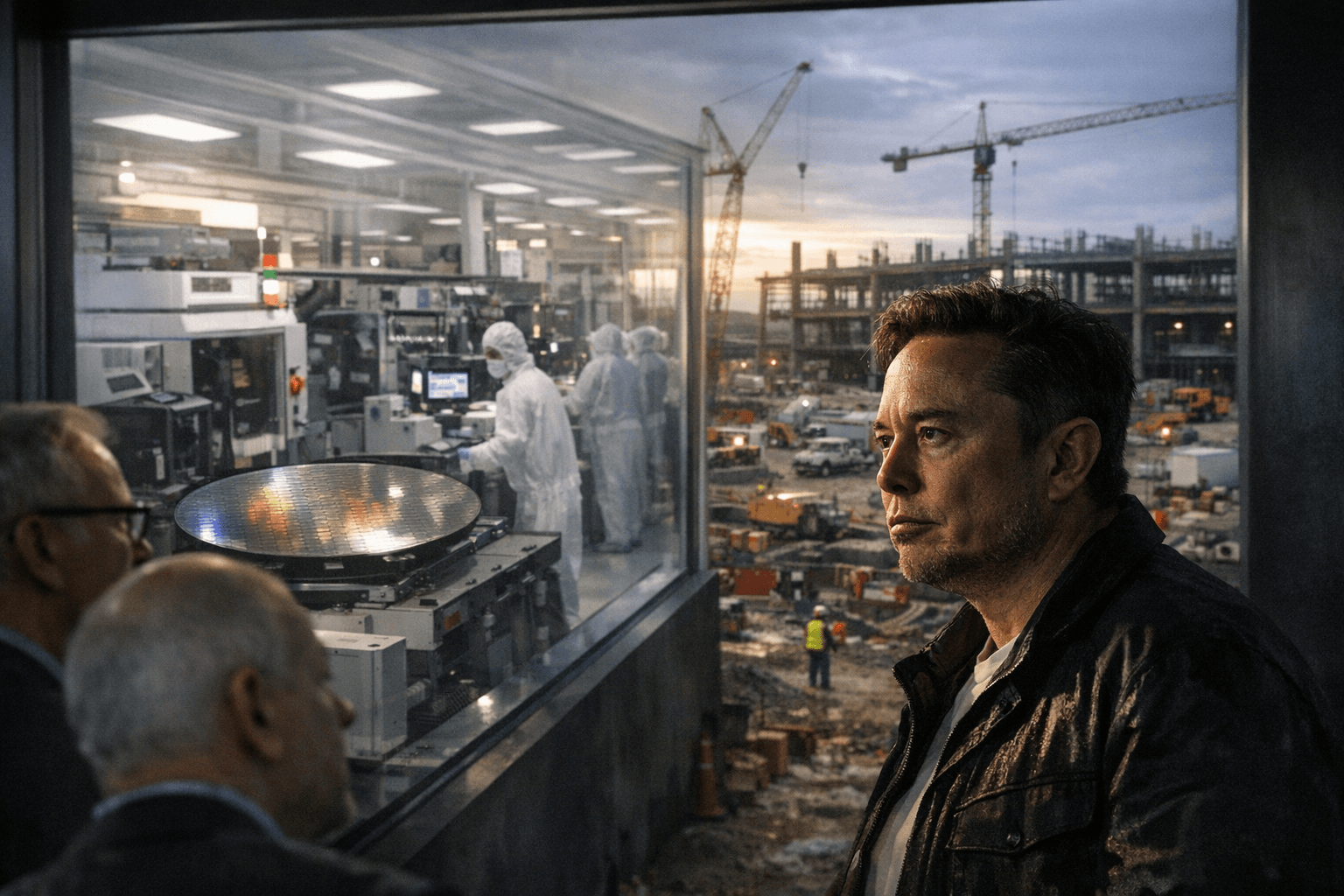
Terafab will produce two distinct chip families: the first, a terrestrial inference chip for Tesla's Full Self-Driving system, the Cybercab robotaxi programme, and the Optimus humanoid robot line, with Tesla's fifth-generation AI chip, AI5, among the first products targeted, with small-batch production in late 2026 and volume production in 2027. The second is the D3, a high-power, radiation-hardened processor built for operation in space. Musk said 80 percent of Terafab's compute output would flow to space-based applications, with 20 percent directed at terrestrial use.
The orbital ambition connects directly to the February 2026 SpaceX-xAI merger. The SpaceX acquisition of xAI closed in early February 2026, creating a combined entity valued around $1.25 trillion and formalizing Musk's consolidation of rockets, satellites, AI infrastructure, and data platforms. SpaceX separately filed an FCC application to launch a constellation of up to 1 million satellites to function as data centers in orbit. In that filing, SpaceX argued that "freed from the constraints of terrestrial deployment, within a few years the lowest cost to generate AI compute will be in space."
Skepticism about the orbital data center concept runs deep. Nick Del Deo, a senior research analyst at MoffettNathanson focused on digital infrastructure, acknowledged the concept of space-based data centers is "conceivable," but predicted it would take "many years before anything substantive happens." Industry observers have also drawn parallels to Musk's prior large-scale manufacturing pledges. In September 2020, Musk stood on a stage and promised a revolution in battery manufacturing with the 4680 cell, projecting a ramp to 10 GWh within a year and eventually 3 TWh by 2030. Five and a half years later, the 4680 program has been a disappointment.
Musk first flagged the chip supply problem on Tesla's January 2026 earnings call, telling investors that even in a best-case scenario for chip supply from existing partners, it still would not be enough to meet Tesla's needs within three to four years. Currently, TSMC is the only company to have achieved large-scale 2nm production, which required decades of development and significant R&D investment. Tesla has no confirmed process partner or confirmed equipment orders.
All eyes are now on Tesla's first-quarter 2026 results, scheduled for release on April 28. Whether Musk can follow Austin's theatrical light-show moment with concrete funding commitments, equipment orders, and a groundbreaking date will determine whether Terafab is remembered as a turning point in American semiconductor history or as another entry in a long ledger of ambitious promises.
This article was produced by Prism’s automated news system from verified source data, official records, and press releases, then run through automated quality and moderation checks before publishing. The system is built and supervised by the people who set the standards it runs under. Read our full AI policy.
Did this article answer your question?