Ethiopia votes in election overshadowed by conflict and Tigray exclusion
Polls opened as Tigray was left out entirely and fighting kept many Ethiopians from voting, exposing how little of the country could take part.
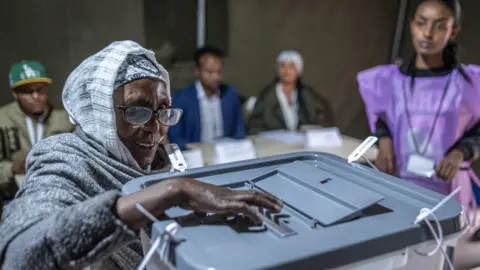
Polls opened in Ethiopia’s general election, but the vote was shaped less by competition than by exclusion. The entire northern region of Tigray was left out, insecurity kept many people from reaching ballot boxes, and Prime Minister Abiy Ahmed’s Prosperity Party was widely expected to dominate a contest that offered a narrow test of legitimacy.
The election was Ethiopia’s seventh since the end of military rule in 1991, but the basic promise of universal participation was badly fractured. Ethiopia’s voters choose the 547-member House of Peoples’ Representatives, and 274 seats are needed to form the next government for a five-year term. Abiy, 49, is not directly elected, but his party has become the central force in the system since he came to power in 2018 after anti-government protests and dissolved the old Ethiopian People’s Revolutionary Democratic Front, replacing it with the more centralized Prosperity Party.

The practical reality of the vote was far from national. Conflict and logistical failures meant many Ethiopians could not cast ballots, while Tigray was totally excluded. That exclusion carried heavy political weight in a country still scarred by the 2020-2022 war in Tigray, a conflict some estimates place at around 600,000 deaths. Violence in Amhara, Oromia and Benishangul-Gumuz also helped define the landscape around the polls, while Ethiopia’s relations with neighboring Eritrea were again described as dangerously fraught.
The last parliamentary election showed how uneven Ethiopian democracy has become. In 2021, 38,234,910 people were registered to vote and 1,817 candidates ran for seats. The Prosperity Party won 448 of the 547 seats in a delayed election held amid war in Tigray. Officials said voting could not be held in about a fifth of constituencies, 64 were pushed back to September 6, and Tigray’s 38 constituencies had no set date.
The political climate remains tightly constrained. Human Rights Watch said in 2025 that Ethiopian authorities had arbitrarily arrested journalists and media professionals, reinforcing long-running concerns about civil liberties, media restrictions and pressure on opponents. Abiy, once celebrated as a reformer and winner of the 2019 Nobel Peace Prize for ending the military stalemate with Eritrea, now faces criticism for suppressing dissent, forcing opponents into exile and arresting political rivals. In that context, the vote measured power more than participation, and the gap between constitutional process and democratic legitimacy remained wide.
This article was produced by Prism’s automated news system from verified source data, official records, and press releases, then run through automated quality and moderation checks before publishing. The system is built and supervised by the people who set the standards it runs under. Read our full AI policy.
Did this article answer your question?