Filament Guide for Hobbyists: Choosing Between PLA, PETG, ABS
Choosing PLA, PETG, or ABS affects print success and part performance; this guide explains trade-offs and practical tips for home and small-shop 3D printing.
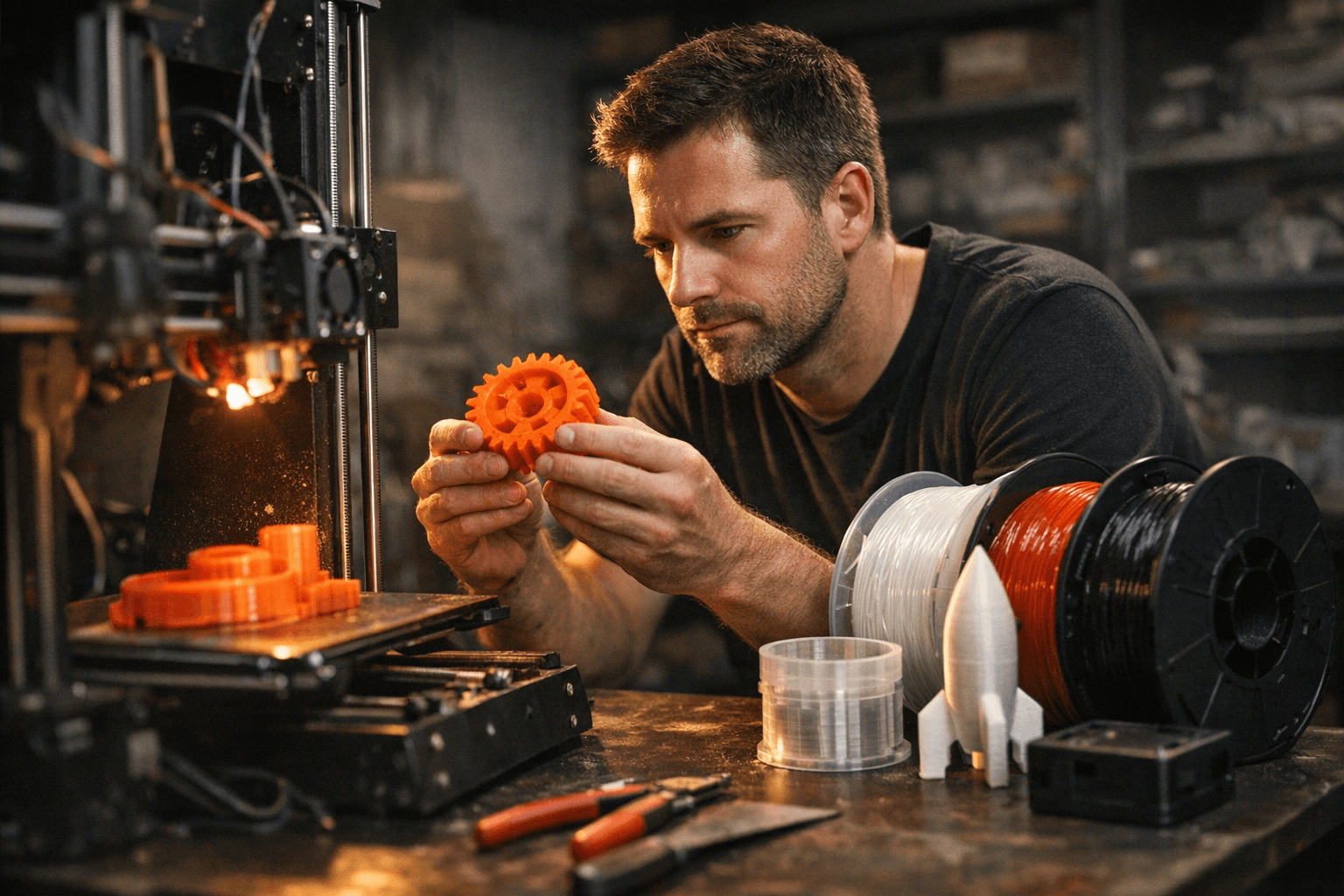
Choosing the right filament determines whether a part fails at the first layer or becomes a long‑lasting tool. PLA, PETG, and ABS each bring clear strengths and constraints for home and small‑shop projects, so match material to function before you fire up the printer.
PLA is the easiest filament to print and the best place to start for beginners and display parts. It prints at lower temperatures, has low warp, and is biodegradable, which makes it forgiving for intricate models and visual prototypes. If you prioritize dimensional accuracy with minimal fuss, PLA will get you consistent results with basic bed adhesion and minimal cooling fine‑tuning.
PETG is the natural next step when you need toughness and chemical resistance for functional prints. It prints hotter than PLA and benefits from slower cooling to avoid layer bonding issues. Expect more stringing and tacky behavior than with PLA, so tune retraction and print speed. PETG is robust for parts that see regular handling or exposure to mild chemicals, but it rewards careful calibration.
ABS offers higher temperature resistance and toughness suited to end‑use parts that face heat or rough use. ABS is more demanding: it needs good bed adhesion strategies, suffers more warping on large flat surfaces, and often requires higher bed and ambient temperatures. ABS also emits fumes, so use an enclosed build chamber and ensure good ventilation when printing.
Practical shop tips cut across all three materials. Dry filament to prevent bubbling and brittle prints—this matters most for PETG, ABS, and hygroscopic nylons. Use a brim or raft for large flat parts prone to warping, and spend time calibrating first‑layer height and extrusion multiplier for reliable layers and proper tolerances. Store filament in sealed containers with desiccant to maintain printability between projects.
For community builds, parts swaps, and classroom rigs, consider workflow as much as material choice: PLA for quick prototypes and display, PETG when strength and chemical resistance matter, ABS when heat resistance is nonnegotiable and you have the enclosure and ventilation to manage it. Calibration time scales with ambition—moving from PLA to PETG or ABS requires patience but adds real capability to your prints.
What this means for your bench is simple: start with PLA to learn core settings, graduate to PETG for functional durability, and only choose ABS when you can control warping and ventilation. With proper drying, storage, and first‑layer discipline, you can pick the filament that matches the job and avoid prints that warp your weekend plans.
Know something we missed? Have a correction or additional information?
Submit a Tip