Ezra Klein Visits San Francisco and Discovers Something Genuinely New
Klein's San Francisco dispatch isn't a vibes piece: 28 homicides, 7.9 million sq ft of AI office demand, and surging BART ridership signal a city the rest of America should be watching.
The San Francisco that Ezra Klein walked through was not the one that had spent three years as shorthand for urban collapse. His New York Times opinion piece, "I Saw Something New in San Francisco," clocked in at eight minutes because the observation required actual evidence rather than a single striking image. What Klein found was harder to dismiss than optimism, because optimism can be rebutted. Numbers are less convenient.
The numbers, it turns out, are striking.
Crime at a Seven-Decade Low
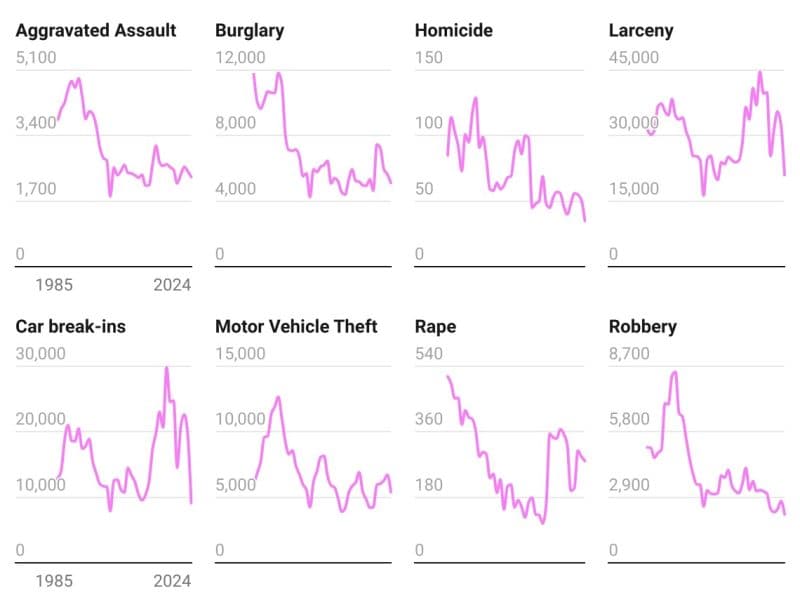
San Francisco reported a 25% overall decline in crime in 2025, including an 18% drop in violent crime and a 27% decrease in property crime, according to police data. The city recorded 28 homicides last year, the lowest total since 1954. That last figure carries particular weight: 1954 was before the Summer of Love, before the crack epidemic, before the tech boom and the inequality it widened. A homicide count not seen since the Eisenhower administration does not emerge from better policing alone; it reflects changes in who is living in a city, who is present on its streets, and what they are doing there.
Resident sentiment has shifted to match. A San Francisco Chamber of Commerce CityBeat Poll found a fivefold increase in San Franciscans who say that crime has gotten better, a fourfold increase in those who say homelessness and street behavior has gotten better, and a 2.5-times increase in those who say street cleanliness has gotten better compared to 2022. That convergence of data and perception matters because perception is ultimately what determines whether restaurants fill their dining rooms and whether offices fill their floors.
The AI Office Machine
The mechanism behind this recovery is not ambiguous if you look at commercial real estate. AI startups have absorbed 3.9 million square feet of office space since 2019, making San Francisco and Silicon Valley prime markets for AI leasing. More telling is the forward-looking figure: tenant requirements, meaning the total square footage companies are actively seeking, hit a record 7.9 million square feet in the third quarter of 2025, fueled largely by AI startups.
For decades, San Francisco's office scene was built on long-term, high-value leases. The AI boom has flipped that playbook. Landlords such as Kilroy Realty are now pre-building speculative suites, fully equipped and move-in ready even before signing a tenant. This is a structurally different tech economy from the platform era. Companies building cognitive infrastructure need physical space immediately and want room to expand fast, which produces a different relationship with real estate than software-as-a-service businesses whose primary asset was a codebase and a subscriber list. Technology firms account for roughly 20% of all office leases signed this year, underscoring the sector's outsized influence on the market's recovery.
The vacancy rate, at 36.9%, remains elevated, a direct consequence of the mass remote-work exodus of the pandemic years. But the direction has reversed, and direction is what precedes destination.
BART and the Return of the Weekday
Transit ridership is a more granular signal than office occupancy because it measures actual human movement, not signed paper. BART ridership continued its steady recovery, with double-digit growth at most stations and overall ridership increasing 11.6% compared to the previous year in November, with riders taking more than 4.4 million trips. BART ridership posted the highest weekday average since the pandemic began in October, with an average of nearly 200,000 weekday riders.
Weekday ridership is the critical metric. The restaurants, dry cleaners, and coffee shops that sustain a downtown economy do not survive on destination visitors alone; they survive on the person who shows up Tuesday through Thursday and buys lunch. Despite suffering some of the steepest office occupancy declines during the pandemic, San Francisco is now mounting one of the most robust recoveries, perhaps helped by the recent AI boom which has attracted new tech talent to the city.
What McLuhan Understood About Claude
Buried in the research surrounding Klein's piece is a single, unsourced sentence: "Marshall McLuhan was right about Claude, too." Without its origin, the line functions almost as a provocation. McLuhan's foundational argument was that the medium reshapes society more profoundly than any content it carries, that the printing press mattered less for what people printed and more for what mass literacy did to institutions, power structures, and cities. His thesis applied to television, to the internet, and it maps with uncomfortable precision onto what large language models are doing to knowledge work and to the cities organized around it.
San Francisco's rebound is not being driven by the same forces that built it before. The app economy created platforms; this economy is building the cognitive infrastructure underneath platforms. The companies flooding into that 7.9 million square feet of newly demanded office space are not selling software subscriptions in the way a decade of venture capital normalized. They are building the medium itself. If McLuhan holds, the medium will determine what follows: what kinds of jobs remain in offices, how commuters move through cities, and which municipal governments are capable of functioning alongside an economy this new.
A Preview, Not an Anomaly
Klein's observation from San Francisco is therefore not a local story about a resilient city bouncing back on its own terms. It is a leading indicator of how technology, governance, and street-level economic life are reorganizing nationally. The homicide rate at its lowest since 1954, BART weekday ridership at its highest since the pandemic, and AI companies seeking a record 7.9 million square feet of office space in a single quarter are not coincidences; they are the visible surface of a structural shift whose full depth is not yet visible.
The rest of the country will face versions of the same question San Francisco is already living: whether this wave of AI-driven economic reorganization produces broadly distributed recovery, or whether it concentrates its gains in the same zip codes that have always captured them first. Klein noticed something genuinely new. What happens next with that something is the story that matters.
This article was produced by Prism’s automated news system from verified source data, official records, and press releases, then run through automated quality and moderation checks before publishing. The system is built and supervised by the people who set the standards it runs under. Read our full AI policy.
Did this article answer your question?