F.A.A. lowers controller staffing target by more than 2,000 positions
The FAA cut its fully staffed controller target to 12,563, betting better schedules can ease shortages without adding fatigue to an overworked system.

The Federal Aviation Administration is betting that smarter scheduling, not just more hiring, can close a chronic air traffic control gap. By increasing the amount of each shift spent actively managing traffic, the agency said it can lower its target for a fully staffed workforce by more than 2,000 positions while trying to curb the overtime, fatigue and burnout that have dogged controllers for years.
The FAA’s 2026-2028 Air Traffic Controller Workforce Plan, released Friday, set a full staffing target of 12,563 certified professional controllers, down from 14,633 in an earlier plan. The agency said the new target was based on findings from the National Academy of Sciences’ Transportation Research Board and reflects a push to use modern staffing models and workforce-management tools to reduce unnecessary overtime. In the agency’s view, better scheduling could improve coverage across the system without forcing already strained controllers to absorb still more hours.
That shift comes with a stark snapshot of the current workforce. As of April 2026, about 11,000 certified controllers were deployed across more than 300 FAA air traffic facilities, while another 4,000 controllers were in the training pipeline. About 1,000 of those were previously certified controllers retraining at new facilities. The FAA said it can take more than two years to fully certify a new hire, depending on how complex the facility is, which means a hiring surge today does not quickly translate into full staffing on the floor.
The plan sets hiring goals of 2,200 controllers in fiscal 2026, 2,300 in 2027 and 2,400 in 2028. The FAA said it was already 60 percent of the way toward this year’s hiring goal. It also said it wants controllers to spend more of each shift actively managing traffic rather than on other duties, part of a broader effort framed around three pillars: expanding hiring, improving controller efficiency and modernizing the National Airspace System.
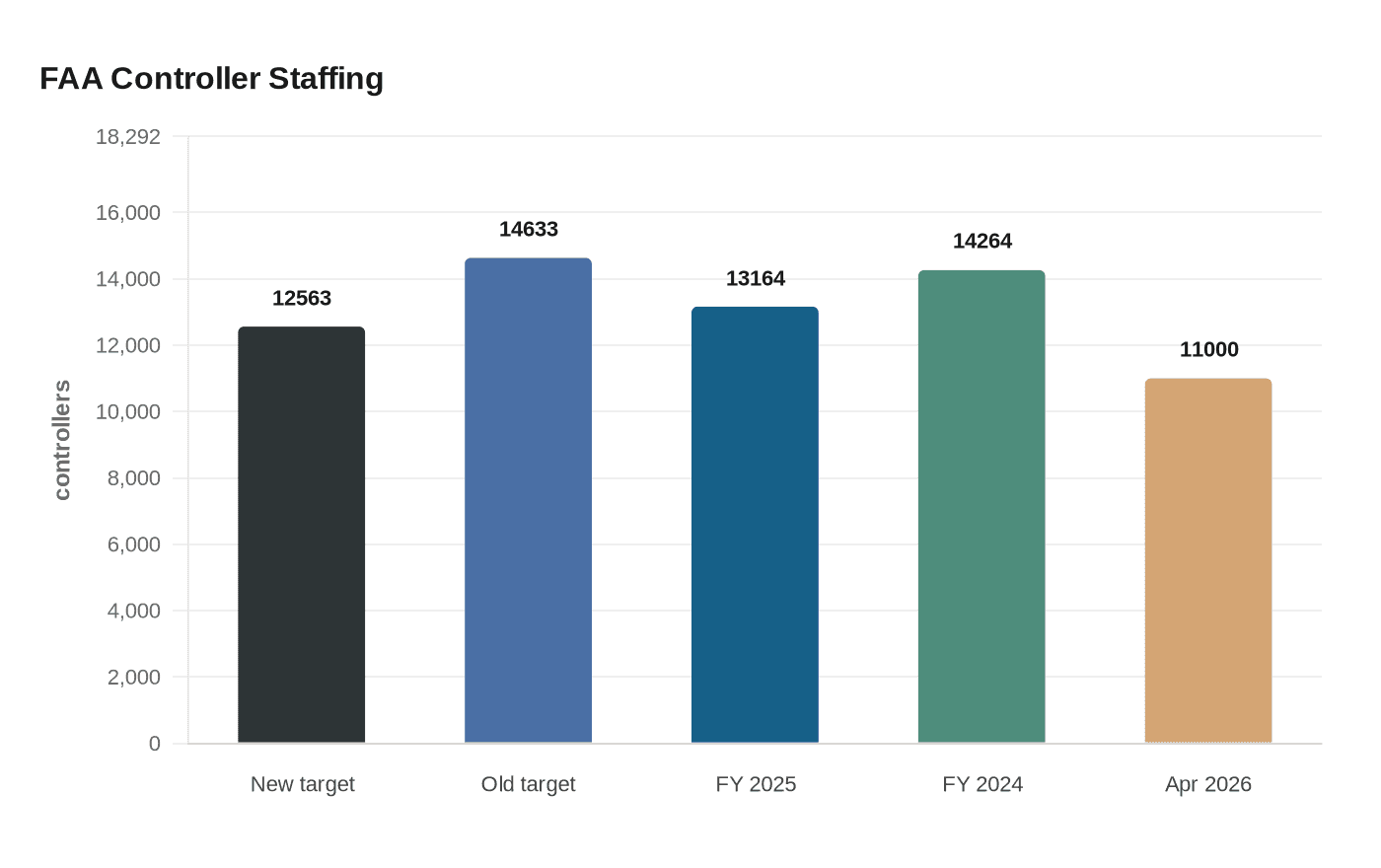
The new target lands against years of documented strain. A December 2025 Government Accountability Office report said the FAA employed 13,164 controllers at the end of fiscal 2025, about 6 percent fewer than in 2015, even as flights using the air traffic control system rose about 10 percent to 30.8 million between fiscal 2015 and 2024. The FAA’s own 2025 workforce plan said the controller workforce reached 14,264 in fiscal 2024, after hiring 1,811 controllers that year and more than 5,700 over the prior five years.
The staffing overhaul also follows a May 1, 2025 agreement between the FAA and the National Air Traffic Controllers Association to strengthen recruitment and retention with financial incentives for academy graduates and new hires, plus a limited-time package aimed at keeping experienced controllers from retiring. Transportation Secretary Sean P. Duffy said the administration was working to reverse decades of staffing declines, while NATCA President Nick Daniels said the union looked forward to working on staffing, safety improvements and modernization. The question now is whether a leaner staffing target reflects real efficiency gains, or simply a system asking exhausted workers to stretch farther.
This article was produced by Prism’s automated news system from verified source data, official records, and press releases, then run through automated quality and moderation checks before publishing. The system is built and supervised by the people who set the standards it runs under. Read our full AI policy.
Did this article answer your question?

