FCDO Advises Against All But Essential Travel to Cuba, Airports Lack Fuel
The FCDO on 5 March 2026 advised against all but essential travel to Cuba after warning that international airports are without aviation fuel, putting travellers at risk of being unable to leave.
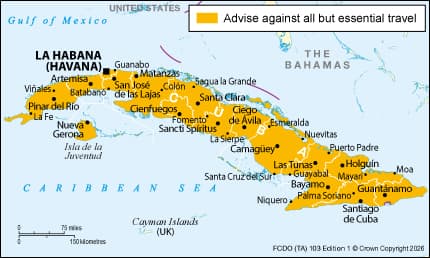
The UK Foreign, Commonwealth & Development Office has advised against all but essential travel to Cuba, warning that international airports are currently without aviation fuel and that visitors face major disruption. The advisory, posted on 5 March 2026, states in part, "Cuba is experiencing severe and worsening disruption to essential infrastructure, persistent power outages across the country and fuel shortages."
Cuban authorities, cited in multiple reports, have said all of the country’s international airports currently lack aviation (jet) fuel, a shortage that has already forced flight diversions and cancellations at major gateways including Havana, Varadero, Santiago de Cuba and Holggin, the latter spelled as reported. Birmingham airport operational detail shows Terminal 2 at José Martí International Airport in Havana, which formerly handled US and some charter services, closed with flights diverted to Terminal 3.
Airline schedules have been affected: Air France has announced the suspension of flights between Paris and Havana from 29 March to 14 June with the last departure from Havana to Paris Charles de Gaulle scheduled for 28 March. Reports also indicate that all Canadian carriers and LATAM have suspended services to and from Cuba, while other airlines are cancelling, rerouting or reviewing routes and diverting services to alternative transport hubs. That combination of airline decisions and airport fuel shortages increases the risk that options for leaving the country could reduce further.
The FCDO spelled out the immediate consequences for visitors: "These conditions are significantly affecting the ability of visitors to access reliable transport, medical care, communications, and basic services." It urged anyone already in Cuba to "carefully consider if your presence is essential" and to "Take precautions by conserving fuel, water, food and mobile phone charge, and be prepared for significant disruption." Travellers have also been told to check messaging from their airline or tour operator and to ensure travel documents and any required visas for onward travel remain valid.

On the ground, authorities have introduced fuel rationing and scaled back public services, with temporary changes to healthcare, education, transport and tourism operations to conserve energy supplies. A March 4 photograph showed a pedicab passing a traffic light blacked out by a power cut in Havana, and another image dated March 5 captured Cuban doctors queued at Ramon Villeda Morales airport in San Pedro Sula, Honduras, illustrating movement of medical staff amid the crisis.
Estimates of how long the fuel shortages will last vary: some projections suggest the problem may persist through at least mid-March, while confirmed airline suspensions extend in some cases to mid-June. Some coverage has linked the shortages to reduced oil imports and international sanctions restricting supplies from traditional partners, a claim that requires official confirmation.
Expect ongoing disruption to flights, transfers and basic services across the island in the coming weeks as authorities and carriers adjust operations and as the FCDO advisory remains in force.
Know something we missed? Have a correction or additional information?
Submit a Tip