FESPA Webinar Explores How Smart Tech Redefines Printed Apparel Production
FESPA’s online webinar argues that producing garments only when demand is confirmed can radically reduce ecological footprint while protecting long-term profitability.
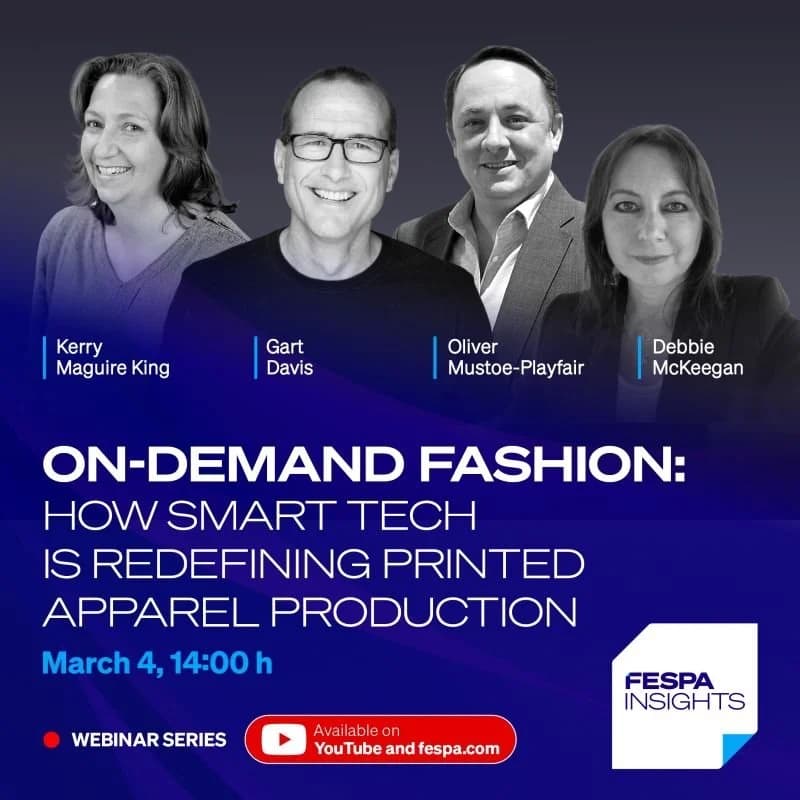
FESPA, with TexIntel listed in the announcement, has scheduled a FESPA Insights webinar titled “On‑Demand Fashion — How Smart Tech Is Redefining Printed Apparel Production” for 4 March 2026 at 14:00 GMT as a virtual session that promises to show how on-demand manufacturing eliminates excess inventory and protects profitability. Promotional copy repeats the claim: “By producing garments only when there is confirmed demand, print businesses can radically reduce their ecological footprint whilst simultaneously protecting their long-term profitability.”
The organisers frame the event as a direct response to what the Dorking press called a critical industry pivot, writing that “the fashion industry currently stands at a critical crossroads, where the traditional model of mass production is no longer viable for the environment or for sustainable business growth.” The announcement also foregrounds overproduction and textile waste as “significant global challenges” and links the issue to the market opportunity that FESPA highlights: “Digital textile printing forecasted to reach $8.8 billion by 2027.”
FESPA’s LinkedIn promotion lays out concrete learning outcomes for attendees, listing verbatim how the session will cover “How real-time production data is reshaping decision‑making,” “The rise of streamlined, sustainable digital textile workflows,” “Opportunities for print businesses adapting to on‑demand cycles,” and “Key technologies unlocking agility, speed and customisation in apparel.” The FESPA page further promises an examination of “digital print innovations, paired technologies and green chemistry — combined with seamless software integration” as solutions to sustainability, speed-to-market and the skills gap.
Speakers named in the materials include industry consultants and founders. Kerry Maguire King is listed with a full bio: “With over 25 years in textile innovation, Kerry led R&D for Spoonflower’s print-on-demand platform and spent 15 years at [TC]2 specializing in supply chain technology. Currently a full-time consultant and PhD candidate at NC State, she is a past president and board member of AATCC, dedicated to advancing digital manufacturing and textile chemistry.” Gart Davis appears as a textile consultant with this description: “Gart is an entrepreneur, problem solver, and a nerd at heart. In a family of .gov, .org, .mil and .edu emails he is a lonely .com, choosing startups as his instrument of impact. His works have focused on teaching, mortgage access, and publishing. Since 2008 he has been smitten by the opportunity to bring digital technology to the textile industry for the benefit of creators, consumers, and the planet.” Oliver Mustoe-Playfair is listed as “Director and Owner of PrinFab” with the note that since 2016 Prinfab “have empowered the design community and built a loyal customer base comprising of many 1,000’s of creatives by supplying custom-printed textiles on-demand, with no minimum order.” Debbie McKeegan is listed among the names in promotional material; no role or affiliation for her is specified in the provided sources.
Social reactions in the LinkedIn feed supplied extra colour on the webinar’s premise, with Mongi Gazelle, PhD writing “Tech's totally flipping how we make clothes now. Real-time data and automation are basically rewiring the whole supply chain from scratch,” and VCRAFT EXPO STUDIO adding “At VCRAFT EXPO STUDIO, we understand how automation and real-time data are redefining production efficiency. The shift toward faster, smarter, and more sustainable apparel manufacturing is accelerating.” FESPA’s organisation page snapshot notes the group has “14,850 followers,” underlining a sizable community reach for the 4 March session.
The webinar is pitched to a wide industry audience: “Whether you are a high-volume manufacturer or an independent brand, a designer, printer or retailer – this session will equip you with the insights and strategies needed to build a resilient, profitable, and future-proof supply chain,” according to the event page. Promotional materials supplied do not include a registration link, session duration, platform or moderator details, and no speaker quotes beyond the bios and social posts appear in the announcements. Given the $8.8 billion digital textile printing forecast and the named roster of consultants and founders, the webinar positions on-demand printed apparel production as a technical and commercial pivot that could materially reduce inventory waste while sustaining margins.
Know something we missed? Have a correction or additional information?
Submit a Tip