FIFA weighs bigger World Cup prize money for 2026 teams
FIFA is considering a larger payout for every 2026 World Cup team, raising the stakes for smaller federations as the tournament’s revenue tops $11 billion.

FIFA was weighing another increase in World Cup prize money for all 48 teams heading to the 2026 tournament, a move that would push the economics of expansion even further toward guaranteed cash for national federations. The proposal was set to go before the FIFA Council in Vancouver on Tuesday, ahead of the 76th FIFA Congress on 30 April, as the organization prepared for the biggest and most expensive World Cup it has staged.
The potential increase would build on a December 2025 council decision that set the tournament’s financial contribution at $727 million, a figure FIFA said was 50% higher than the payout for Qatar 2022. FIFA had previously said the 2026 prize money would total $655 million, and its official announcements later indicated that the winning national federation would receive $50 million. Any additional boost would matter most for associations that rely on FIFA distributions to cover travel, staffing, player bonuses and preparation costs.
That financial pressure is especially sharp because the tournament will run across 16 host cities in the United States, Canada and Mexico from 11 June to 19 July 2026. The expanded format already makes qualification more valuable for smaller federations that may not generate significant commercial revenue of their own. For those countries, reaching the World Cup is no longer only a sporting milestone; it can become a funding event that supports domestic development well beyond the month-long tournament.
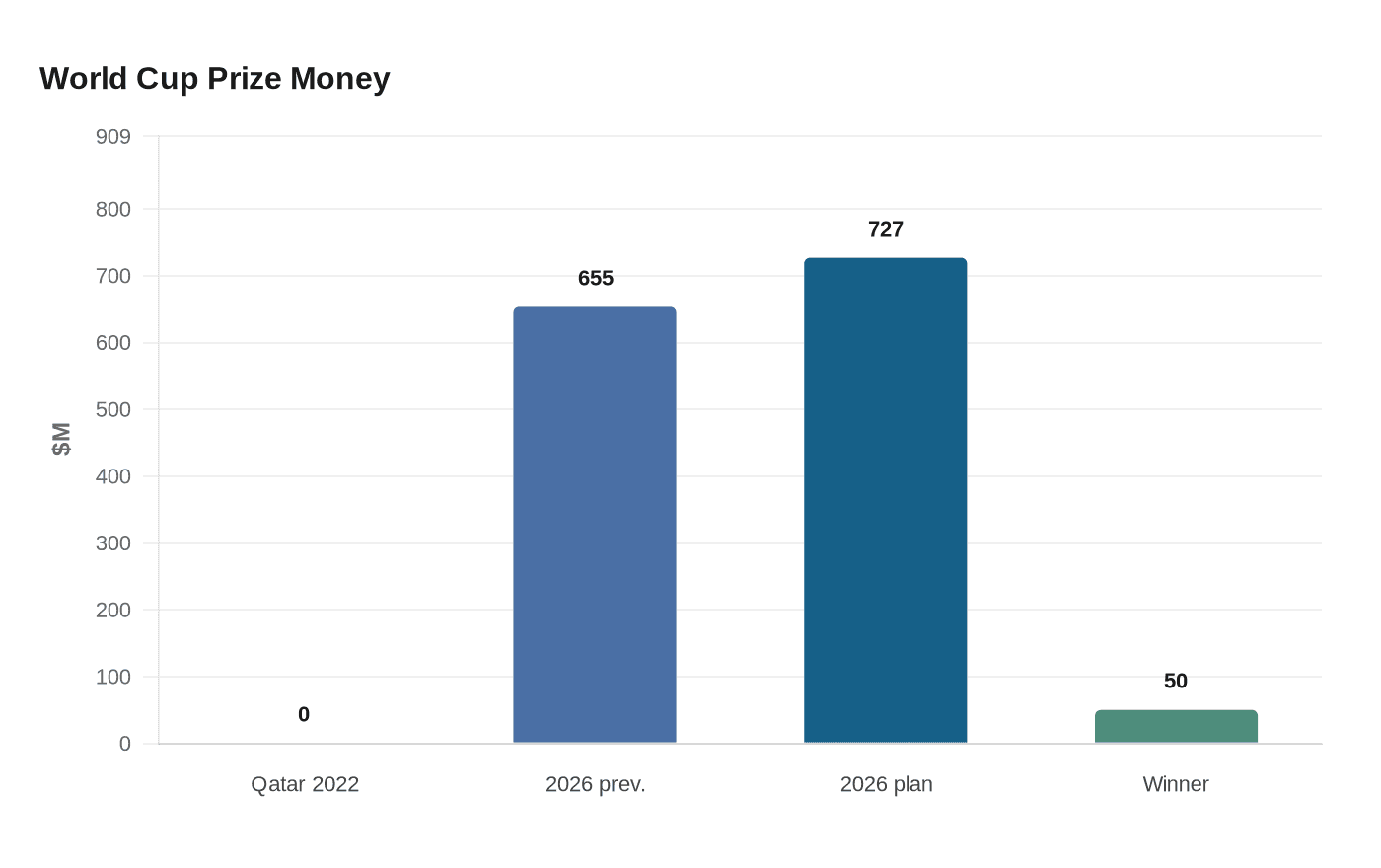
FIFA’s own numbers show why the governing body can consider raising payouts again. It has projected more than $11 billion in revenue for the 2023-2026 cycle, while budget documents list 2023-2026 revenue at $11,000 million. At the same time, FIFA has earmarked a record $2.25 billion for football development through the FIFA Forward 3.0 Programme, signaling that it is trying to expand both prize money and long-term development spending at once.
The scale of demand around the tournament reinforces that strategy. FIFA said more than 150 million ticket requests had already been submitted by fans in more than 200 countries, and it introduced a $60 supporter entry tier for fans of qualified teams across all 104 matches. The commercial pull is clear, but so is the policy tradeoff: as FIFA spreads more money across 48 teams and 211 member associations, the center of gravity in world football is shifting toward broader participation, stronger national programs and larger guaranteed payouts for countries that once saw qualification as symbolic rather than transformational.
This article was produced by Prism’s automated news system from verified source data, official records, and press releases, then run through automated quality and moderation checks before publishing. The system is built and supervised by the people who set the standards it runs under. Read our full AI policy.
Did this article answer your question?
.jpg&w=1920&q=75)