First-year Wyoming WWAMI students meet Governor Mark Gordon, legislators in Cheyenne
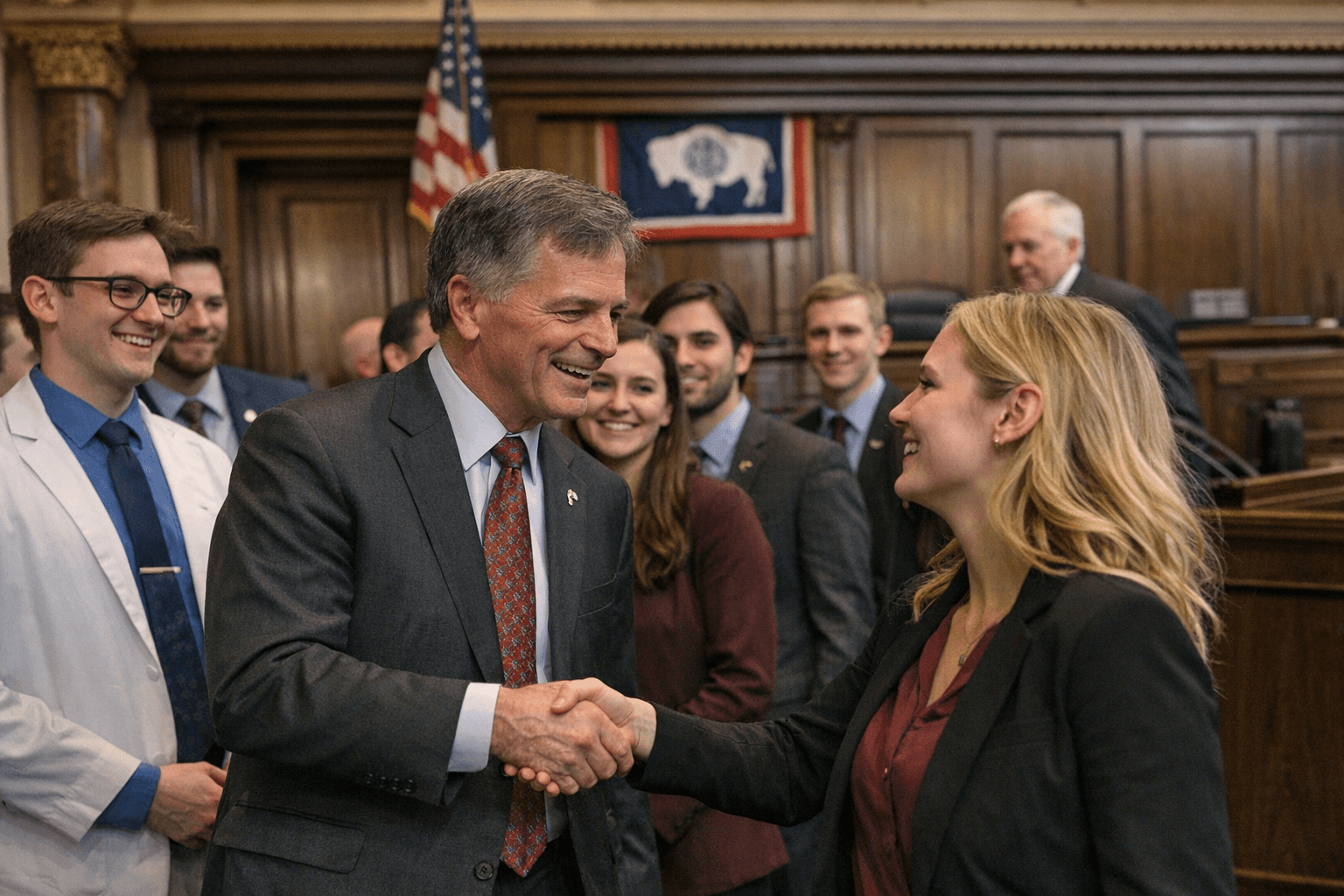
Twenty first-year Wyoming WWAMI students traveled to the Wyoming Capitol on Feb. 17 to meet Gov. Mark Gordon, be introduced on the House and Senate floors, and hear a student speaker, Hagen.
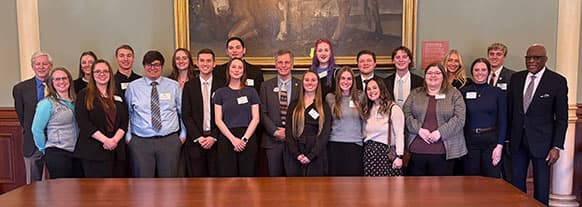
Twenty first-year Wyoming WWAMI medical students from across the state visited the Wyoming Capitol on Feb. 17 for the annual WWAMI Legislative Day, meeting with Governor Mark Gordon and legislators and receiving introductions on both the House and Senate floors. The delegation of roughly 20 students — labeled E-2025 in a UW College of Health Sciences social post — was joined in Cheyenne by University of Wyoming President Ed Seidel, Interim Provost Anne Alexander, College of Health Sciences Dean Patrick Hardigan, and University of Washington President Dr. Robert J. Jones.
Legislative Day activities included a luncheon attended by several state legislators and representatives of Wyoming’s congressional delegation, and for the first time a student speaker addressed the room. Identified only by last name, Hagen told attendees, “Throughout the day, we heard repeatedly that student voices can influence legislative decision making. It is a rare opportunity to engage with state leaders at this level, and the emphasis they place on our education felt very sincere.” UW posts also noted students “had the opportunity to visit with Gov. Mark Gordon and discuss issues related to education and the practice of medicine in Wyoming.”
Hardigan framed the event as a practical link between medical education and state policy, saying, “Legislative Day in Cheyenne is an important part of our WWAMI Medical Education Program, giving our students a meaningful opportunity to engage directly with Wyoming’s top policy leaders. This year’s event was especially notable as we welcomed Dr. Robert J. Jones, president of the University of Washington, to join our delegation further underscoring the strong and enduring partnership between our institutions in preparing Wyoming’s future physicians.”
The WWAMI program — Washington, Wyoming, Alaska, Montana, and Idaho — educates students in a multi‑state structure. Students complete the Foundations Phase terms at partner universities in each state; Wyoming students complete the final third term of the Foundations Phase at the University of Washington in Seattle before entering a 12‑month Patient Care Phase and a 15‑month Career Explore and Focus Phase, then clinical rotations across the region. The Cheyenne visit emphasized legislative awareness and recognition of the Wyoming legislature’s support for the WWAMI Medical Education Program; a UW LinkedIn post called the cohort “incredible ambassadors for our program” and included images without alternative text descriptions.
The Cheyenne engagement comes as broader WWAMI capacity and political debates play out regionally, most visibly in Idaho. The University of Washington currently accepts 40 Idaho WWAMI students per year, and UW has said it cannot add more Idaho students because of limited clinical training slots. Idaho legislators have debated a bill to withdraw from WWAMI and a draft resolution tying support to anti‑DEI guidelines; the withdrawal bill has sat on the House calendar with no action for more than a week, and House Speaker Mike Moyle said leaders are looking for a path forward. More than 1,600 Idahoans signed an open letter opposing defunding WWAMI that warned, “We are profoundly concerned about the long‑term impacts of defunding the WWAMI program, especially because the legislation does not describe an actual plan for continuing the kind of program WWAMI provides. Without WWAMI, our students, residents, teachers, patients, friends, families, and communities will suffer.”
Dr. Frank Batcha, assistant clinical dean for UW’s School of Medicine, pushed back on accusations about program practices, calling them “absolutely false” and saying, “We adhere to Idaho law. We adhere to Washington law, which also does not allow us to do anything to favor a particular group.” Batcha noted Idaho WWAMI has produced over 800 physicians with more than 400 returning to Idaho to practice, a roughly 50 percent return rate, while Idaho remains last in the country for physicians per capita.
As UW pursues funding to expand class size in Spokane — a move a Tripp Umbach analysis called “clearly the most cost‑effective option” to meet workforce needs — the Cheyenne Legislative Day highlighted how Wyoming’s WWAMI cohort is being positioned to engage with policymakers directly. Both the UW College of Health Sciences coverage and the UW social post list Feb. 17 as the event date; the two accounts differ on the weekday reported for that date.
Know something we missed? Have a correction or additional information?
Submit a Tip