Flatiron Building gets rebuilt revolving door, a century after invention
A rebuilt revolving door returned to the Flatiron Building, linking Theophilus Van Kannel’s century-old invention to the landmark’s residential rebirth.
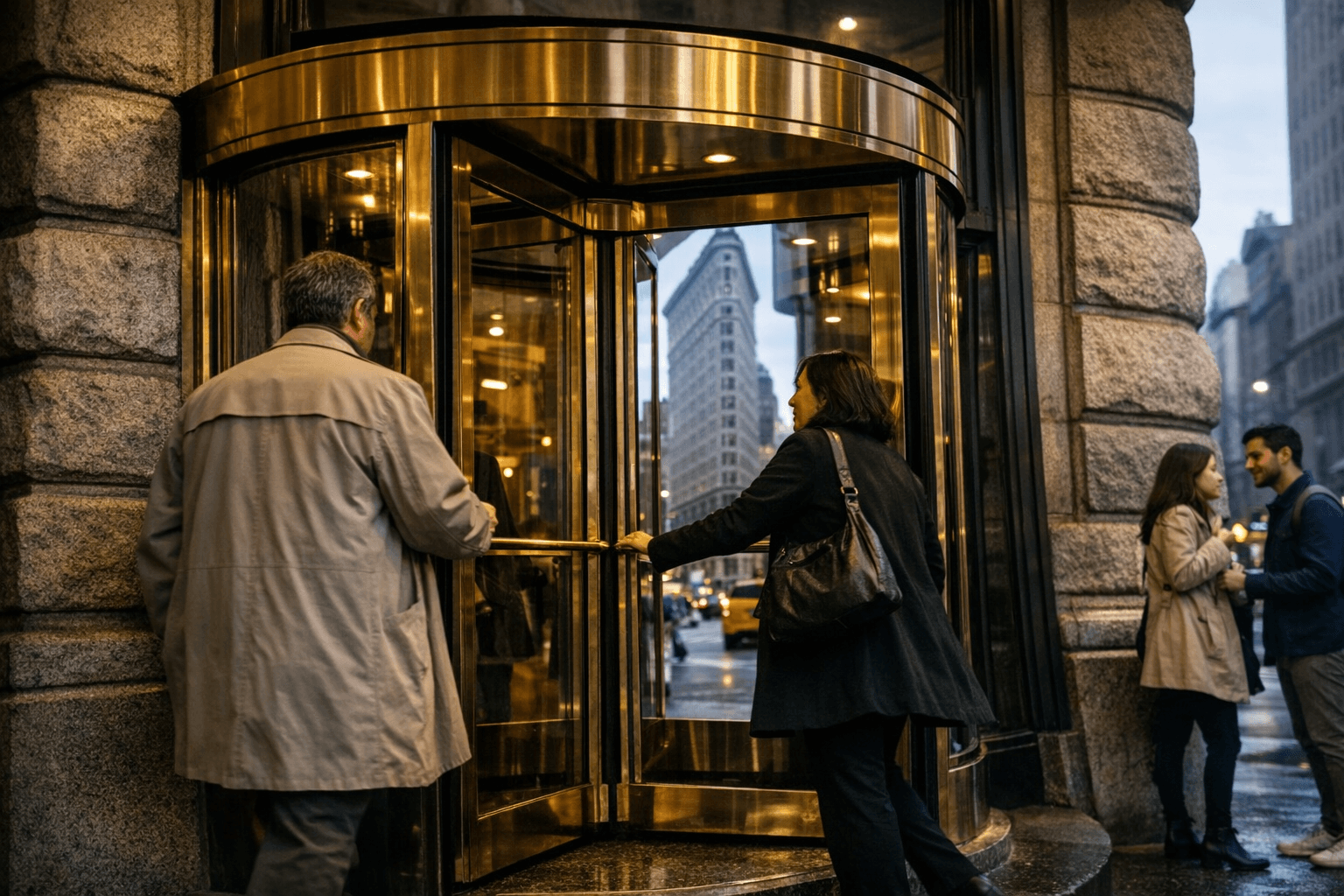
The Flatiron Building has recovered one of its most distinctive original details: a revolving door designed more than a century ago by Theophilus Van Kannel. Reinstalled in April 2026, the rebuilt entryway gives New Yorkers a tangible piece of the 22-story landmark’s early craftsmanship back at 175 Fifth Avenue, where the building once known as the Fuller Building has long stood as one of Manhattan’s most recognizable silhouettes.
The door is more than a decorative flourish. Van Kannel’s invention was meant to solve a practical urban problem, keeping out wind and street noise while letting people move in and out without the bottlenecks that came with ordinary swinging doors. He received the Franklin Institute’s John Scott Medal in 1889 for the idea, and the restored Flatiron door connects that innovation to the building’s original identity as a bustling commercial tower at the intersection of architecture and city life.
The rebuilt showpiece was fabricated by the International Revolving Door Company in Evansville, Indiana, a firm that has produced revolving doors for more than 100 years. At its headquarters, tens of thousands of hand-drawn specifications on onion-skin paper preserve the early history of a once-novel invention, a paper trail that helped make the Flatiron restoration feel less like a copy and more like a recovery. The result restores a small but defining detail that helps explain how the building once worked, not just how it looked from the street.
That restoration arrives after years of scaffolding and a major overhaul tied to the building’s changing ownership and redevelopment plans. The Flatiron sold at auction in May 2023 for $161 million, after a prior auction and ownership dispute, and its new direction has centered on conversion from office use toward luxury residential units. The return of exterior historic elements, including the revolving door, marks a visible step in that transformation.
For New York, the significance goes beyond preservation theater. Cities keep their identity through details that people touch, pass through and remember, and the Flatiron’s rebuilt door shows how adaptive reuse can give a landmark a second life without erasing the design choices that made it matter in the first place. As office buildings across Manhattan face pressure to change, the Flatiron is emerging as a test case for how preservation, economics and residential redevelopment can meet in the same frame.
This article was produced by Prism’s automated news system from verified source data, official records, and press releases, then run through automated quality and moderation checks before publishing. The system is built and supervised by the people who set the standards it runs under. Read our full AI policy.
Did this article answer your question?