Florida sand dollar hunt reveals secrets of these strange sea creatures
A Florida beach hunt becomes a lesson in living coastline science, from sand dollar anatomy to the rules that keep shellfish in the wild.
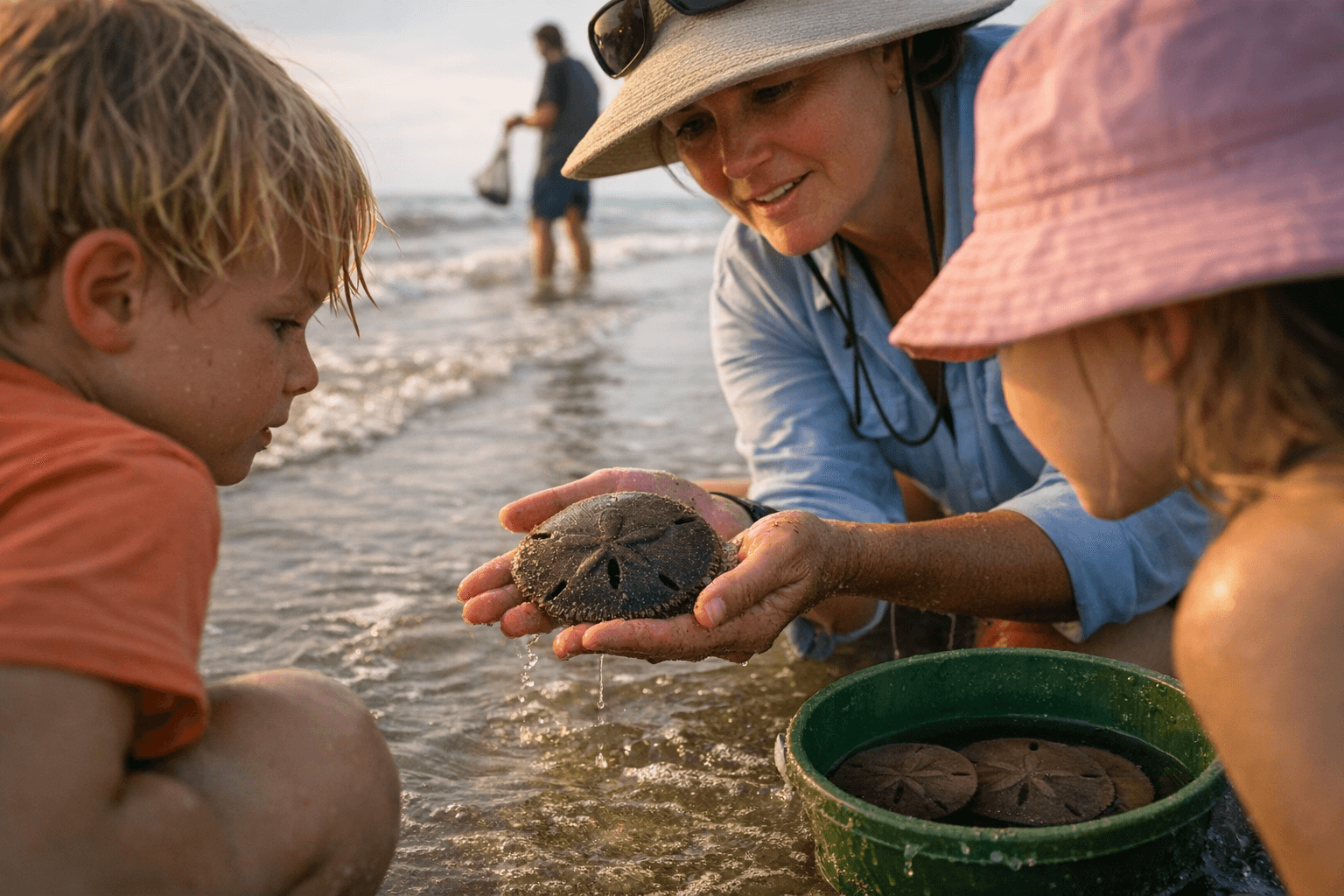
A shoreline lesson hidden in plain sight
A sand dollar looks like a keepsake, but it is a living animal built for one of the harshest homes on the coast. In Florida, Martha Teichner joins naturalist Kristen Williams, known as The Seashell Mermaid, on a hunt that turns a beach walk into a lesson in coastal literacy, and the CBS News Sunday Morning segment aired April 12, 2026.
The larger message is simple: the pale, fragile disc people often pick up is only part of the story. Sand dollars are not beach trinkets first and creatures second. They are part of a much bigger marine family, and understanding them changes how the shoreline itself is read.
What a sand dollar really is
Sand dollars are echinoderms, a group of marine animals whose name literally means “spiny skin.” That phylum also includes sea stars, sea urchins, sea cucumbers, brittle stars, and crinoids, which makes the sand dollar less of an oddity and more of a branching point in a larger evolutionary family. At heart, it is a flattened sea urchin adapted for life on sandy seafloors.
That shape matters. Sand dollars do not drift through the ocean as ornaments; they live where the bottom shifts, presses, and moves around them. Like other echinoderms, they begin life in a larval stage before metamorphosing into the familiar adult disc, a transformation that helps explain why the creature looks so unlike the young form people might never see.
Their body is protected by a hard outer skeleton called a test. In some species, holes in that test allow tube feet to protrude, another sign that what appears to be a simple shell is actually part of a highly specialized animal.
How they survive on shifting sand
A sand dollar’s survival strategy is built around movement, filtration, and patience. Living sand dollars use tiny spines, cilia, tube feet, and a water vascular system to move, burrow, and handle food in a habitat that is constantly changing. Those features let the animal stay partly hidden while still working the sand around it.
They feed on detritus, plankton, and algae, which places them in the middle of the seafloor’s recycling system. That is one reason the species draws scientific attention well beyond the beach. Rich Mooi, who has studied echinoderms at the California Academy of Sciences for more than 30 years, has spent a career helping map that broader family tree and its peculiar adaptations.
The Academy has highlighted sand dollars as unusually well suited to shifting sand environments, and a KQED feature quoted Mooi saying they have done something “really amazing and different” in the way they thrive on sandy seafloors. That is the right scale for understanding them: not as novelty objects, but as creatures that solved a difficult ecological problem.
Why the aquarium matters
The Florida beach search is paired with a visit to the Steinhart Aquarium in San Francisco, part of the California Academy of Sciences in Golden Gate Park. The aquarium is described by the Academy as one of the most biologically diverse and interactive aquariums on Earth, with nearly 60,000 live animals representing more than 800 species.
That setting gives the sand dollar story a wider frame. When a visitor sees sea stars, sea urchins, sea cucumbers, brittle stars, and sand dollars together, the family resemblance becomes clearer, and so does the variety of forms that have emerged from the same phylum. The aquarium does more than display animals. It helps translate a strange beach find into a broader understanding of marine life, evolution, and habitat.
Florida rules are part of the science
The collecting rules in Florida are not a side note. They are central to responsible beachcombing, because the rules depend on whether a shell contains a living organism, what organism it is, and where it was found. According to the Florida Fish and Wildlife Conservation Commission, sea shells containing live organisms cannot be sold unless the seller has a valid commercial saltwater products license.
Local rules can go further. In places such as Sanibel, shelling rules prohibit the harvest and possession of live shellfish, and sand dollars, sea stars, and sea urchins are specifically protected. That means the common beach instinct to scoop up a beautiful find can quickly become a legal and ecological mistake if the animal is still alive.
The distinction matters because a living sand dollar is part of the habitat, not a souvenir. Once it dies, its test may wash ashore and become the white, bleached shape most people recognize. But while it is alive, it belongs in the sand, where it feeds, burrows, and helps sustain the coastal ecosystem.
What the hunt really reveals
The appeal of a sand dollar hunt is not just that the animal is strange. It is that the search exposes how much life is hidden inside what looks like empty shoreline. The Florida beach, the aquarium tanks in San Francisco, and the science behind echinoderms all point to the same lesson: beaches are living systems, and the rules that govern them exist for a reason.
Seen that way, the sand dollar is more than a curiosity. It is a small, flattened reminder that the coast is full of specialized creatures, fragile habitats, and public responsibilities that reach far beyond a single shell in the hand.
This article was produced by Prism’s automated news system from verified source data, official records, and press releases, then run through automated quality and moderation checks before publishing. The system is built and supervised by the people who set the standards it runs under. Read our full AI policy.
Did this article answer your question?

