Forecasts place engagement-ring market at $88.26B in 2026, $145.24B by 2035
BusinessResearchInsights' Feb. 21, 2026 update puts the engagement-ring market at US$88.26 billion in 2026 and forecasts US$145.24 billion by 2035 at a 5.7% CAGR.
BusinessResearchInsights' market update dated Feb. 21, 2026 opens with a bold metric: "Updated engagement‑ring market forecast starts at US$88.26 billion in 2026," and the same excerpt projects the market to reach US$145.24 billion by 2035 with a compound annual growth rate of 5.7% from 2026 to 2035. The bulletin frames engagement rings as "a discrete, large market" and "a high‑volume, high‑value segment within the broader jewelry complex," language that signals an industry treating bridal as a standalone category rather than a footnote of wider jewelry totals.
A near‑concurrent IntelMarketResearch release dated Feb. 20, 2026 gives a slightly different baseline and endpoint: Intel values the global engagement‑ring market at USD 87.5 billion in 2025, projects USD 92.3 billion in 2026 and USD 132.8 billion by 2034, "exhibiting a CAGR of 5.7% during the forecast period." That same Intel excerpt also contains an anomalous fragment projecting "$48 billion by 2027, growing at 5.2% CAGR," a figure numerically inconsistent with Intel's own 87.5B/92.3B series and worth clarification.
PrismHarbor Research, in a LinkedIn excerpt, offered a markedly different tempo, forecasting an annual growth rate of 12.7% from 2026 to 2033. PrismHarbor emphasizes technology-driven retail changes and notes that "The Engagement Ring market is increasingly utilizing advanced technologies such as artificial intelligence, big data analytics, and virtual reality to gather insightful market data" and that "augmented reality allows customers to visualize rings interactively, enhancing their purchasing experience." That combination of a steeper CAGR and tech optimism positions PrismHarbor as an outlier against the 5.7% projections.
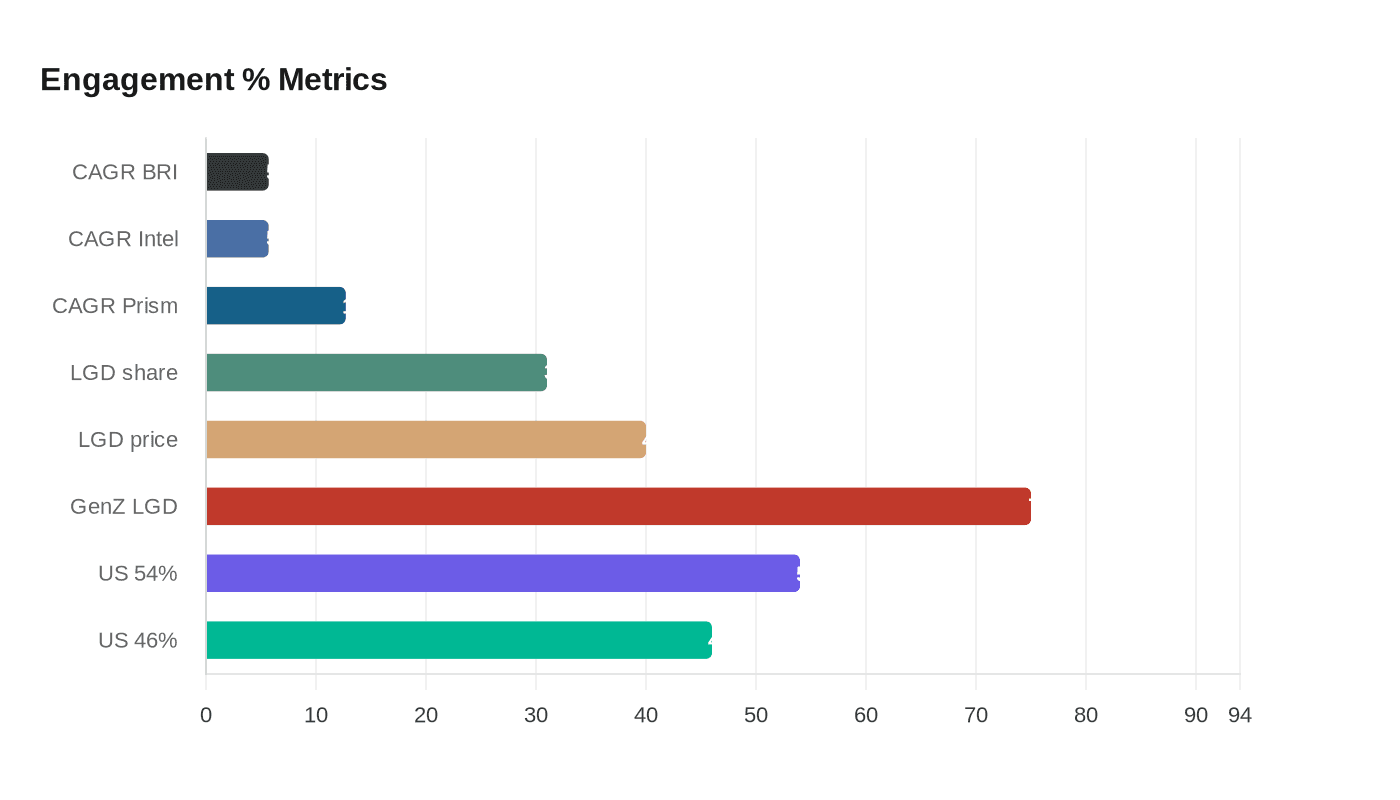
Lab‑grown diamonds are already reshaping the numbers. An Icecartel compilation states "The Lab‑Grown Surge: Lab‑grown diamonds, valued for their ethical and environmental appeal, have reached a global valuation of USD 12.8 billion in 2025, now accounting for 31% of all engagement ring sales." Icecartel also reports that LGD pricing "may reduce by up to 40%" compared to mined stones and that Gen‑Z may capture as much as 75% of LGD market share, signaling both downward pressure on per‑carat prices and a demographic shift in demand composition.
Regional and channel dynamics are central to the forecasts. BusinessResearchInsights' excerpt notes North America "controls the engagement ring market" while Asia‑Pacific — "especially China and India" — shows rising demand; the same excerpt ties growth to rising incomes, "social media trends and celebrity fashion influence," and digital retail tools, saying "the market evolved through e‑commerce innovation which allows buyers to shop and purchase rings on the internet by using virtual try‑on features alongside AI recommendation systems." DecipherMarketResearch flags that the field is under rapid revision, issuing a 7th edition and explicitly including Covid‑19 pandemic impact analysis in its Global Engagement Rings Market Report 2026.
Taken together, the sources paint two plausible trajectories: a steady climb to roughly USD 133–145 billion over the next decade at a mid single‑digit CAGR, or a materially faster expansion if PrismHarbor's 12.7% view — driven by AR, AI and rapid LGD adoption — holds. The conflicting fragments in Intel's $48 billion note and Icecartel's unexplained 54%/46% U.S. figures underscore methodological differences; the industry pivot toward lab‑grown stones, e‑commerce and Asia‑Pacific customers will determine which forecast proves prescient.
Know something we missed? Have a correction or additional information?
Submit a Tip