Forsyth County State of the County Outlines Growth Management, Infrastructure Plans
Forsyth County leaders tied a $350,000 LEAP investment to workforce goals while reaffirming an 11-area Community Character Map to guide growth and infrastructure planning.
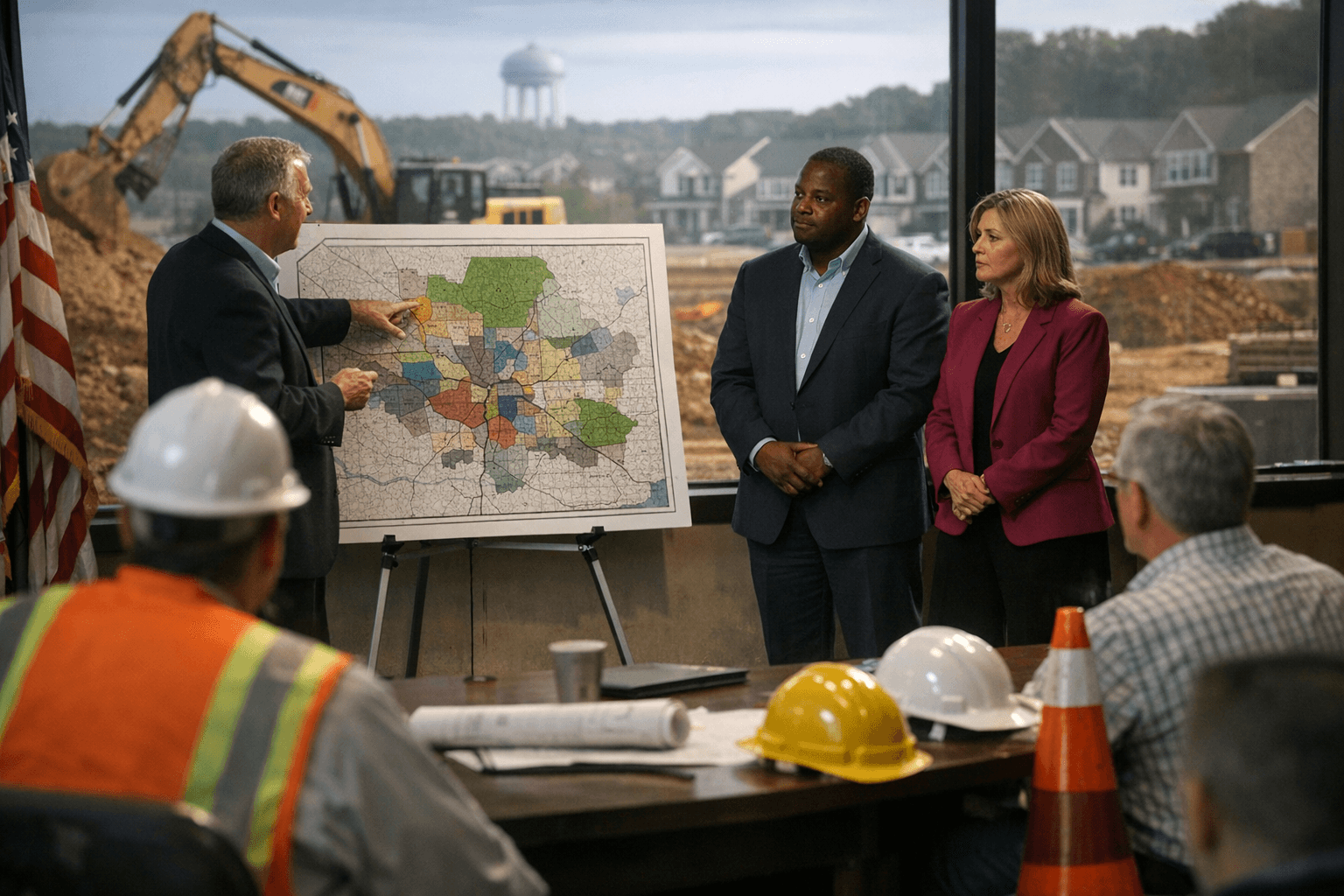
Forsyth County leaders used the 2026 State of the County address to frame a coordinated push on growth management, infrastructure and services for a county mapped into 11 planning areas and backed by recent workforce investments. The address emphasized planning for future roads, utilities and public services while linking those efforts to existing county programs such as the Board’s recent $350,000 appropriation for the LEAP apprenticeship program.
The county’s long-range framework traces to the 2012 Future Development Map and the 2017 major Comprehensive Plan update that produced the Foster Forsyth Vision Statement. The Vision Statement reads: “Forsyth County will promote responsible use of our natural assets and green space while advancing a balanced growth management strategy that strengthens and sustains quality of life for everyone.” That statement remains in the 2022 Comprehensive Plan and in the 2023–2027 minor update carried out during 2021–2022.
Key implementation tools named in planning materials include the Community Character Map, which identifies 11 distinct planning areas across unincorporated Forsyth County, described in staff materials as 10 character areas plus a stand-alone regional node in the McFarland area, and a Commercial Corridors Map intended to shape where jobs and shopping concentrate. County documents stress that each of the 11 areas will need tailored design standards rather than a one-size-fits-all zoning approach.
The Board of Commissioners has moved planning into operational priorities following a Board Goals Session facilitated by the North Carolina Association of County Commissioners on January 16, 2025. After that session, “the Board directed staff and consultants to compile a summary of the key priority areas... Once the goals are formally adopted, staff will develop and implement corresponding action items, along with timelines spanning the next 3-5 years, to guide operations and strategic initiatives.” The session flagged sustainable growth management practices, affordable housing collaboration with the City of Winston-Salem, economic development, and operations efficiency as priority areas; Public Safety was summarized as “Enhancing safety and emergency services through resource equity and staffing stability.”
Education funding was specifically highlighted in the board priorities with guidance to “maintain a commitment to ensuring adequate funding is allocated to support the needs of the K-12 school system and community college. Focus particularly on resources that directly support the classroom, primarily teacher pay.” The board also directed a push to “develop a sustainable funding formula for K-12 schools” that ties schools to local revenue growth and declines for Winston-Salem/Forsyth County Schools.
County program details anchor the planning talk in tangible steps: the Board’s recent $350,000 investment aims to keep the LEAP (Learn and Earn Apprenticeship) program debt-free as Forsyth Tech and participating employers expand. Forsyth County reports 4 LEAP apprentices have completed health sciences training and are working with Atrium Health Wake Forest Baptist or Novant Health, and 16 apprentices are actively enrolled in medical assisting, MRI technician or CT imaging programs. Housing-related actions include City of Winston-Salem interlocal agreement funds that support homeowner rehabilitation and down-payment assistance for city residents, including emergency repairs and accessibility modifications tied to code compliance.
Planning materials include an explicit caveat about projections: “Ultimately, projections are just the informed calculation of one growth scenario. The ultimate growth that Forsyth County experiences over the next several years will be the result of a variety of factors, including how closely the County’s future land use plan (the Community Character Map) is followed by County leadership, changes in market interests, the overall health of the metro Atlanta economy, the activities of surrounding jurisdictions, and other unforeseen factors.” The 2026 State of the County summary provided to reporters did not identify the speech’s speaker or include detailed budget figures or specific program timelines, leaving staff materials and adopted board goals as the next sources to confirm concrete policy and funding commitments.
Know something we missed? Have a correction or additional information?
Submit a Tip