Founders Must Prioritize Diverse Hiring From the Very First Employee
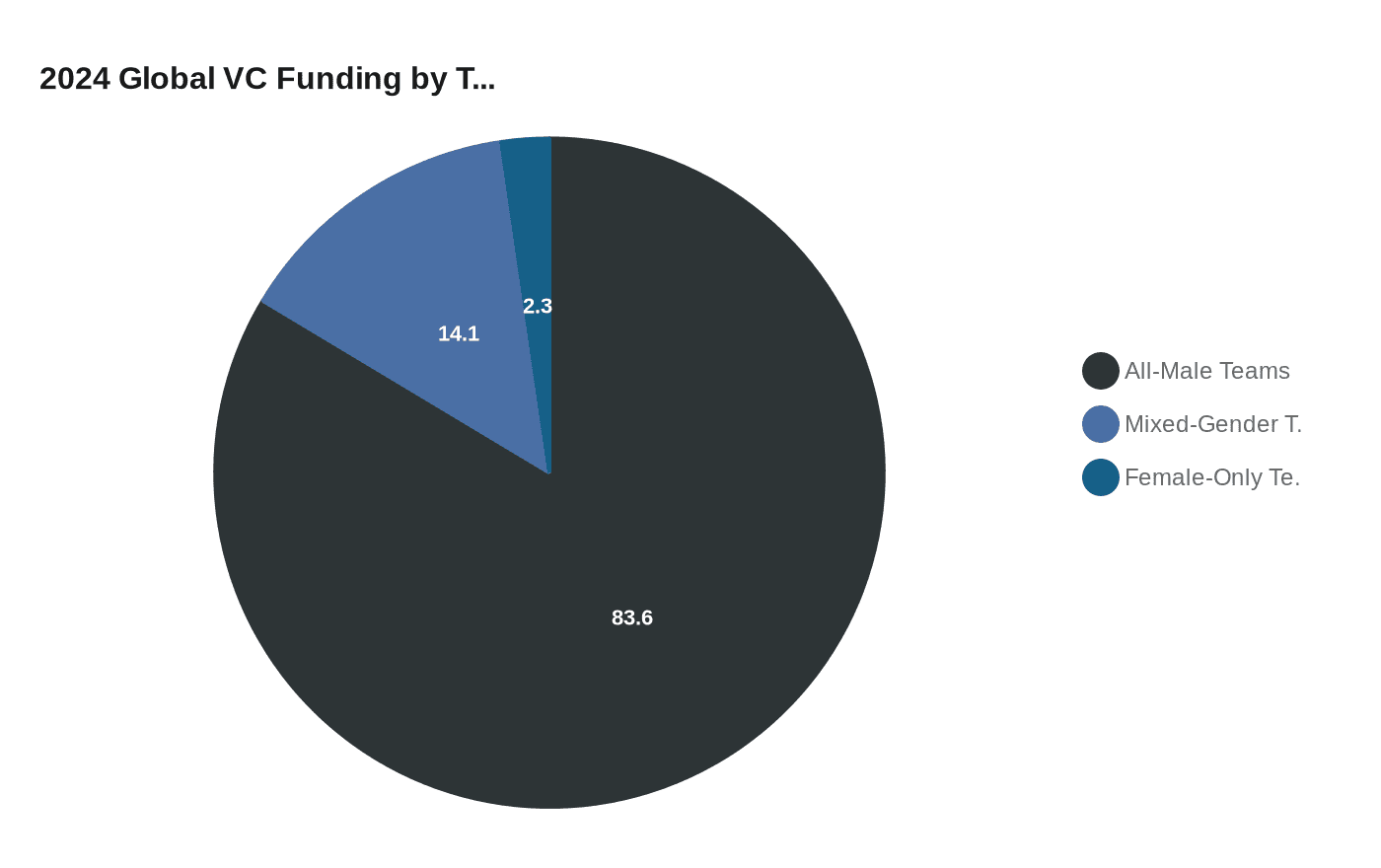
When 83.6% of 2024 venture capital flowed to all-male teams, homogeneity isn't accidental: the demographics inside VC firms determine who gets funded, boarded, and hired.

The Pipeline Starts at the Top
The numbers at the top of the venture capital stack are stark. Women make up just 8% of investors at VC firms, Hispanic investors account for 2%, and Black investors represent fewer than 1%. Against that backdrop, the funding outcomes are almost mathematically predictable: of the $289 billion invested globally in 2024, all-male founding teams captured 83.6%, or $241.9 billion. Female-only teams received 2.3%, totaling $6.7 billion. Mixed-gender teams took 14.1%. At the current pace of improvement, analysts project it will take until approximately 2065 to reach gender parity in venture capital allocation. These are not anomalies. They are outputs of a system whose inputs have barely changed.
The mechanism driving this gap has a name in sociology: homophily, the deeply human tendency to associate with, trust, and ultimately invest in people who resemble yourself. General partners act as the gatekeepers of capital, and when a GP's network is largely composed of people who share their alma mater, professional background, or demographic profile, the deal flow that crosses their desk reflects exactly that. As Diversity VC's analysis put it, "when investors predominantly come from similar homogenous groups, their investments reflect and reinforce their own experiences and biases, inadvertently sidelining a vast pool of untapped entrepreneurial potential." The point isn't malice; it is structural gravity.
How Homophily Flows Downstream
The causal chain does not stop at the check-writing stage. A VC partner who leads a deal typically takes a board seat, and that board seat becomes one of the most consequential levers in a startup's early life. Board members weigh in on executive hires, refer candidates from their own networks, and set the cultural expectations that filter down into every subsequent hiring decision. A homogenous board naturalizes a homogenous leadership team. That leadership team then builds its own network-dependent hiring pipeline, and by the time a company reaches 50 or 100 employees, the composition of the cap table's first row has essentially determined the composition of the org chart.
Research from Harvard Kennedy School underscores the feedback loop on the investor side: there are significantly more women with the requisite professional backgrounds for venture capital than there are female VCs, meaning the pipeline shortage VC firms claim to face is largely self-constructed. The same firms that decline to hire diverse partners then find themselves unable to credibly source or evaluate diverse founders. One striking data point illustrates how personal circumstances can break the cycle: male VCs who have daughters are measurably more likely to hire female investment partners. Structural diversity does not happen by exposure alone, but the data show that expanding a partner's frame of reference, even informally, shifts behavior.
The Compounding Cost of Waiting
For founders, the moment the homophily trap closes is not Series B. It is employee one. Leah Solivan, who bootstrapped Taskrabbit on her personal credit cards before scaling it into one of the defining platforms of the gig economy, built diversity into the company's hiring architecture from the beginning. Now the founder and managing director of Precedent.VC, Solivan joined Isabelle Johannessen on Build Mode to explain why the timing of this commitment is not incidental.
"But if you do that from the beginning, then it becomes easier," Solivan said, "because the culture that's built, the team that's built, the network that you've built as a company, is more diverse, and it feeds itself. It becomes an ecosystem. It's too late if you wait until you've scaled and it's at the end."
That is a description of compounding: a diverse early team builds a diverse referral network, which surfaces diverse candidates for the next round of hiring, which reinforces a culture that retains people who might otherwise leave a homogenous environment. The inverse is equally true. A startup that hires its first ten engineers from a single university pipeline or a single professional network effectively locks in the demographic contours of its next hundred hires. Startups are often quick to say they value diversity while being slow to implement hiring practices that reflect it. The Silicon Valley default, drawing from the same concentrated set of feeder schools, former employers, and warm introductions, is not neutral. It actively narrows the talent pool.
The economic argument for breaking that cycle is substantial. According to the Center for American Progress, closing the racial wealth gap and directing capital toward historically underserved entrepreneurs could unlock $1.8 trillion in economic value. That figure is not a moral aspiration; it is a market opportunity being systematically left on the table.
Board Influence as an Operating Variable
Founders evaluating term sheets should treat board composition as an operating variable, not a formality. A board seat granted to a partner from a homogenous firm is not just a governance structure; it is a sourcing channel, a reference network, and a signal to every future hire about what kind of company this is. The partner who sits on a dozen portfolio company boards and refers candidates almost exclusively from within their own network is not a neutral actor. They are actively shaping headcount in a direction that mirrors their own professional circle.
LPs are beginning to demand accountability here. California's SB 54 law required fund managers with a California nexus to file their first annual diversity-reporting form covering 2025 investments by April 1, 2026. That mandatory transparency is new, but the questions it enforces are ones any LP or founder should have been asking already: Who are your partners? Where do your deals come from? What does the board composition of your portfolio companies actually look like, and how does it correlate with the executive hiring that follows?
Questions That Pressure-Test the Claims
Diversity commitments stated in a pitch deck or LP deck are not operating decisions. The following questions separate performance from practice:
- What percentage of your investment partners are women, Black, Latino, or from other underrepresented groups, and at what seniority level?
- What share of your deals in the last three years came through referrals from within your existing portfolio versus new, external sourcing channels?
- On boards where your firm holds a seat, what is the demographic composition of the executive team that was hired after your investment?
- Can you name a portfolio company where your firm's board involvement directly surfaced a diverse C-suite hire, and what was the specific sourcing mechanism?
- Do your standard term sheets or portfolio support practices include any structured commitments around inclusive hiring at the earliest stage?
For founders, the parallel set of questions is simpler but equally demanding: Does your first hire expand or replicate your existing network? Is your recruiting process reaching candidates who would never appear in a warm introduction? And does your current cap table, including your board observers, give you access to talent networks your founding team does not already have?
The venture ecosystem will not self-correct through good intentions. Over 65% of AI engineers are concentrated in San Francisco and New York City alone, according to SignalFire's 2025 tech talent analysis, a geographic consolidation that mirrors and reinforces the social consolidation at the top of the funding stack. Breaking that loop requires founders and LPs alike to treat diversity not as a downstream outcome to optimize later, but as an architectural decision made at the very moment the first seat at the table is filled.
This article was produced by Prism’s automated news system from verified source data, official records, and press releases, then run through automated quality and moderation checks before publishing. The system is built and supervised by the people who set the standards it runs under. Read our full AI policy.
Did this article answer your question?