FPGA Versus Software Emulation: Tradeoffs in Accuracy, Latency, Practical Setup
Pick FPGA (MiSTer/Analogue Pocket/openFPGA) for cartridge‑perfect accuracy and CRT/light‑gun support; pick software emulation (RetroArch, MAME, Dolphin) for convenience, enhancements, and broader compatibility.
If your priority is the most faithful timing and the lowest perceived input lag when playing on original hardware or CRTs, treat that as the decision point: FPGA-based cores reimplement the original machine in hardware, while software emulators translate calls into a host OS and CPU. "When you put a Game Boy cartridge into a Pocket, its FPGA‑fueled hardware recognizes that it’s from the Game Boy, and it then parses a series of instructions (also known as a 'core') to emulate the original Game Boy on a hardware level. That’s different from software emulation, which tricks a combination of processor and OS to take calls originally intended for a Game Boy and treat them like they're native to something like Windows or Android." This guide explains those practical differences and what to check before you buy, upgrade, or build.
**What an FPGA core is, and why that matters** FPGA "cores" are bitstreams that map the logic and timing of a classic system onto configurable silicon. Ars Technica lays it out: an OpenFPGA core runs on the Pocket to "re‑create any classic computer platform or console family," effectively running the original hardware behavior in gate‑level logic rather than relying on a host CPU’s instruction translation. The practical result is deterministic timing and the ability to reproduce quirks of the original hardware without per‑game hacks; communities and preservationists prize that for authenticity.
**What software emulation does differently** Software emulators like RetroArch, MAME, and Dolphin run on general‑purpose CPUs and use layers — high‑level emulation, dynamic recompilation, or OS services — to simulate original behavior. That approach is extremely flexible: it enables graphical upscalers, shaders, netplay, rewinding, save states, cheat layers, and rapid iteration across platforms. It also means some titles, especially late‑era consoles like N64, often require game‑by‑game tweaks to run perfectly; as one write‑up notes, "software‑based N64 emulation... typically relies on high‑level emulation that often requires tweaking on a game‑by‑game basis."
**Concrete hardware notes you should know before buying** Community posts and product reporting give specific fingerprints you’ll see in the wild. A Hacker News poster pasted MiSTer tech details verbatim: "Intel/Altera Cyclone V SE (5CSEBA6U23I7) FPGA SoC with 110,000LE (41,500ALM) and 5,570Kbit of Block RAM. ARM Cortex A9 dual‑core CPU at 800MHz. HDMI video and audio allowing easy connectivity to any modern monitor/TV. 1GB of DDR3 RAM that is directly available to both ARM and FPGA. High‑speed ARM <-> FPGA interconnect due to both being in the same chip." The same poster supplied an OpenFPGA fragment for the Pocket: "Intel/Altera Cyclone V FPGA 49K logic elements and 3.4Mbit BRAM [...]" — note that line is truncated in the source and should be verified. These numbers influence which cores will fit and how complex a system you can accurately recreate on a given board.
**Openness, development workflow, and community dynamics** OpenFPGA has been positioned as an ecosystem where "OpenFPGA developers will be able to operate essentially the same as MiSTer developers do: via open, connected platforms like Github and in ways that allow the full open source development community to contribute." Analogue has said it won’t "stomp on community efforts," meaning third‑party cores can be developed and shared. That said, "open is relative here" — Analogue has not committed to publishing hardware schematics for OpenFPGA, and historically many Analogue devices shipped as closed systems before community jailbreaks and subsequent open‑framework support. MiSTer, by contrast, has long been an "enthusiast‑friendly" platform with modular add‑ons and community maintenance, while the OpenFPGA approach on Pocket skews toward being "end‑user friendly" according to community commentary.
**Use cases: when FPGA wins** FPGA stands out where timing and analog behavior are essential. Community posters capture this bluntly: "Easy answer, fpga is better for things like accuracy, and software is better for enhancements." If you plan to use a CRT or peripherals like light guns, one user wrote, "FPGA emulation is great because peripherals like light guns work due to the zero latency of analog output on things like MiSTer." For SNES, Game Boy, and other supported systems many collectors prefer MiSTer or Analogue Pocket for the "pure" experience: "If I want to play SNES games, my MiSTer or Analogue Pocket are always going to be my go–to devices for it."
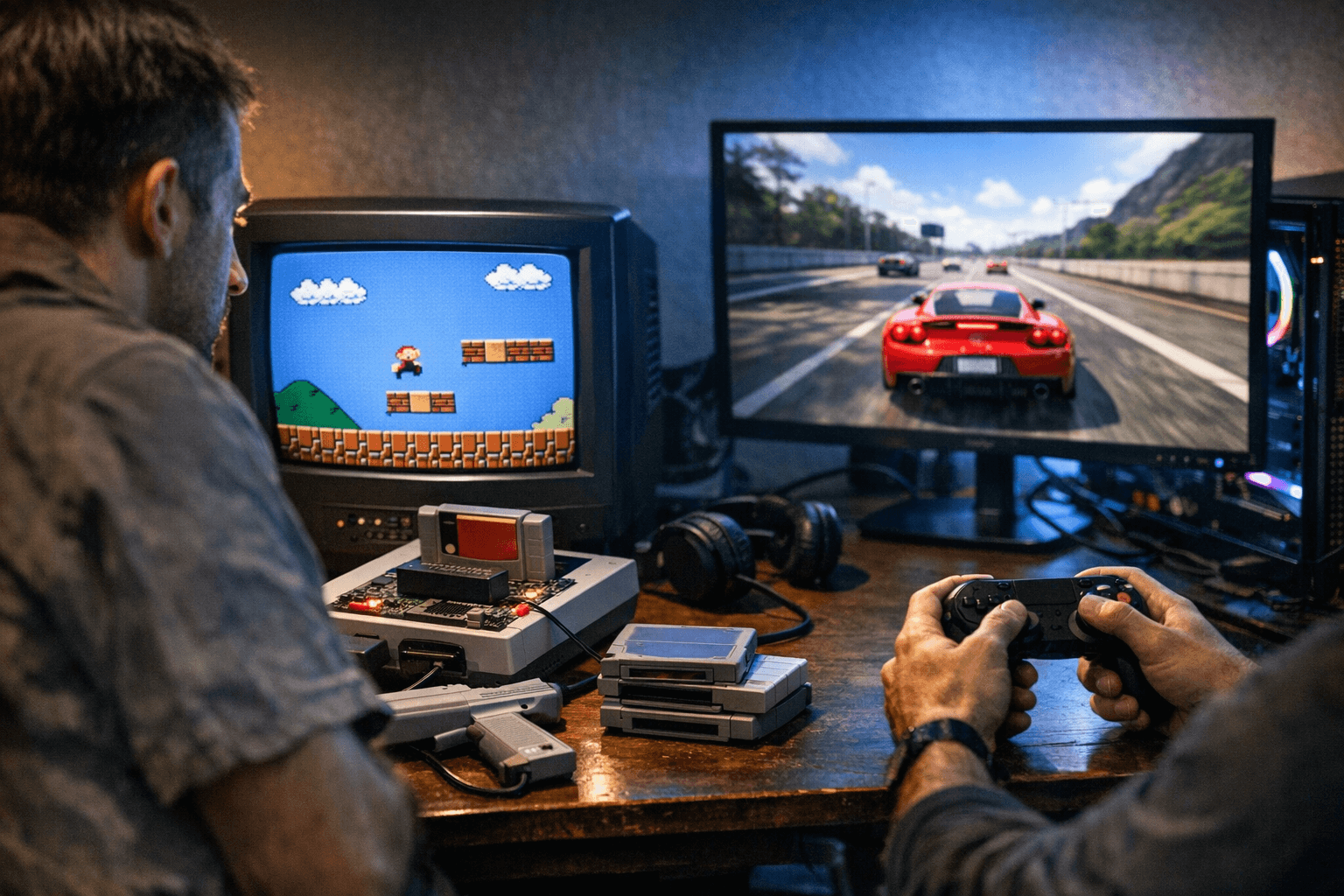
**Use cases: when software emulation wins** Software emulators beat FPGA on accessibility, features, and cost of entry. Software lets you run hundreds of systems from a single PC, add enhancements like shaders and netplay, and iterate quickly on compatibility. As MARl0 put it: "FPGAs are a more 'pure' approach but come with a price tag. Software emulation is very accessible and can do some things that FPGA can't." Budget, convenience, and the desire for modern conveniences (upscaling, controller overlays, cloud streaming) make RetroArch and MAME compelling for most casual setups.
**Market dynamics and the fork in the road** The ecosystem is splitting two ways: boutique, cartridge‑centric hardware and more accessible, open standards. One write‑up framed it as a choice between collector’s items and an accessible ecosystem: "With Analogue betting on closed hardware and ModRetro chasing a new open‑source standard, FPGA gaming stands at a fork in the road. One path leads toward boutique collector’s items, the other to a more accessible ecosystem. The winner could define the next era of retro gaming." TheMemoryCore also flagged a $199 consumer N64 clone as a potential disruptor that "may also replace a full MiSTer FPGA stack" if it catches on — that price point is worth watching for buyers weighing cost vs fidelity.
- *Practical setup advice and quick decision checklist**
- If you want cartridge play, CRT compatibility, or peripheral support (light guns), prioritize FPGA hardware like MiSTer or Analogue Pocket (openFPGA).
- If you want enhancements, universal convenience, and low upfront cost, choose software (RetroArch, MAME, Dolphin) on PC or a modern console.
- If you want both, plan for tradeoffs: FPGA ecosystems are growing (openFPGA cores and MiSTer modules), but software remains the fastest path to netplay and graphical tinkering.
- Check the hardware: verify FPGA part numbers and BRAM/LE counts before investing, because core availability and fidelity depend on those limits.
**Verification and what to confirm before you buy** The MiSTer technical lines above come from a community Hacker News post and should be confirmed against official MiSTer or DE10‑Nano documentation. The OpenFPGA Cyclone V line is truncated and likewise requires vendor confirmation. Likewise, the $199 N64 clone and its claims should be validated with the manufacturer. Treat community statements about "zero latency" and "authenticity" as experience‑based and valuable, but seek lab benchmarks if you need millisecond‑level evidence.
Conclusion The choice between FPGA and software emulation is a conscious trade: FPGA delivers hardware‑level fidelity, deterministic timing, and native peripheral support at higher cost and narrower convenience; software delivers flexibility, features, and breadth of libraries at the cost of occasional per‑game tinkering. Community voices — from MiSTer modders to Analogue Pocket users — make clear there is no single "right" answer. Decide whether you are chasing preservation and cartridge‑perfect behavior or broad accessibility and enhancements, verify the hardware numbers and core support for the systems you care about, and proceed with the knowledge that both approaches are evolving toward each other through open cores, shared repositories, and lively community development.
Know something we missed? Have a correction or additional information?
Submit a Tip