Free Elon course aims to bridge campus-community divide in Alamance
Elon launched a free Winter Term HealthEU course that sends students into Alamance County to volunteer, learn and support local organizations.
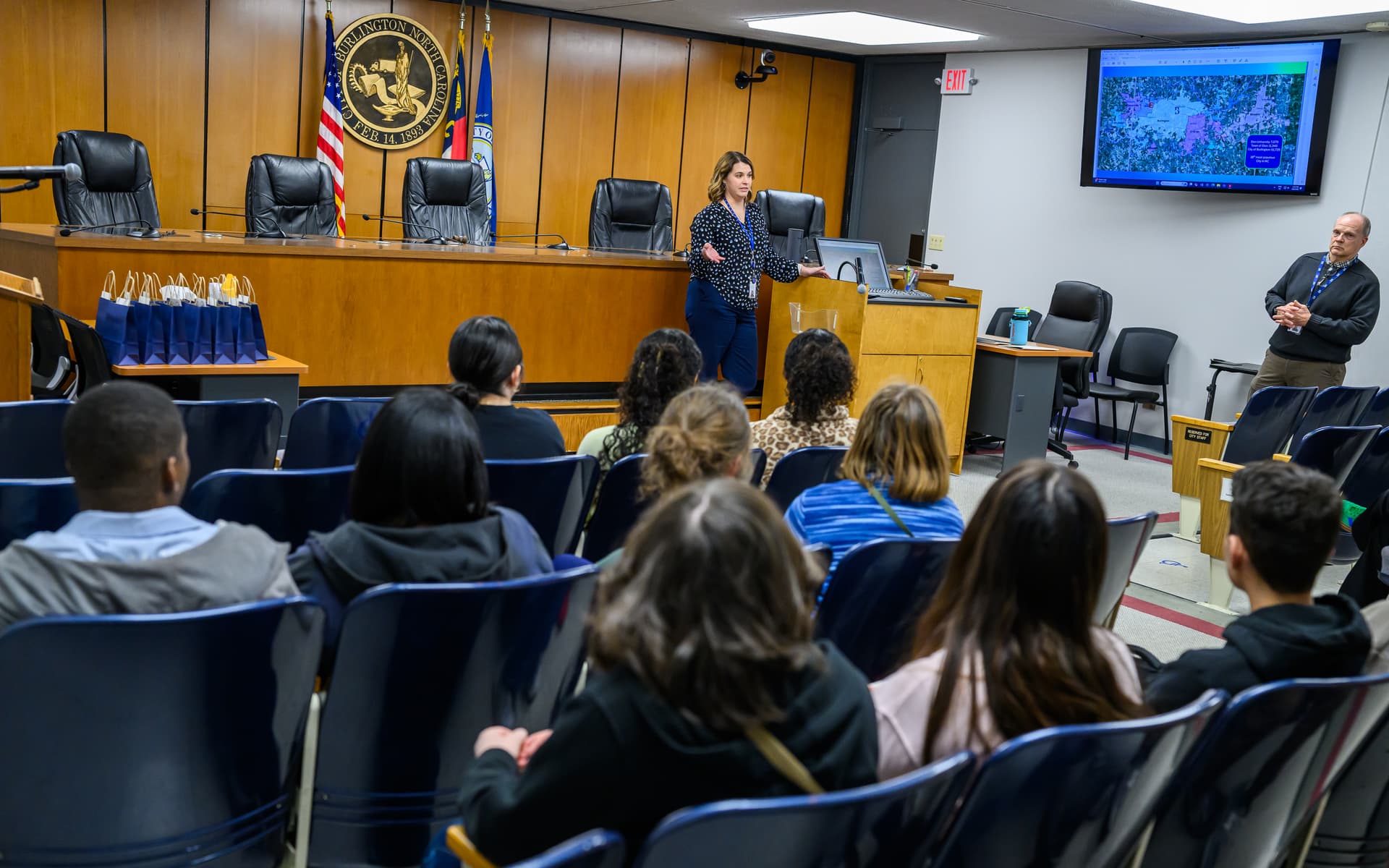
Elon University this winter launched a free HealthEU course, Beyond the Elon Bubble, that sends students into Alamance County for hands-on civic learning, volunteer shifts and local exploration. The one-credit Winter Term class is part of a new offering of no-cost HealthEU courses designed to support students’ wellness across dimensions including physical, emotional, social, financial, purpose and community wellness.
The course, co-taught by Kyle Anderson, associate director of the Kernodle Center for Civic Life, and Sara Beth Hardy, assistant director for community partnerships, centers weekly field trips and community challenges that push students beyond campus routines. Early visits took students to downtown Burlington, where they met with the city manager and assistant city manager and toured parks and businesses. Other excursions included volunteering with the Alamance Dream Center and a trip to downtown Mebane that featured a student-led “mini cash mob” using gift cards to shop locally.
“One of my hopes is that students just get to see a little more of the county beyond campus, meet some interesting people and learn more about interesting places,” Anderson said. The course frames such visits as a way to move students from observers to participants in local civic life. “Whether they know it or not, you’re a resident of this community. So, part of it is learning how to be a responsible community member,” he added.
The curriculum borrows from Melody Warnick’s book This Is Where You Belong: Finding Home Wherever You Are, assigning weekly “community challenges” such as attending a local council meeting or identifying a neighborhood issue and reflecting on it. Anderson said the challenges are meant to build agency. “You can see an issue and you don’t have to throw your hands up,” he said. “You can actually try and do something about it.” He later emphasized, “You can choose to engage positively, not just complain.”

Local leaders and nonprofit staff who met students during the term told program coordinators they appreciated the extra volunteer capacity and the economic boost when students patronize downtown businesses. For nonprofit partners already stretched thin, a steady stream of engaged students can mean expanded programs and deeper outreach to vulnerable residents.
Offering HealthEU courses for free lowers a financial barrier that can keep students from pursuing short-term experiential learning, an equity point Anderson highlighted when discussing students from diverse economic backgrounds. The course also aims to seed longer-term civic ties; Anderson said he hopes alumni will remember the experience and return to engage with the county after graduation.
For Alamance residents, the course signals more intentional town-gown partnership and an influx of young volunteers in community spaces this semester. Expect to see students at neighborhood meetings, serving with local nonprofits and shopping in downtown Burlington and Mebane as the term continues, small acts that may yield longer-standing civic relationships.
Sources:
Know something we missed? Have a correction or additional information?
Submit a Tip