From Brazil to India, BBC asks how the world sees America today
America still captivates the world, but admiration now sits beside distrust, especially over U.S. politics, Trump and the country's reliability.
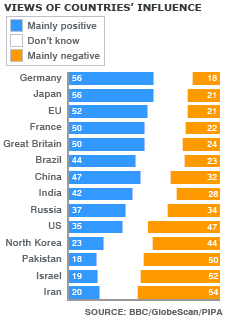
America still looks like a giant to much of the world, but the latest polling shows a shrinking gap between cultural admiration and political confidence. The BBC’s global sampling from Brazil, India and Egypt lands in the same tension: people are still watching the United States closely, but they are no longer assuming its politics can carry the same prestige as its music, universities or technology.
Admiration still travels
For all the criticism, the United States remains unusually visible in the global imagination. In Pew Research Center’s 2023 survey of 23 countries, many respondents said American technological achievements, entertainment, universities and the military were the best in the world or at least above average among wealthy nations. That is a reminder that U.S. power has never been only about Washington: it is also about Netflix, Silicon Valley, major research universities and a long-exported cultural style that still sets the pace for global conversation.
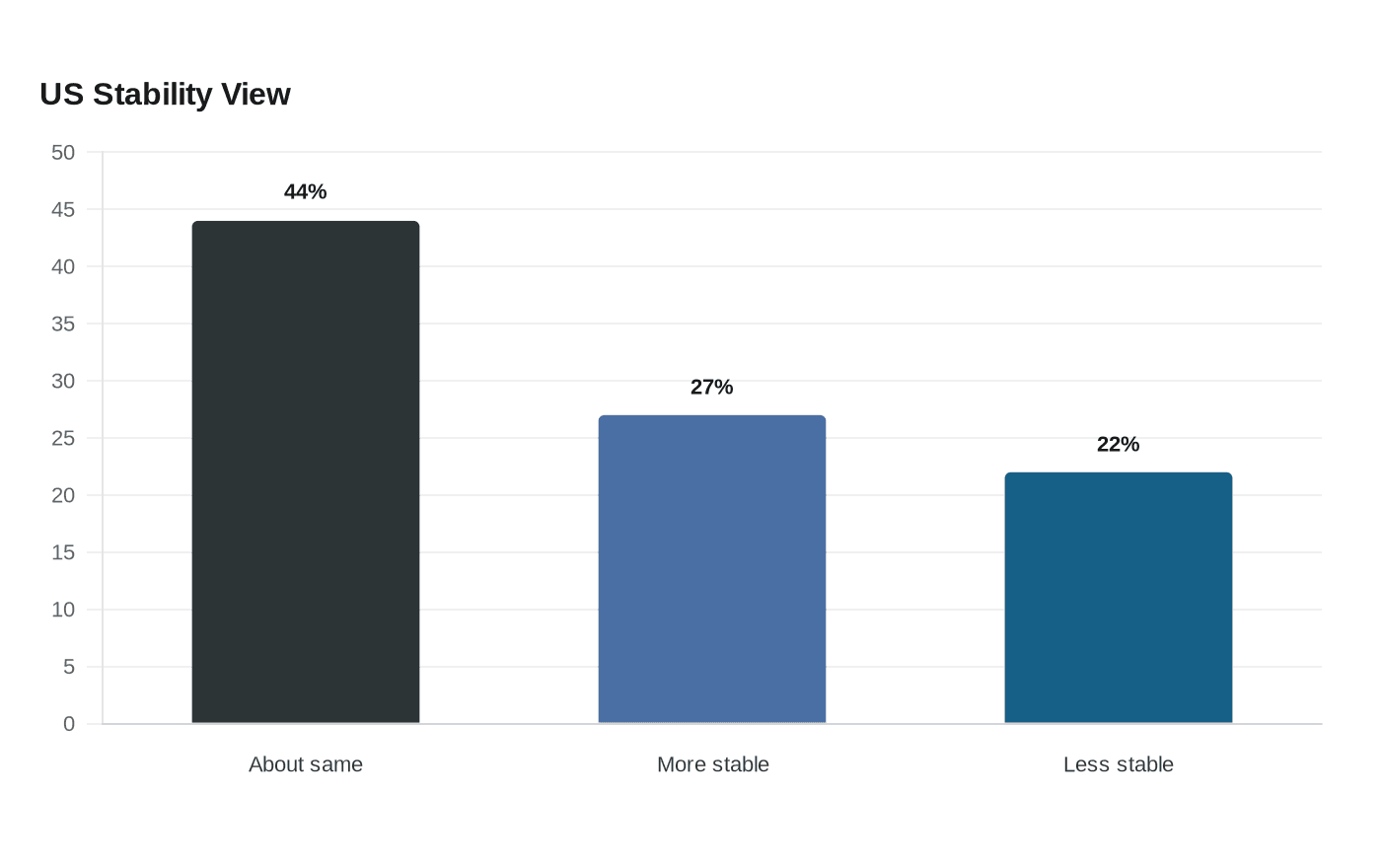
But that admiration has limits. The same Pew study found that people generally saw the U.S. as similar to other wealthy countries on political stability, safety, democracy, religiosity and tolerance, not clearly ahead of them. On political stability alone, a median of 44% said the U.S. was about as stable as peer nations, 27% said more stable and 22% said less stable, a split that captures the basic paradox of America’s image abroad: the country is still exceptional as a cultural exporter, but not universally convincing as a model polity.
Distrust has become the louder signal
The sharper current picture is much colder. Pew’s 2026 global survey covered 42,151 adults in 36 countries and found that a median of just 23% expressed confidence in Donald Trump’s leadership of world affairs. Across those same countries, a median of 37% held a favorable view of the United States, while 57% held an unfavorable view, and 35% said the U.S. contributes to peace and stability around the world. On another core question, only 32% said the U.S. takes into account the interests of countries like theirs when making foreign policy decisions, and 39% said the U.S. government respects the personal freedoms of its people.

The declines are not abstract. Pew found double-digit drops in favorable views of the U.S. in Indonesia, Italy, Nigeria, South Africa, South Korea and Turkey, while confidence that America is a reliable partner fell steeply in countries with long-standing economic and security ties to Washington. Canada is the starkest example in the data Pew highlighted: 83% described the U.S. as a reliable partner in 2022, compared with 35% in the 2026 survey. That is the kind of drop that changes diplomacy, because it signals not just disagreement with a president, but erosion in the default assumption that the United States will behave predictably.
Even so, the map is not uniformly hostile. Seven nations in the 2026 Pew study rated the U.S. positively overall, and Israel posted the highest favorable rating at 81%. Pew also found that Trump’s strongest ratings were in the Philippines, Israel, Nigeria, Kenya and Ghana, which shows that U.S. standing now varies sharply by region and by issue. The world is not rejecting America everywhere at once; it is sorting American power into pockets of approval and large zones of skepticism.
Influence is still real, but conditional
That distinction matters because influence and trust are no longer traveling together. A country can dominate screens, classrooms and global pop culture while still losing credibility on tariffs, Gaza, Iran, Greenland and the Russia-Ukraine war, the foreign-policy files where Pew says Trump received poor marks internationally. In practical terms, that means America’s soft power still works, but its hard power now faces more friction, more scrutiny and a lower starting level of goodwill than it enjoyed only a few years ago. That is the clearest inference from the polling: the world still wants what America produces, but it is less willing to sign off on how America uses its power.
The BBC’s country-to-country lens, running from Brazil to India to Egypt, fits that pattern because it treats the United States less like a fixed symbol and more like a moving target. Brazil, India and Egypt sit in a world where American films, brands and universities remain familiar reference points, but where geopolitical behavior is judged more carefully than before. The result is an external mirror that reflects both attraction and fatigue at once.
Fatigue is now part of the story
That fatigue is visible inside the United States too, and it sharpens the way outsiders read the country’s 250th year. Pew’s June 2026 survey found that 69% of U.S. adults were dissatisfied with the way things were going, while 59% said the country’s best years were behind it. The same report found that Americans were nearly evenly split between optimism and pessimism about the country as a whole, with 48% optimistic and 51% pessimistic, even as 54% said they felt hopeful when thinking generally about the future.
AP-NORC’s America 250 polling adds another layer: only about a third of Americans said the American Dream still exists, and just 28% said they had a lot of pride in how U.S. democracy works, down from 42% in 2017. The same survey found that freedom or liberty was the most common answer when people were asked what unites Americans, while political values were most often cited as what divides them. That combination, pride in the ideals and doubt about the machinery, helps explain why the anniversary feels celebratory in one register and uneasy in another.
At 250, America still commands attention because it has built the world’s most recognizable cultural and strategic brand. What the latest international polling shows, though, is that the brand now comes with a warning label: admiration is still there, but trust has become conditional, and in many places it must be earned country by country rather than assumed.
This article was produced by Prism’s automated news system from verified source data, official records, and press releases, then run through automated quality and moderation checks before publishing. The system is built and supervised by the people who set the standards it runs under. Read our full AI policy.
Did this article answer your question?