Fundora Stops Thurman in Six, Retains WBC Super Welterweight Title
Keith Thurman was stopped for the first time in 33 pro fights Saturday night; what the sixth-round TKO means for his health, comeback odds, and Fundora's title future.
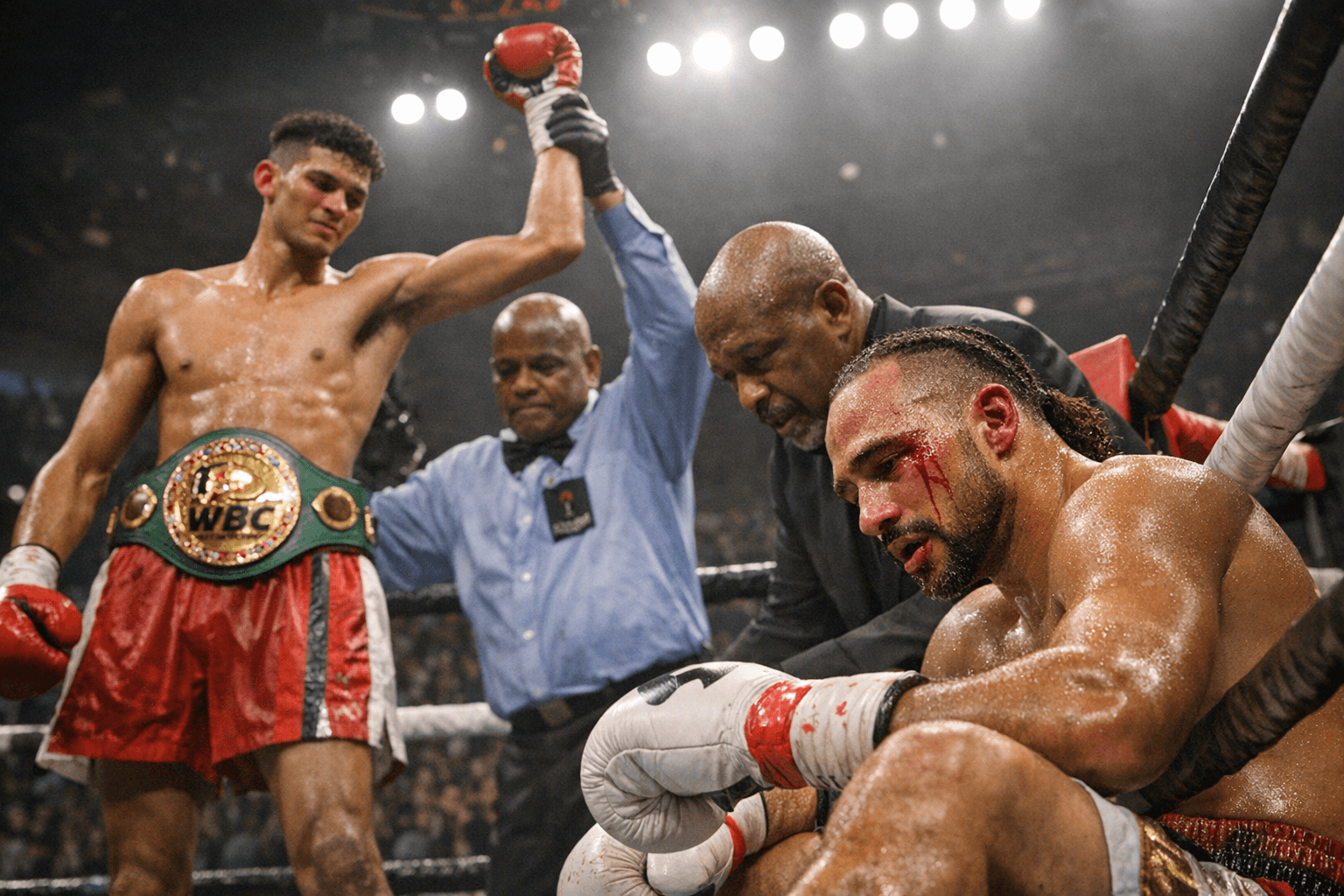
Pressed against the ropes with ice already collecting in his corner bucket, Keith Thurman argued afterward that the fight should have continued. Referee Thomas Taylor had reached a different conclusion at 1:17 of round six inside the MGM Grand Garden Arena in Las Vegas: the 37-year-old former unified welterweight champion was absorbing heavy, unanswered power shots, his defensive reflexes visibly slowing, and no sustained counteroffensive was coming. Taylor stepped in and made boxing history of a grim kind, delivering Thurman the first technical knockout loss of 33 professional fights.
Sebastian Fundora retained his WBC super welterweight title by the stoppage, improving to 24-1-1 with 16 knockouts. Thurman, now 31-2, acknowledged Fundora's superiority while disputing the timing. "If it had gone on, maybe I would have found a way," he said, still holding ice to the left side of his battered face.
Taylor's call illustrates how boxing commissions and their licensed referees measure fighter safety in real time. Under the ABC Unified Rules governing Nevada bouts, a referee can halt a contest whenever a competitor faces unreasonable physical danger, without requiring a knockdown as the legal threshold. Thurman had not been floored. He had, however, spent rounds four and five pinned on the ropes and turning away from exchanges, his punch output declining as Fundora's nine-inch height and reach advantage closed off angles. When the sixth round produced more unanswered combinations, Taylor intervened.
The medical stakes around a first career stoppage at 37 deserve more scrutiny than the result alone suggests. Thurman spent a significant portion of his prime navigating right elbow surgery and a deep bone bruise on his left hand, injuries that cost him extended stretches of competitive activity. A fighter whose body has absorbed that kind of cumulative damage, and who has gone through multiple long layoffs, does not recover competitive sharpness simply by returning to training. Compounding the challenge, Thurman stepped up from his natural welterweight limit of 147 pounds to face Fundora at 154, a seven-pound class jump that placed him against a 6-foot-5 opponent generating power shots from angles a welterweight-framed body cannot efficiently neutralize. The human body does not adapt upward in weight class the way promotional matchmaking often implies.
What Taylor saw in the sixth, a fighter whose defensive instincts had stopped protecting him, is precisely the scenario ringside physicians and commission medical staff flag as the point where a stoppage shifts from controversial to necessary. That Thurman has never been stopped before makes the image of him being stopped now the starkest possible signal about where he stands as a competitor.
For Fundora, the night confirmed what his record and physical gifts have been suggesting since he captured the title. His assessment of what comes next was blunt: "There's all kinds of names, big names. 154 is the best division right now. So, whoever wants it next, they can get it."
The WBC will likely direct Fundora toward a mandatory defense before any unification talks formalize, but promoters have every incentive to accelerate those negotiations while Fundora's stock is at its peak. The junior middleweight division holds active champions across multiple sanctioning bodies, and a unification fight would carry significant commercial weight.
For Thurman, the harder accounting lies ahead. A first stoppage at 37, against an opponent younger, larger, and still improving, is the data point that commissions, trainers, and the fighters themselves use to evaluate whether championship-level competition remains a realistic goal or a risk no longer worth taking.
Know something we missed? Have a correction or additional information?
Submit a Tip