George Nakashima, furniture pioneer whose craft shaped modern American design
George Nakashima turned wartime loss, Japanese inheritance and American craft into furniture that recast modern design, and his New Hope workshop still carries that legacy.
A craft language built from migration and memory
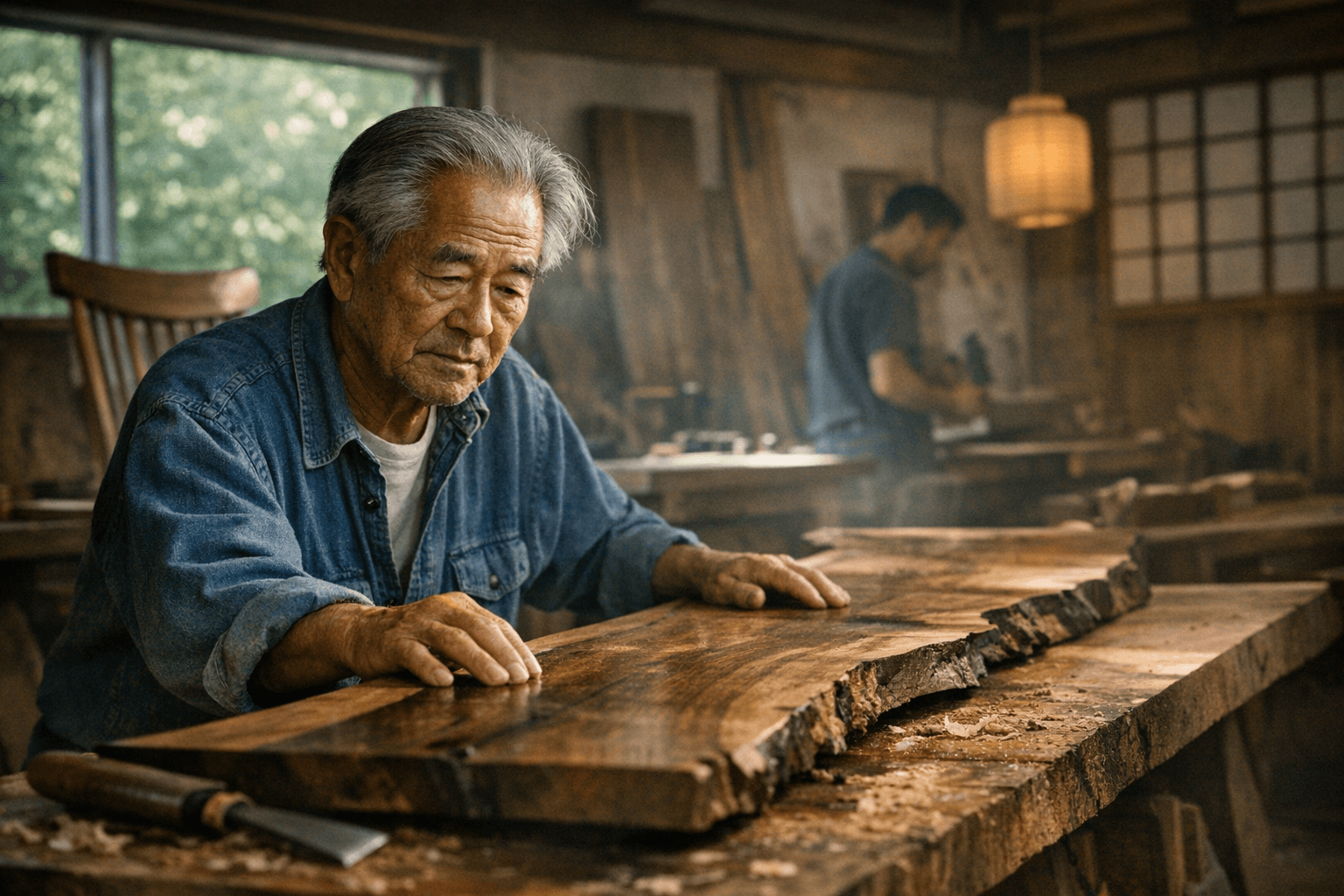
George Nakashima stands as one of the defining figures of 20th century furniture design because he made woodworking speak in an unmistakably American voice without severing it from deeper cultural memory. Born in 1905 to Japanese parents in Spokane, Washington, he moved through Paris, Tokyo and Pondicherry, India as an architect before his work took a devastating turn during World War II. That experience, and the materials and methods he later embraced, helped shape a body of furniture that fused Japanese folk tradition, Shaker design and modernism into a single, disciplined language.
What made his work endure was not only elegance, but conviction. Nakashima and the company that bears his name described the mission as creating the “antiques of the future,” a phrase that captures both his respect for craft and his refusal to treat furniture as disposable design. He built each project around custom-milled, sustainably harvested hardwoods selected plank by plank, a practice that tied the final object to the character of the tree and the hand that worked it.
From Minidoka to New Hope
The wartime rupture at the center of Nakashima’s life remains inseparable from his art. During World War II, he, his wife and their infant daughter were sent to the Minidoka War Relocation Center, one of the incarceration sites used against Japanese Americans. In that harsh setting, he learned woodworking from an elderly Japanese carpenter, a formative apprenticeship that transformed confinement into a source of technical and artistic discipline.
When he opened his woodworking business in 1945 in New Hope, Pennsylvania, it was not as a grand design manifesto but as a way to earn a living using the skills he had accumulated in very different places. Those skills came from his years as an Eagle Scout in the Pacific Northwest, as an architect in the Far East and as a woodworker in the Idaho desert. The result was a studio practice rooted in survival, mobility and inherited knowledge, yet capable of producing furniture that belongs to the center of modern American design.
The New Hope compound as a living work
The New Hope property itself became part of the story. Nakashima discovered a south-facing slope along Aquetong Road in 1945 and persuaded the owner to let him purchase three acres of land in exchange for labor. That first parcel grew over time as his business expanded, eventually incorporating two more parcels and about a dozen buildings. The compound was not an accidental backdrop to the work; it was an extension of the same design intelligence that shaped his tables, chairs and cabinets.
The buildings were arranged with care, including structures designed for passive solar gain, which reflects Nakashima’s long attention to the relationship between shelter, climate and craft. The studio grounds became a kind of working landscape in Bucks County, Pennsylvania, where architecture, shop practice and daily life merged. That physical setting gives the legacy unusual coherence: the furniture, the workshop and the land all tell the same story about restraint, purpose and the dignity of making by hand.
Recognition, preservation and the meaning of heritage
The importance of the New Hope site has been recognized far beyond the family business. The Nakashima home, studio and workshop are listed on the Pennsylvania National Register of Historic Places, and in 2014 the property was designated a United States National Historic Landmark with support from the World Monuments Fund. Those designations do more than preserve a set of buildings. They acknowledge that Nakashima’s workshop is part of the country’s cultural record, a place where immigrant experience, wartime injustice and American craft history meet.
Preservation has also been a shared institutional effort. The Heritage Conservancy, the National Park Service and the World Monuments Fund have helped fund study and preservation of the buildings, underscoring the site’s value as both a design landmark and a historical document. In an era when workshop culture is often erased by redevelopment or reduced to branding, the continued care of the New Hope compound marks a more serious public understanding of craft as heritage.
A family business carried forward
Nakashima’s legacy did not end with his death in 1990. His daughter, Mira Nakashima, inherited the shop and took the reins of Nakashima Woodworkers, continuing the family business in New Hope. That continuity matters because it keeps the studio’s standards alive not as museum memory, but as a living practice shaped by the same demands of material, labor and judgment that guided George Nakashima.
The most recent major construction on the property, the Pole Barn lumber shed, reflects that continuity as well. Designed in 1990 by Mira, her daughter Maria and her ex-husband Tetsu Amagasu, then expanded in 1995, it shows how the site evolved without losing its original logic. The workshop remains a family enterprise, but also a national reference point for how American design can carry the imprint of Japanese American experience, wartime displacement and the patient authority of handwork.
George Nakashima’s achievement is that he transformed furniture into more than function and style. He built a distinctly American artistic language from migration, discipline and memory, and he left behind a place where that language still has a home.
This article was produced by Prism’s automated news system from verified source data, official records, and press releases, then run through automated quality and moderation checks before publishing. The system is built and supervised by the people who set the standards it runs under. Read our full AI policy.
Did this article answer your question?