Goldman Sachs Macro Outlook Forecasts 2026 Growth, Signals Hiring and Regional Priorities
Goldman Sachs Research raised its 2026 global GDP view to roughly 2.8% and flags business investment above 5% as the key growth engine, while Marcus warns AI has trimmed only 5,000-10,000 jobs so far.

Goldman Sachs Research published "Forecasts for the World’s Biggest Economies in 2026" on February 27, 2026, projecting global GDP growth of 2.8% in 2026 versus a consensus of 2.5%, a headline the firm amplified on its LinkedIn account with 5,529,833 followers. The report frames the upside as regional and policy driven: US tax cuts and reduced tariff drag, and export strength in China, are core reasons the firm expects growth to beat consensus next year.
The US outlook is the most optimistic relative to consensus, with Goldman forecasting US growth of 2.6% in 2026. An internal Q&A labeled Marcus shows Goldman expecting business investment to be the strongest GDP component, rising just over 5% on both a Q4/Q4 and full-year basis — roughly double consensus — driven by spending on AI, imported equipment, easier financial conditions, and more generous tax incentives. Corporate messaging on LinkedIn reiterated tax cuts and reduced tariff drag as central to the forecast outperformance.

Employment and hiring remain the most uncertain pieces of Goldman’s outlook. Marcus explicitly flagged the labor market as the hardest-to-predict element and quantified AI’s near-term labor effect: net job losses to date of about 5,000-10,000 concentrated in the subindustries where AI is most ready to deploy. The same Marcus note answered affirmatively that single-family housing starts would rebound above 1 million, signaling confidence in construction activity contingent on labor outcomes.
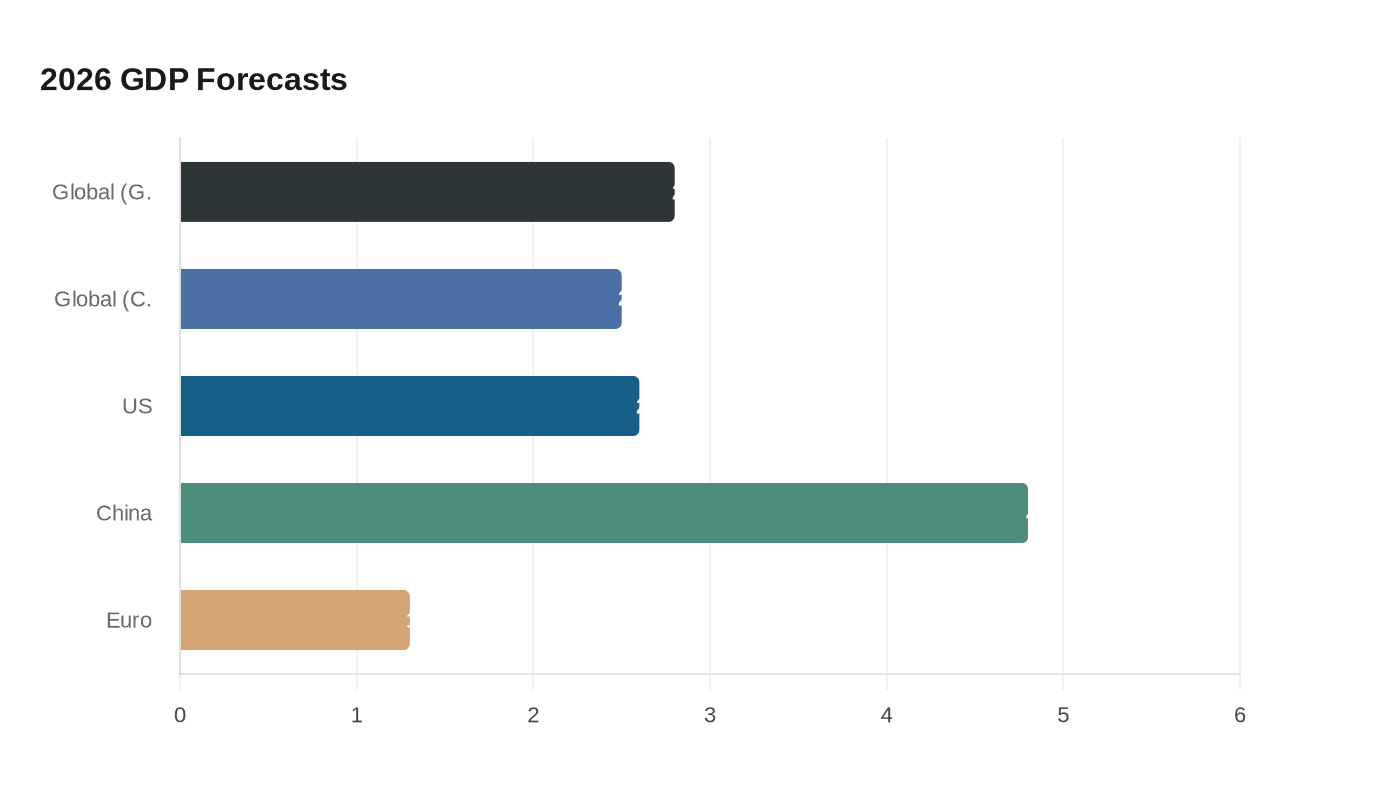
China is forecast to expand 4.8% in 2026, with Goldman emphasizing export-led manufacturing strength offsetting sluggish domestic demand. Jan Hatzius wrote that "All this suggests that the Chinese manufacturing sector should continue to grow robustly." Commodity and reserve dynamics feed into the regional picture: TheStreet, summarizing Goldman’s view, noted China’s central bank extended gold purchases for the 15th consecutive month in January 2026 and cited Goldman’s forecast of central banks buying about 60 tonnes of gold per month in 2026, supporting a raised gold target of $5,400 per ounce.
The euro area is projected to grow 1.3% in 2026, with Goldman Sachs Research pointing to fiscal stimulus in Germany and strong growth in Spain. Goldman Sachs Asset Management added that Europe’s growth profile should narrow the gap with the US and that Europe’s diverse equity market favors quantitative strategies. AM Gs also laid out G10 scenario language on rates, calling for a likely moderation in core inflation and declines in policy rates across developed markets, while singling out country-level nuances such as a probable Bank of Japan hike and varying easing prospects for Sweden, Australia, Norway, Switzerland, and New Zealand.
Goldman’s published 2.8% global headline sits alongside related internal metrics in Marcus — Q4/Q4 global GDP of 2.5% and a full-year figure of 2.9% — underscoring definitional differences within the firm’s materials. For Goldman’s deal teams, technologists, and regional leads, the takeaway is operational: prepare for an investment-led cycle centered on AI equipment and cross-border manufacturing flows, while the firm and clients watch whether AI-driven productivity gains translate into broader hiring freezes or job redeployments in 2026.
Know something we missed? Have a correction or additional information?
Submit a Tip